
Investigation of Kite Properties
Loading the math board and drawing, please wait…
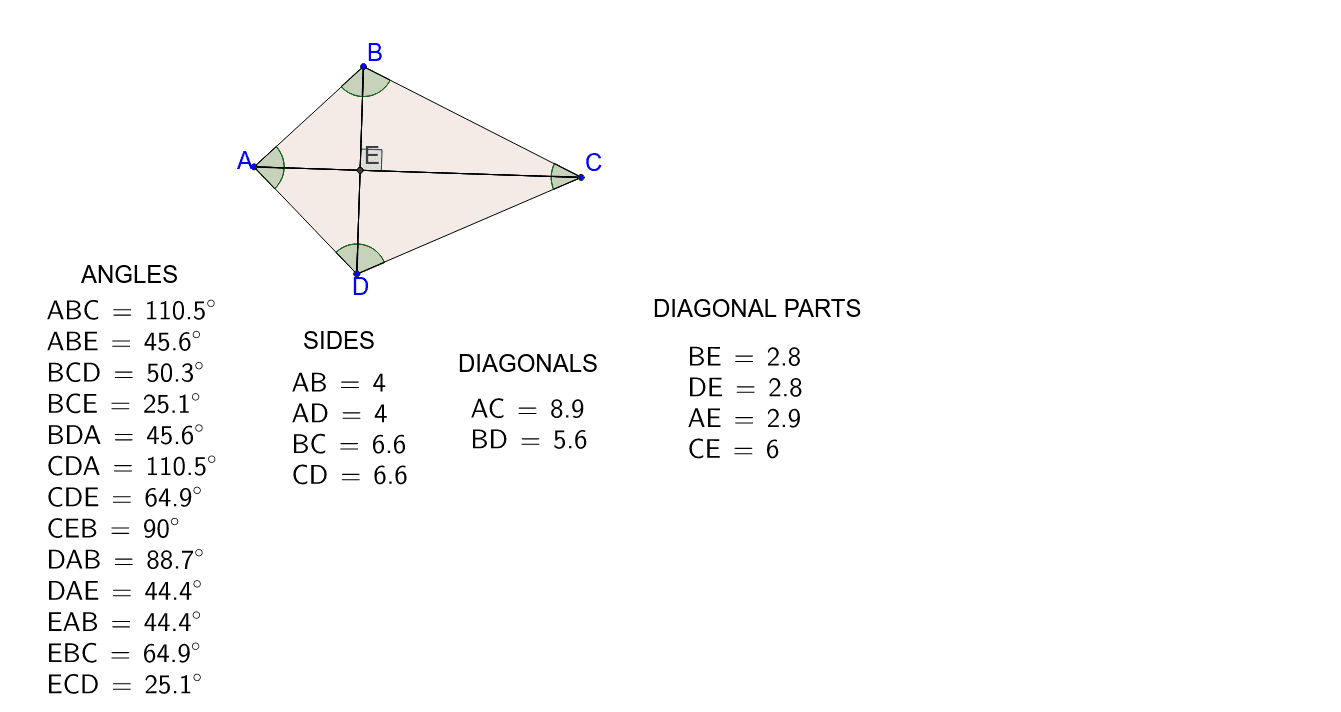
This example demonstrates the properties of a kite. Key mathematical concepts include symmetry and diagonal properties of kites. Using GeoGebra commands such as Segment, Mirror, and Intersect, one can construct a kite and observe its properties. Suitable for middle school and above students or teachers.
GeoGebra Commands & Parameters
Segment(A, B) → ABSegment(B, C) → BCSegment(A, C) → AC_1Mirror(A, AC_1) → A'Mirror(B, AC_1) → DSegment(A', D) → ADMirror(B, AC_1) → B'_1Mirror(C, AC_1) → C'Segment(B'_1, C') → CDSegment(B, D) → BD_1Intersect(AC_1, BD_1) → EPolygon(B, A, D, C) → poly1, b_1, a_1, d_1, c_1Segment(B, E) → BE_1Segment(A, E) → AE_1Segment(E, D) → DE_1Segment(E, C) → CE_1TableText({{LaTeX[AB, true, true]}, {LaTeX[AD, true, true]}, {LaTeX[BC, true, true]}, {LaTeX[CD, true, true]}}) → text1Segment(A, E) → AESegment(B, E) → BESegment(E, C) → CESegment(E, D) → DESegment(B, D) → BDSegment(A, C) → ACTableText({{LaTeX[AC, true, true]}, {LaTeX[BD, true, true]}}) → text2TableText({{LaTeX[BE, true, true]}, {LaTeX[DE, true, true]}, {LaTeX[AE, true, true]}, {LaTeX[CE, true, true]}}) → text3Angle(C, E, B) → CEBAngle(A, B, E) → ABEAngle(E, A, B) → EABAngle(D, A, E) → DAEAngle(E, B, C) → EBCAngle(B, D, A) → BDAAngle(C, D, E) → CDEAngle(B, C, E) → BCEAngle(E, C, D) → ECDAngle(A, B, C) → ABCAngle(B, C, D) → BCDAngle(C, D, A) → CDAAngle(D, A, B) → DABTableText({{LaTeX[ABC, true, true]}, {LaTeX[ABE, true, true]}, {LaTeX[BCD, true, true]}, {LaTeX[BCE, true, true]}, {LaTeX[BDA, true, true]}, {LaTeX[CDA, true, true]}, {LaTeX[CDE, true, true]}, {LaTeX[CEB, true, true]}, {LaTeX[DAB, true, true]}, {LaTeX[DAE, true, true]}, {LaTeX[EAB, true, true]}, {LaTeX[EBC, true, true]}, {LaTeX[ECD, true, true]}}) → text5
AI Drawing Prompt Reference
Draw a quadrilateral ABCD with points A, B, C, and D connected in sequence. First, draw segments AB, BC, and AC. Then, mirror point A over line AC to get A', and mirror point B over line AC to get D, and draw segment A'D. Next, mirror point B over line AC to get B', and mirror point C over line AC to get C', and draw segment B'C'. Finally, draw segments BD and AC, which intersect at point E, and then draw quadrilateral ABCD and segments AE, BE, CE, and DE.
The prompt above was compiled from the original drawing commands and is for reference only.