
Rhombus Properties Investigation by [email protected]
Loading the math board and drawing, please wait…
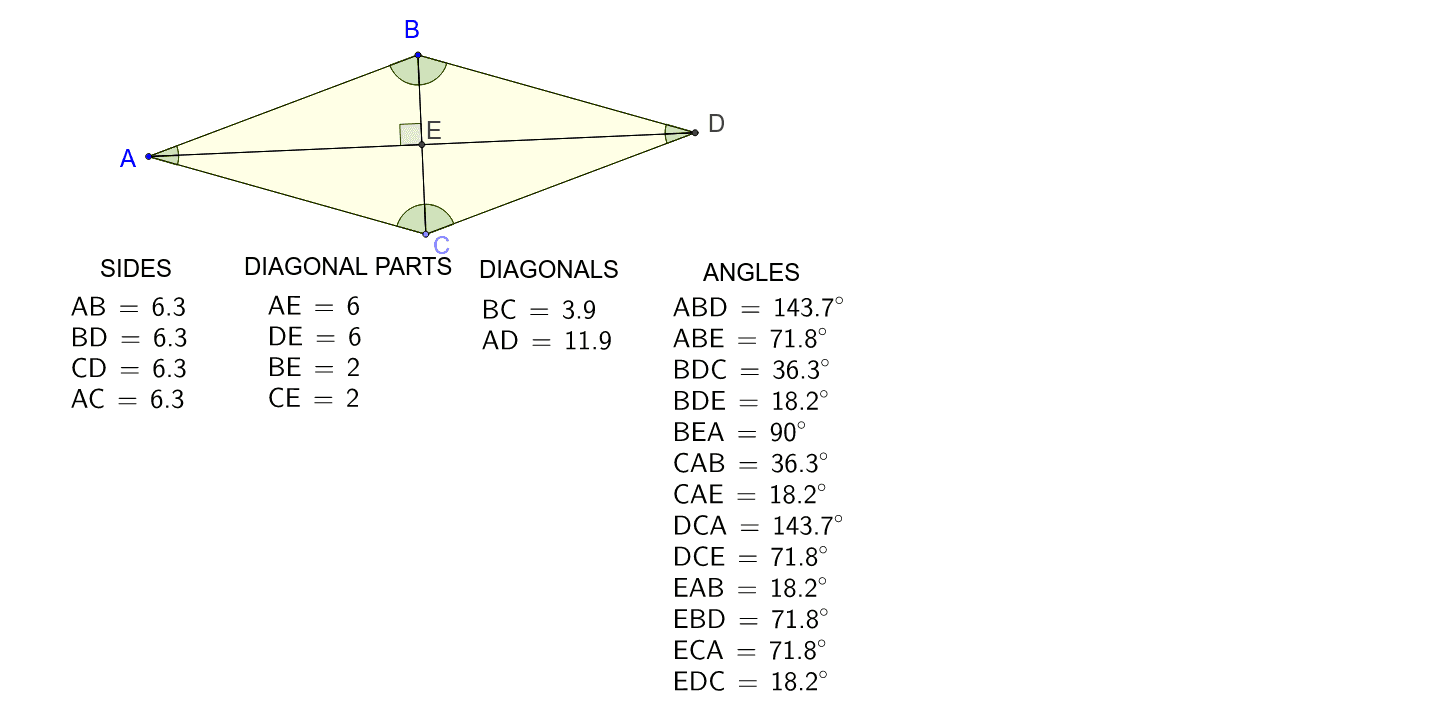
This example demonstrates the geometric properties of a rhombus through dynamic constructions, highlighting features like diagonals bisecting each other at right angles, equal side lengths, and congruent interior angles. It involves core concepts such as geometric construction, symmetry, angle measurement, and polygon properties. The construction utilizes GeoGebra commands like Circle, Point, Segment, Line, Intersect, Polygon, TableText, and Angle. Suitable for high school mathematics education, it aids in visualizing the relationships between rhombuses, squares, and parallelograms while fostering spatial reasoning skills.
GeoGebra Commands & Parameters
Circle(A, B) → cPoint(c) → CSegment(A, C) → AC_1Line(B, AC_1) → bSegment(A, B) → AB_1Line(C, AB_1) → eIntersect(b, e) → DSegment(B, D) → BD_1Segment(C, D) → CD_1Segment(B, C) → BCSegment(A, D) → ADPolygon(A, B, D, C) → poly1, a_1, b_1, d_1, c_1Intersect(BC, AD) → ESegment(A, E) → AESegment(E, D) → DESegment(B, E) → BESegment(C, E) → CESegment(A, B) → ABSegment(B, D) → BDSegment(D, C) → CDSegment(A, C) → ACTableText({{LaTeX[AB, true, true]}, {LaTeX[BD, true, true]}, {LaTeX[CD, true, true]}, {LaTeX[AC, true, true]}}) → text1TableText({{LaTeX[AE, true, true]}, {LaTeX[DE, true, true]}, {LaTeX[BE, true, true]}, {LaTeX[CE, true, true]}}) → text2TableText({{LaTeX[BC, true, true]}, {LaTeX[AD, true, true]}}) → text3Angle(C, A, B) → CABAngle(A, B, D) → ABDAngle(B, D, C) → BDCAngle(D, C, A) → DCAAngle(D, C, E) → DCEAngle(E, C, A) → ECAAngle(C, A, E) → CAEAngle(E, A, B) → EABAngle(A, B, E) → ABEAngle(E, B, D) → EBDAngle(B, D, E) → BDEAngle(E, D, C) → EDCAngle(B, E, A) → BEATableText({{LaTeX[ABD, true, true]}, {LaTeX[ABE, true, true]}, {LaTeX[BDC, true, true]}, {LaTeX[BDE, true, true]}, {LaTeX[BEA, true, true]}, {LaTeX[CAB, true, true]}, {LaTeX[CAE, true, true]}, {LaTeX[DCA, true, true]}, {LaTeX[DCE, true, true]}, {LaTeX[EAB, true, true]}, {LaTeX[EBD, true, true]}, {LaTeX[ECA, true, true]}, {LaTeX[EDC, true, true]}}) → text4
AI Drawing Prompt Reference
Draw a rhombus shape. The rhombus has four equal sides, and its diagonals are perpendicular and bisect each other. Start by drawing a point as a vertex, then draw a circle to define the boundary, and connect points and diagonals to form the rhombus. The diagonals divide the shape into four right triangles, which can be marked with diagonals, sides, and vertices. Ensure symmetry and highlight the differences between rhombus, square, and parallelogram.
The prompt above was compiled from the original drawing commands and is for reference only.