
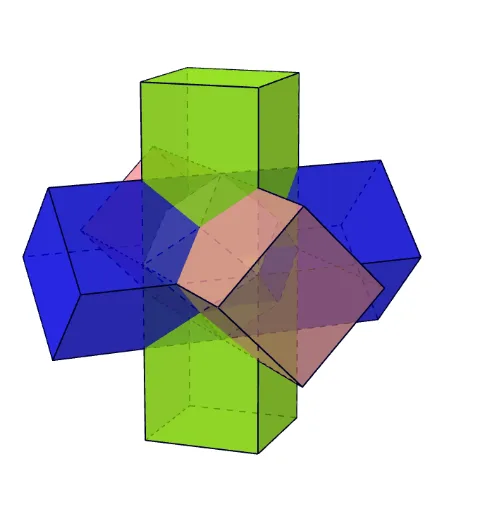
Intersection of Three Cuboids
Loading the math board and drawing, please wait…
This example demonstrates the geometric intersection of three cuboids, showcasing complex spatial relationships. Key math concepts include solid geometry, polygons, prisms, intersections, and line segments. It is constructed using GeoGebra commands like Polygon, Prism, Intersect, and Segment. Suitable for high school geometry education or introductory geometric modeling.
GeoGebra Commands & Parameters
Polygon(A_1, B_1, C_1, D_1) → v1, a_1, b_1, c_1, d_1Prism(v1, H_1) → a, A, Kante2, Kante3, Kante4, Kante5, KanteAB, KanteBC, Kante6, B, C, Fläche1, Fläche3, Fläche4, Fläche2, Fläche5, Kante1Polygon(A_2, B_2, C_2, D_2) → v2, a_2, b_2, c_2, d_2Prism(v2, H_2) → b, D, Kante8, Kante9, Kante10, Kante11, KanteDE, KanteEF, Kante12, E, F, Fläche6, Fläche8, Fläche9, Fläche7, Fläche10, Kante7Polygon(A_3, B_3, C_3, D_3) → v3, a_3, b_3, c_3, d_3Prism(v3, H_3) → c, G, Kante14, Kante15, Kante16, Kante17, KanteGH, KanteHI, Kante18, H, I, Fläche11, Fläche13, Fläche14, Fläche12, Fläche15, Kante13Intersect(Kante10, Kante14) → JIntersect(Kante13, Kante2) → KIntersect(Kante7, Fläche1) → LIntersect(Kante8, Kante14) → MIntersect(Kante13, Kante4) → NIntersect(Kante2, Kante15) → OIntersect(Kante1, Kante9) → PIntersect(Kante4, Kante15) → QIntersect(Kante16, Kante10) → RIntersect(Kante3, Kante9) → SIntersect(Kante16, Kante8) → TIntersect(Kante3, Kante7) → UIntersect(Kante3, Kante16) → VSegment(K, V) → fIntersect(Kante2, Kante10) → WSegment(U, W) → gIntersect(xAxis, Kante13) → ZSegment(R, Z) → hIntersect(g, h) → E_1Segment(W, L) → iSegment(Z, J) → jIntersect(Kante1, Kante14) → F_1Segment(K, F_1) → kIntersect(i, j) → G_1Segment(O, F_1) → lSegment(W, P) → mIntersect(Kante15, Kante9) → I_1Segment(J, I_1) → nIntersect(m, n) → J_1Segment(R, I_1) → pSegment(V, O) → qSegment(W, S) → rIntersect(r, p) → K_1Intersect(Kante4, zAxis) → L_1Segment(U, L_1) → sSegment(V, N) → tSegment(Z, T) → eIntersect(t, s) → M_1Segment(L, L_1) → f_1Segment(N, F_1) → g_1Segment(Z, M) → h_1Intersect(g_1, f_1) → N_1Segment(P, L_1) → i_1Segment(M, I_1) → j_1Segment(F_1, Q) → k_1Intersect(j_1, k_1) → O_1Segment(S, L_1) → l_1Segment(Q, V) → m_1Segment(T, I_1) → n_1Intersect(l_1, m_1) → P_1Polygon(Z, G_1, W, E_1) → v4, z_1, p_1, w, e_1Polygon(G_1, F_1, J_1, W) → v5, q_1, r_1, s_1, w_1Polygon(J_1, I_1, K_1, W) → v6, t_1, f_2, g_2, w_2Polygon(W, K_1, V, E_1) → v7, w_3, h_2, v, i_2Polygon(V, M_1, Z, E_1) → v8, v_1, j_2, z_2, k_2Polygon(M_1, L_1, N_1, Z) → v9, l_2, m_2, n_2, z_3Polygon(Z, N_1, F_1, G_1) → v10, z_4, p_2, q_2, r_2Polygon(L_1, O_1, F_1, N_1) → v11, s_2, o_1, t_2, e_2Polygon(F_1, O_1, I_1, J_1) → v12, f_3, g_3, h_3, i_3Polygon(L_1, P_1, I_1, O_1) → v13, j_3, k_3, l_3, m_3Polygon(P_1, V, K_1, I_1) → v14, n_3, v_2, p_3, q_3Polygon(L_1, M_1, V, P_1) → v15, r_3, s_3, v_3, t_3