
Interactive Trapezoid Area Discovery
Loading the math board and drawing, please wait…
In collections
Perimeter & Area
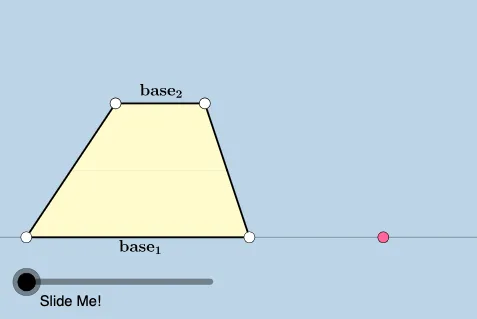
This example demonstrates how to explore the area of a trapezoid through interactive manipulation. Core math concepts include the area formula for trapezoids, properties of the median line, logical reasoning, and applications of the Pythagorean theorem and trigonometry. Construction highlights involve using commands and objects like Ray, Point, Segment, Slope, PointIn, Midpoint, Line, Dilate, Rotate, Polygon, OrthogonalLine, Intersect, Min, Circle, Angle, CircleSector, Vector, Translate in GeoGebra. Suitable for middle school and above students to understand area calculation and geometric constructions.
GeoGebra Commands & Parameters
Ray(A, B) → gPoint(g) → CSegment(A, C) → iSlope(i) → mPointIn(a) → DMidpoint(D, A) → SLine(A, B) → fRay(A, C) → hLine(D, i) → jPoint(j) → ERay(D, E) → kPoint(k) → FSegment(D, F) → lSegment(A, D) → nSegment(F, C) → pMidpoint(p) → GDilate(A, If[0 < c ≤ 1, 1 - c, 0], C) → A'Segment(A, A') → qDilate(C, If[1 < c ≤ 2, 2 - c, 0], G) → C'Dilate(G, If[2 < c ≤ 3, 3 - c, 0], F) → G'Segment(G, G') → sRotate(C, If[3 < c ≤ 4, ((c - 3) * pi), pi], G) → C'_1Rotate(C', If[3 < c ≤ 4, ((c - 3) * pi), pi], G) → C''Dilate(F, If[4 < c ≤ 5, 5 - c, 0], D) → F'Segment(F, F') → tDilate(D, If[5 < c ≤ 6, 6 - c, 0], S) → D'Dilate(D, If[6.5 < c ≤ 7.5, 7.5 - c, 0], G) → D'_1Polygon(A, C, G, S) → poly1, e, f_1, g_1, k_1Rotate(G, If[8 < c ≤ 9, ((-(c - 8)) * pi), pi], G) → G'_1Rotate(F, If[8 < c ≤ 9, ((-(c - 8)) * pi), pi], G) → F'_1Rotate(D, If[8 < c ≤ 9, ((-(c - 8)) * pi), pi], G) → D'_2Rotate(D, If[8 < c ≤ 9, ((-(c - 8)) * pi), pi], G) → D'_3Rotate(D'_1, If[8 < c ≤ 9, ((-(c - 8)) * pi), pi], G) → HRotate(C'_1, If[8 < c ≤ 9, ((-(c - 8)) * pi), pi], G) → IRotate(C'', If[8 < c ≤ 9, ((-(c - 8)) * pi), pi], G) → C'''OrthogonalLine(D, q) → i_1Intersect(f, q) → JDilate(D, If[6 < c ≤ 7, 7 - c, 0], J) → D'_4Segment(D, D'_4) → j_1Min(t, q) → oCircle(J, (0.15 * o)) → e_1Intersect(e_1, i_1) → K, LIntersect(e_1, f) → M, NAngle(D, J, A) → αAngle(C, A, D) → βIntersect(i_1, f) → ODilate(D, If[6 < c ≤ 7, 7 - c, 0], O) → D'_5Point(f) → PPoint(f) → QCircle(C, t) → p_1Intersect(p_1, f, 2) → RRay(R, Q) → m_1Angle(F, C, A) → δLine(A, D) → l_1Rotate(D, If[6 < c ≤ 7, ((-(c - 6)) * pi), (-pi)], S) → D'_6Rotate(D', If[6 < c ≤ 7, ((-(c - 6)) * pi), (-pi)], S) → D''Segment(F, C) → rSegment(D, A) → dMidpoint(D, O) → TPolygon(S, G, F, D) → q1, s_1, g_2, f_2, d_1Circle(A, (0.4 * Distance[A, S])) → c_1Intersect(c_1, d, 1) → UIntersect(c_1, q, 1) → VDilate(D, If[5 < c ≤ 6, 6 - c, 0], T) → D'_7Segment(D, D'_7) → n_1Dilate(T, If[6 < c ≤ 7, 7 - c, 0], O) → T'Segment(T, T') → q_1Angle(C, O, D) → γRotate(D, If[7 < c ≤ 8 - ((c - 7) * pi), (-pi)], T) → D'_8Rotate(D'_7, If[7 < c ≤ 8 - ((c - 7) * pi), (-pi)], T) → WRotate(D, If[7 < c ≤ 8, ((-(c - 7)) * pi), (-pi)], T) → D'_9Rotate(D'_7, If[7 < c ≤ 8, ((-(c - 7)) * pi), (-pi)], T) → ZSegment(D'_9, Z) → r_1Dilate(T, If[8 < c ≤ 9, 9 - c, 0], S) → T'_1Dilate(T, If[8 < c ≤ 9, 9 - c, 0], G) → T'_2Segment(T, T'_2) → t_1Segment(T, T'_1) → a_1Angle(V, A, U) → εRotate(V, If[9 < c ≤ 10, ((c - 9) * ε), ε], A) → V'CircleSector(A, V, V') → h_1Dilate(A, If[10.5 < c ≤ 11.5, 11.5 - c, 0], S) → A'_1Vector(A, A'_1) → uTranslate(h_1, u) → c_2Rotate(S, If[12 < c ≤ 13, ((-(c - 12)) * pi), pi], G) → S'Rotate(G, If[12 < c ≤ 13, ((-(c - 12)) * pi), pi], G) → G'_2Rotate(F, If[12 < c ≤ 13, ((-(c - 12)) * pi), pi], G) → F'_2Rotate(D, If[12 < c ≤ 13, ((-(c - 12)) * pi), pi], G) → D'_{10}Polygon(S', G'_2, F'_2, D'_{10}) → q1', s', g'_2, f'_2, d'_{10}Rotate(F, If[12 < c ≤ 13, ((-(c - 12)) * pi), pi], G) → F'_3Rotate(F', If[12 < c ≤ 13, ((-(c - 12)) * pi), pi], G) → F''Segment(F'_3, F'') → t'Segment(G, F'_2) → b_1Rotate(S, If[12 < c ≤ 13, ((-(c - 12)) * pi), pi], G) → S'_1Segment(S'_1, D'_{10}) → h_2Segment(S'_1, G) → i_2Segment(F, G) → j_2Segment(G, C) → k_2Dilate(A, If[13 < c ≤ 14, 14 - c, 0], D'_{10}) → A'_2Vector(A, A'_2) → vTranslate(h_1, v) → d_2