
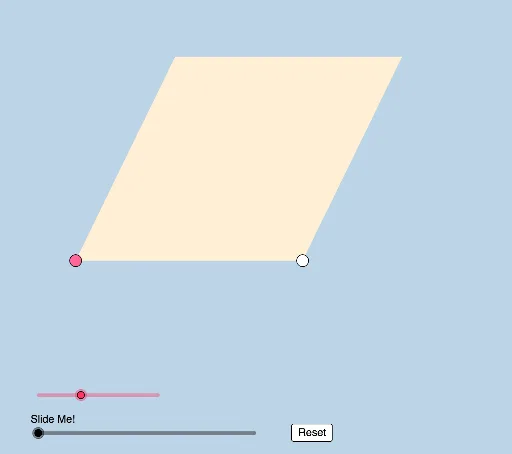
Interactive Discovery of Rhombus Area
Loading the math board and drawing, please wait…
In collections
Congruence (Vol 2)
Area, Surface Area, Volume, Cross Section, 3D
Perimeter & Area
Perimeter & Area
This example demonstrates how to explore the calculation of rhombus area through interactive means, involving core math concepts like rhombus properties, area formulas, vector operations, and linear regression. Key GeoGebra commands and objects used include Rotate, Ray, Circle, Intersect, Polygon, Dilate, Segment, Vector, Translate, and CircleSector, making it suitable for high school mathematics instruction or student-led geometric property exploration.
GeoGebra Commands & Parameters
Rotate(B, (a * π / 180), A) → B'Ray(A, B) → fRay(A, B') → gCircle(B, Distance[A, B]) → cCircle(B', Distance[A, B]) → dIntersect(c, d, 2) → CPolygon(A, B, C, B') → q1, a_1, b, c_1, b'Dilate(A, If[0 < e ≤ 1, 1 - e, 0], B) → A'Segment(A, A') → hRotate(B, If[1 < e ≤ 2, ((a * (e - 1)) * π / 180), (a * π / 180)], A) → B'_1Segment(A, B'_1) → iRotate(A, If[2 < e ≤ 3, (((180 - a) * (e - 2)) * π / 180), ((180 - a) * π / 180)], B'_1) → A'_1Segment(B'_1, A'_1) → jDilate(A, If[3 < e ≤ 4, 4 - e, 0], B) → A'_2Vector(A, A'_2) → uTranslate(A, u) → A'_3Translate(B'_1, u) → DSegment(A'_3, D) → i'Segment(B'_1, B) → kSegment(A, A'_1) → lIntersect(k, l) → EPolygon(B'_1, E, A) → t1, a_2, b'_1, e_1Polygon(A, E, B) → t2, b_1, a_3, e_2Polygon(B'_1, E, A'_1) → t3, a'_1, b'_2, e_3Polygon(B, A'_1, E) → t4, e_4, b_2, a'_2Dilate(A, If[5 < e ≤ 6, 6 - e, 0], E) → A'_4Segment(A, A'_4) → mDilate(E, If[6 < e ≤ 7, 7 - e, 0], A'_1) → E'Segment(E, E') → nRotate(A, If[7 < e ≤ 8, ((e - 7) * π), π], E) → A'_5Segment(E, A'_5) → pDilate(B'_1, If[8 < e ≤ 9, 9 - e, 0], E) → FSegment(B'_1, F) → qDilate(E, If[9 < e ≤ 10, 10 - e, 0], B) → E'_1Segment(E, E'_1) → rRotate(B'_1, If[10 < e ≤ 11, ((e - 10) * π), π], E) → GSegment(E, G) → sCircle(E, (0.25 * Min[q, m])) → tIntersect(t, s, 1) → HRotate(H, If[12 < e ≤ 13, ((e - 12) * π / 2), π / 2], E) → H'CircleSector(E, H, H') → d_1Rotate(d_1, If[14 < e ≤ 15, ((e - 14) * π / 2), π / 2], E) → f_1Dilate(A, If[16 < e ≤ 17, 17 - e, 0], B) → A'_6Vector(A, A'_6) → vTranslate(B'_1, v) → ITranslate(E, v) → E'_2Translate(A, v) → A'_7Polygon(I, E'_2, A'_7) → t1', a'_7, i_1, e'_2Translate(A, v) → A'_8Translate(B'_1, v) → JSegment(A'_8, J) → i'_1Translate(B'_1, v) → KTranslate(F, v) → F'Segment(K, F') → q'Translate(A, v) → A'_9Translate(A'_4, v) → LSegment(A'_9, L) → m'Dilate(B'_1, If[17 < e ≤ 18, 18 - e, 0], A) → MVector(B'_1, M) → wTranslate(B'_1, w) → PTranslate(E, w) → E'_3Translate(A'_1, w) → QPolygon(P, E'_3, Q) → t3', q_1, p_1, e'_3Segment(M, Q) → g_1Translate(B'_1, w) → NTranslate(F, w) → F'_1Segment(N, F'_1) → q'_1Translate(E, w) → E'_4Translate(A'_5, w) → OSegment(E'_4, O) → p'Segment(A, B'_1) → h_1Segment(B'_1, A'_1) → j_1Segment(E, B'_1) → k_1