
Hyperboloid as a Ruled Surface
Loading the math board and drawing, please wait…
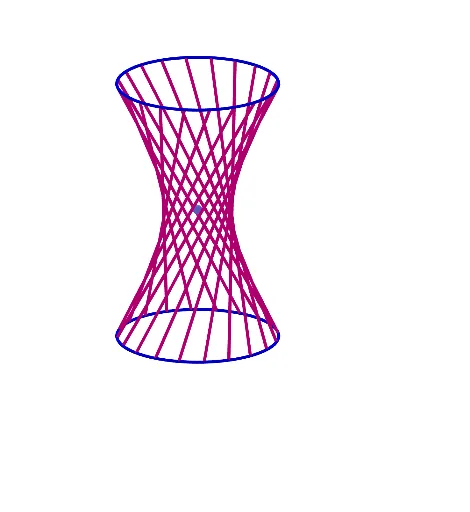
① This applet demonstrates a one-sheet hyperboloid generated by a family of straight lines, visually illustrating its nature as a ruled surface. ② Core mathematical concepts include ruled surfaces, hyperboloids, spatial lines and circles, rotation and mirror transformations, and the construction of polygons and segments in 3D space. ③ Construction highlights: from the summary, the applet uses GeoGebra commands such as Intersect, Circle, Rotate, Polygon, Point, OrthogonalPlane, Mirror, and Segment, with multiple auxiliary objects (A, c, B, d, n, C, D, α, etc.) to create and rotate line segments, then mirror them to form the ruled surface. ④ Suitable for high school to undergraduate courses in solid geometry, analytic geometry, or mathematical modeling, this applet helps students grasp the geometric essence of ruled surfaces and can serve as a visual aid for 3D printing or interactive teaching.
GeoGebra Commands & Parameters
Intersect(xAxis, yAxis) → ACircle(A, 2) → cIntersect(xAxis, yAxis) → BCircle(B, 2) → dIntersect(c, xAxis, 2) → CIntersect(d, xAxis, 2) → DRotate(D, (360°) / n, B) → D'Rotate(C, α, A) → C'Polygon(D, D', n) → poly2, j_1, t_1, a_1, b_1, c_1, d_1, e_1, f_2, g_2, h_2, i_2, k_1, j_2, m_3, p_3, r_3, s_3, t_3, d_3, e_3, f_4, g_4, l_1, l_4, W, Z, A_1, B_1, C_1, D_1, E_1, F_1, G_1, m_1, H_1, I_1, J_1, K_1, L_1, M_1, N_1, O_1, P_1, U_1, n_1, W_1, A_2, B_2, C_2, G_2, H_2, I_2, J_2, O_2, p_1, q_1, r_1, s_1Rotate(C', (360°) / n, A) → C''Polygon(C', C'', n) → poly1, f, q, r, s, t, a, b, e, f_1, g_1, h_1, g, i_1, n_3, q_3, a_3, b_3, c_3, h_4, i_4, j_4, k_4, h, m_4, E, F, G, H, I, J, K, L, M, i, N, O, R, S, T, U, V, Q_1, R_1, V_1, j, Z_1, D_2, E_2, F_2, K_2, L_2, M_2, N_2, P_2, k, l, m, pPoint(zAxis) → POrthogonalPlane(P, zAxis) → p_2Mirror(poly1, p_2) → poly1'Mirror(E, p_2) → E'Mirror(c, p_2) → c'Mirror(C', p_2) → C''_1Mirror(C'', p_2) → C'''Mirror(F, p_2) → F'Mirror(G, p_2) → G'Mirror(H, p_2) → H'Mirror(I, p_2) → I'Mirror(J, p_2) → J'Mirror(K, p_2) → K'Mirror(L, p_2) → L'Mirror(M, p_2) → M'Mirror(N, p_2) → N'Mirror(O, p_2) → O'Mirror(R, p_2) → R'Mirror(S, p_2) → S'Mirror(T, p_2) → T'Mirror(U, p_2) → U'Mirror(V, p_2) → V'Mirror(Q_1, p_2) → S_1Mirror(R_1, p_2) → T_1Segment(C''', D') → k_2Segment(C''_1, D) → l_2Segment(E', W) → m_2Segment(F', Z) → n_2Segment(G', A_1) → r_2Segment(H', B_1) → s_2Segment(I', C_1) → t_2Segment(J', D_1) → a_2Segment(K', E_1) → b_2Segment(L', F_1) → c_2Segment(M', G_1) → q_2Segment(N', H_1) → d_2Segment(O', I_1) → e_2Segment(R', J_1) → f_3Segment(S', K_1) → g_3Segment(T', L_1) → h_3Segment(U', M_1) → i_3Segment(V', N_1) → j_3Segment(S_1, O_1) → k_3Segment(T_1, P_1) → l_3
AI Drawing Prompt Reference
Draw a one-sheet hyperboloid, demonstrating it as a ruled surface generated by a family of straight lines. Start by creating two circles on coordinate planes, then rotate and mirror points on these circles to form lines. Connect these lines into polygons and use mirror operations to construct the complete hyperboloid.
The prompt above was compiled from the original drawing commands and is for reference only.