
Hidden Symmetry in Regular Polygons
Loading the math board and drawing, please wait…
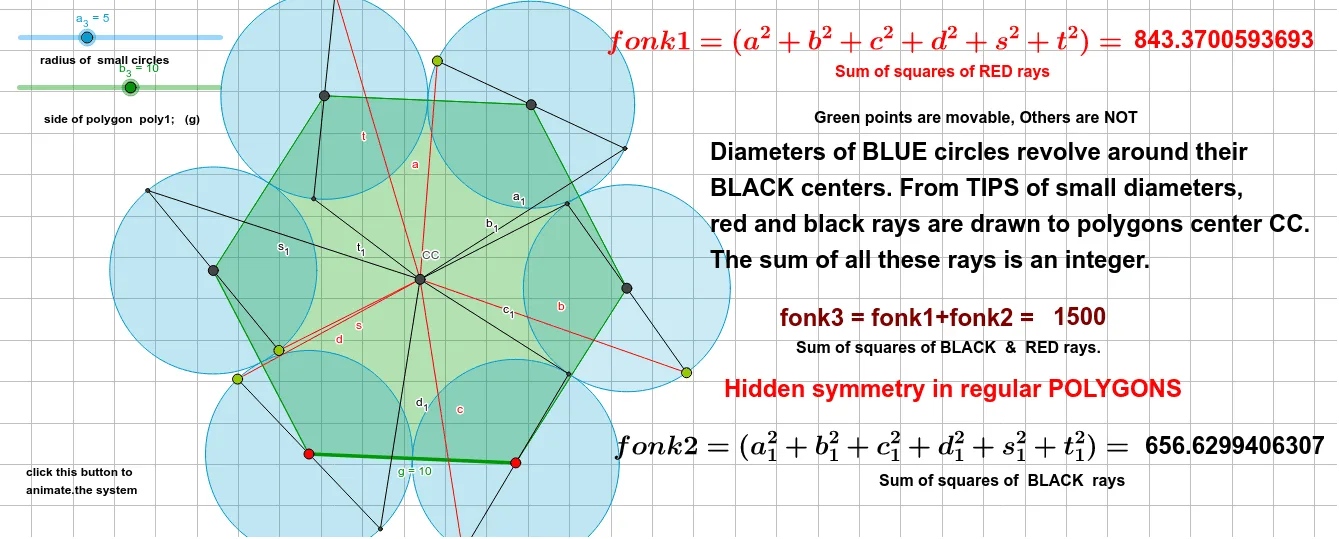
This example demonstrates the hidden symmetry in regular polygons. It involves key mathematical concepts such as geometric transformations and symmetry. Using GeoGebra commands like Point, Polygon, LineBisector, etc., one can construct regular polygons and observe their symmetries. Suitable for middle school and above students or teachers.
GeoGebra Commands & Parameters
Point(Circle[A, b_3]) → DPolygon(A, D, 6) → poly1, g, H, h, i, j, k, l, E, F, GLineBisector(k) → mLineBisector(j) → nLineBisector(i) → pIntersect(m, n) → CCCircle(G, a_3) → d_2Circle(F, a_3) → eCircle(E, a_3) → qCircle(D, a_3) → rCircle(A, a_3) → s_2Circle(H, a_3) → t_2Point(d_2) → PPoint(e) → QPoint(t_2) → RPoint(s_2) → SPoint(r) → TPoint(q) → ULine(P, G) → f_1Line(H, R) → g_1Line(S, A) → h_1Line(T, D) → i_1Line(U, E) → j_1Line(Q, F) → k_1Intersect(d_2, f_1, 2) → VIntersect(t_2, g_1, 2) → WIntersect(s_2, h_1, 2) → ZIntersect(r, i_1, 2) → A_1Intersect(q, j_1, 2) → B_1Intersect(e, k_1, 2) → C_1Segment(P, V) → l_1Segment(R, W) → m_1Segment(S, Z) → n_1Segment(T, A_1) → p_1Segment(U, B_1) → q_1Segment(C_1, Q) → r_1Segment(R, CC) → sSegment(P, CC) → tSegment(Q, CC) → aSegment(U, CC) → bSegment(T, CC) → cSegment(S, CC) → dSegment(W, CC) → s_1Segment(V, CC) → t_1Segment(C_1, CC) → a_1Segment(B_1, CC) → b_1Segment(A_1, CC) → c_1Segment(Z, CC) → d_1
AI Drawing Prompt Reference
Draw a regular hexagon and observe its hidden symmetry. Start by drawing a circle with point A as the center, then take a point D on the circle and draw a regular hexagon with D and A as vertices. Next, draw the diagonals of the hexagon and then find the perpendicular bisectors of these diagonals, with their intersection point CC being the center of the hexagon. Finally, draw line segments from each vertex to the center and their symmetric counterparts.
The prompt above was compiled from the original drawing commands and is for reference only.