
Hexagonal Surprise!
Loading the math board and drawing, please wait…
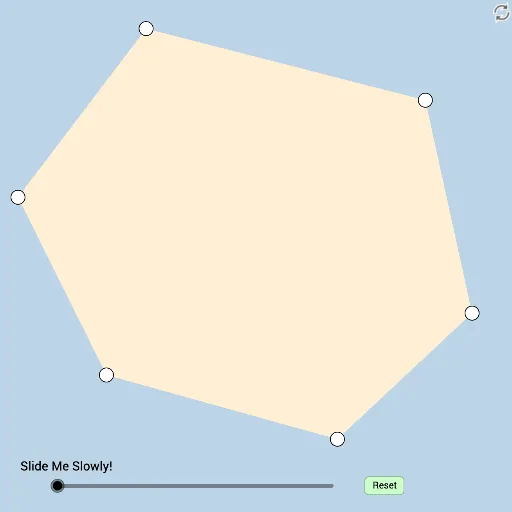
This dynamic and modifiable illustration demonstrates phenomena that occur within any hexagon (convex or concave). It showcases various geometric phenomena within a hexagon. The example involves core mathematical concepts such as similar triangles and polygons. Using GeoGebra commands like Polygon, Segment, Midpoint, Line, etc., the construction of the hexagon and related geometric elements is demonstrated. Suitable for high school and above students or teachers.
GeoGebra Commands & Parameters
Polygon(A, B, C, D, E, F) → poly1, a, b, c, d, e, fSegment(F, A) → gSegment(A, B) → hSegment(B, C) → iSegment(C, D) → jSegment(D, E) → kSegment(E, F) → lMidpoint(l) → GMidpoint(g) → HMidpoint(h) → IMidpoint(i) → JMidpoint(j) → KMidpoint(k) → LLine(A, G) → mLine(E, H) → nIntersect(m, n) → MLine(F, L) → pLine(D, G) → qIntersect(p, q) → NLine(C, L) → rLine(E, K) → sIntersect(r, s) → OLine(D, J) → tLine(B, K) → f_1Intersect(t, f_1) → PLine(C, I) → g_1Line(A, J) → h_1Intersect(g_1, h_1) → QLine(B, H) → i_1Line(F, I) → j_1Intersect(i_1, j_1) → RPolygon(M, N, O, P, Q, R) → poly2, m_1, n_1, o, p_1, q_1, r_1Dilate(A, If[0 < u ≤ 1, 1 - u, 0], I) → A'Dilate(B, If[0 < u ≤ 1, 1 - u, 0], J) → B'Dilate(C, If[0 < u ≤ 1, 1 - u, 0], K) → C'Dilate(D, If[0 < u ≤ 1, 1 - u, 0], L) → D'Dilate(E, If[0 < u ≤ 1, 1 - u, 0], G) → E'Dilate(F, If[0 < u ≤ 1, 1 - u, 0], H) → F'Segment(A, A') → k_1Segment(B, B') → l_1Segment(C, C') → s_1Segment(D, D') → t_1Segment(E, E') → a_1Segment(F, F') → b_1Rotate(A, If[1 < u ≤ 2, ((-(u - 1)) * π), (-π)], I) → A'_1Rotate(A', If[1 < u ≤ 2, ((-(u - 1)) * π), (-π)], I) → A''Segment(A'_1, A'') → c_1Rotate(B, If[1 < u ≤ 2, ((-(u - 1)) * π), (-π)], J) → B'_1Rotate(B', If[1 < u ≤ 2, ((-(u - 1)) * π), (-π)], J) → B''Segment(B'_1, B'') → d_1Rotate(C, If[1 < u ≤ 2, ((-(u - 1)) * π), (-π)], K) → C'_1Rotate(C', If[1 < u ≤ 2, ((-(u - 1)) * π), (-π)], K) → C''Segment(C'_1, C'') → e_1Rotate(D, If[1 < u ≤ 2, ((-(u - 1)) * π), (-π)], L) → D'_1Rotate(D', If[1 < u ≤ 2, ((-(u - 1)) * π), (-π)], L) → D''Segment(D'_1, D'') → f_2Rotate(E, If[1 < u ≤ 2, ((-(u - 1)) * π), (-π)], G) → E'_1Rotate(E', If[1 < u ≤ 2, ((-(u - 1)) * π), (-π)], G) → E''Segment(E'_1, E'') → g_2Rotate(F, If[1 < u ≤ 2, ((-(u - 1)) * π), (-π)], H) → F'_1Rotate(F', If[1 < u ≤ 2, ((-(u - 1)) * π), (-π)], H) → F''Segment(F'_1, F'') → h_2Dilate(A, If[2 < u ≤ 3, 3 - u, 0], G) → A'_2Dilate(E, If[2 < u ≤ 3, 3 - u, 0], H) → E'_2Segment(A, A'_2) → i_2Segment(E, E'_2) → j_2Dilate(F, If[3 < u ≤ 4, 4 - u, 0], L) → F'_2Dilate(D, If[3 < u ≤ 4, 4 - u, 0], G) → D'_2Segment(F, F'_2) → k_2Segment(D, D'_2) → l_2Dilate(C, If[4 < u ≤ 5, 5 - u, 0], L) → C'_2Dilate(E, If[4 < u ≤ 5, 5 - u, 0], K) → E'_3Segment(C, C'_2) → m_2Segment(E, E'_3) → n_2Dilate(D, If[5 < u ≤ 6, 6 - u, 0], J) → D'_3Dilate(B, If[5 < u ≤ 6, 6 - u, 0], K) → B'_2Segment(B, B'_2) → p_2Segment(D, D'_3) → q_2Dilate(C, If[6 < u ≤ 7, 7 - u, 0], I) → C'_3Dilate(A, If[6 < u ≤ 7, 7 - u, 0], J) → A'_3Segment(A, A'_3) → r_2Segment(C, C'_3) → s_2Dilate(B, If[7 < u ≤ 8, 8 - u, 0], H) → B'_3Dilate(F, If[7 < u ≤ 8, 8 - u, 0], I) → F'_3Segment(F, F'_3) → t_2Segment(B, B'_3) → a_2Dilate(R, If[15 < u ≤ 16, 16 - u, 0], M) → R'Segment(R, R') → b_2Dilate(R, If[16 < u ≤ 17, 17 - u, 0], P) → R'_1Vector(R, R'_1) → vTranslate(R, v) → R'_2Translate(R', v) → R''Segment(R'_2, R'') → c_2Dilate(M, If[17 < u ≤ 18, 18 - u, 0], N) → M'Segment(M, M') → d_2Dilate(M, If[18 < u ≤ 19, 19 - u, 0], Q) → M'_1Vector(M, M'_1) → wTranslate(M, w) → M'_2Translate(M', w) → M''Segment(M'_2, M'') → e_2Dilate(N, If[19 < u ≤ 20, 20 - u, 0], O) → N'Segment(N, N') → f_3Dilate(N, If[20 < u ≤ 21, 21 - u, 0], R) → N'_1Vector(N, N'_1) → u_1Translate(N, u_1) → N'_2Translate(N', u_1) → N''Segment(N'_2, N'') → g_3