
Hexagon Puzzle: Exploring Polygons and Symmetry in Geometric Construction
Loading the math board and drawing, please wait…
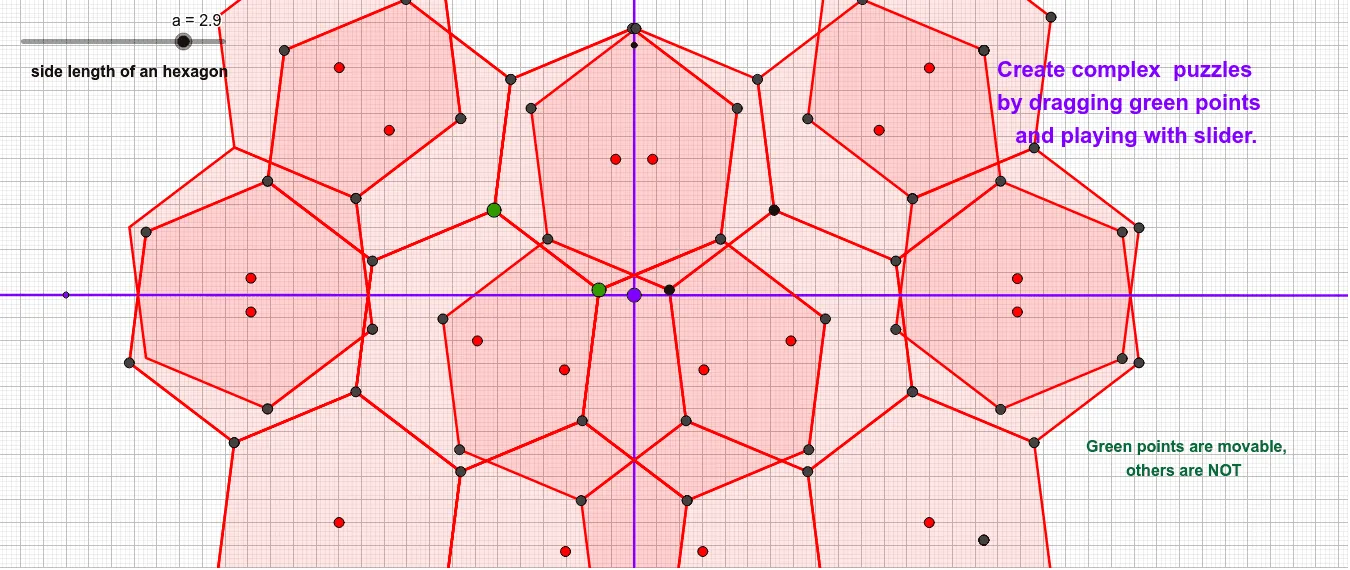
① This example demonstrates how to construct a complex geometric figure using a hexagon-based puzzle, combining multiple polygons, segments, and symmetry operations to create a visual puzzle effect. ② Core mathematical concepts include polygons (especially quadrilaterals and hexagons), centroid (barycenter), symmetry (reflection), translation, orthocenter, and function graphs, involving area, geometric transformations, and inequalities. ③ Construction highlights: Based on the construction summary, GeoGebra commands such as Point, Polygon, Centroid, Line, Mirror, and Segment are used, creating multiple points (A, B, C, D, E, F, G, H, I, J, K, L, M, N) and polygons (poly1, poly2, poly3, poly4), with mirroring and segment connections forming the puzzle structure. ④ Suitable for: Upper middle school to high school students, for teaching geometric transformations, symmetry, and polygon properties, as well as for mathematical exploration or puzzle games to stimulate interest in geometric structures.
GeoGebra Commands & Parameters
Point(Circle[A, a]) → BPolygon(A, B, 6) → poly1, g, F, h, i, j, k, l, C, D, EPolygon(D, C, 6) → poly2, m, J, n, p, q, r, s, G, H, IPolygon(E, D, 6) → poly3, t, N, b, c, d, e, f_1, K, L, MPolygon(F, E, 6) → poly4, g_1, R, h_1, i_1, j_1, k_1, l_1, O, P, QPolygon(A, F, 6) → poly5, m_1, V, n_1, p_1, q_1, r_1, s_1, S, T, UPolygon(B, A, 6) → poly6, t_1, B_1, a_1, b_1, c_1, d_1, e_1, W, Z, A_1Polygon(C, B, 6) → poly7, f_2, F_1, g_2, h_2, i_2, j_2, k_2, C_1, D_1, E_1Centroid(poly1) → G_1Centroid(poly2) → H_1Centroid(poly3) → I_1Centroid(poly4) → J_1Centroid(poly5) → K_1Centroid(poly6) → L_1Centroid(poly7) → M_1Line(N_1, O_1) → l_2Mirror(poly1, l_2) → poly1'Mirror(poly2, l_2) → poly2'Mirror(poly3, l_2) → poly3'Mirror(poly4, l_2) → poly4'Mirror(poly5, l_2) → poly5'Mirror(poly6, l_2) → poly6'Mirror(poly7, l_2) → poly7'Mirror(A, l_2) → A'Mirror(B, l_2) → B'Mirror(G_1, l_2) → P_1Mirror(H_1, l_2) → Q_1Mirror(I_1, l_2) → R_1Mirror(J_1, l_2) → S_1Mirror(K_1, l_2) → T_1Mirror(L_1, l_2) → U_1Mirror(M_1, l_2) → V_1Mirror(L, l_2) → L'Mirror(M, l_2) → M'Mirror(N, l_2) → N'Mirror(E_1, l_2) → W_1Mirror(E_1, l_2) → Z_1Mirror(E_1, l_2) → A_2Mirror(E_1, l_2) → B_2Mirror(E_1, l_2) → C_2Mirror(D_1, l_2) → D_2Mirror(A_1, l_2) → E_2Mirror(B_1, l_2) → F_2Mirror(U, l_2) → U'Mirror(V, l_2) → V'Mirror(Z, l_2) → Z'Mirror(T, l_2) → T'Mirror(R, l_2) → R'Mirror(Q, l_2) → Q'Mirror(P, l_2) → P'Mirror(H, l_2) → H'Mirror(I, l_2) → I'Mirror(J, l_2) → J'Mirror(N, l_2) → N'_1Mirror(G, l_2) → G'Mirror(D, l_2) → D'Mirror(C, l_2) → C'Mirror(B, l_2) → B'_1Mirror(F, l_2) → F'Mirror(D, l_2) → D'_1Mirror(E, l_2) → E'Line(N_1, G_2) → fMirror(poly2, f) → poly2'_1Mirror(poly3, f) → poly3'_1Mirror(poly2', f) → poly2''Mirror(poly3', f) → poly3''Mirror(C, f) → C'_1Mirror(D, f) → D'_2Segment(C'_1, D'_2) → i'Mirror(D, f) → D'_3Mirror(E, f) → E'_1Segment(D'_3, E'_1) → j'Mirror(E, f) → E'_2Mirror(O, f) → O'Segment(E'_2, O') → m_2Mirror(O, f) → O'_1Mirror(F_1, f) → I_2Mirror(F_1, f) → J_2Mirror(C, f) → C'_2Segment(J_2, C'_2) → q_2Mirror(H_1, f) → K_2Mirror(I_1, f) → L_2Mirror(Q_1, f) → M_2Mirror(R_1, f) → N_2Mirror(L', f) → L''Mirror(M', f) → M''Mirror(N', f) → N''Mirror(Z_1, f) → P_2Mirror(A_2, f) → Q_2Mirror(B_2, f) → R_2Mirror(C_2, f) → S_2Mirror(H', f) → H''Mirror(I', f) → I''Mirror(J', f) → J''Mirror(N'_1, f) → T_2Mirror(G', f) → G''Mirror(D', f) → D''Mirror(C', f) → C''Mirror(D'_1, f) → U_2Mirror(E', f) → E''
AI Drawing Prompt Reference
Draw a puzzle-like geometric figure composed of seven regular hexagons arranged around a central point, each hexagon subdivided into smaller polygons, creating a honeycomb-like symmetric pattern. All hexagons share edges or vertices, radiating outward. Mark a point at the center of each hexagon to indicate its centroid. Then, choose a symmetry axis running through the entire figure, and reflect the whole structure—including all hexagons, inner polygons, and center points—across this axis, producing a mirrored copy that together with the original forms a complete puzzle. The drawing should clearly show segment connections and symmetry, emphasizing polygon properties and geometric transformations.
The prompt above was compiled from the original drawing commands and is for reference only.