
Geometric Transformations in a Parallelogram
Loading the math board and drawing, please wait…
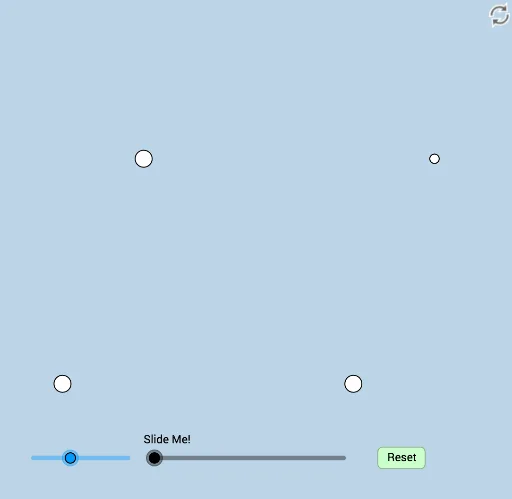
This example illustrates a problem involving geometric transformations within a parallelogram. Key mathematical concepts include rotation, translation, and dilation. Using GeoGebra commands such as Rotate, Translate, and Dilate, dynamic demonstrations of these transformations are provided. Suitable for students at the junior high school level and above.
GeoGebra Commands & Parameters
Rotate(B, a°, A) → B'Angle(B, A, B') → αRay(A, B) → fRay(A, B') → gLine(B, g) → hPoint(g) → CLine(C, f) → iIntersect(h, i) → DSegment(C, D) → jSegment(A, B) → kSegment(B, D) → lSegment(A, C) → mMin(m, k) → bCircle(C, (0.2 * b)) → dCircle(A, (0.2 * b)) → eCircle(B, (0.2 * b)) → pCircle(D, (0.2 * b)) → cIntersect(e, k, 1) → EIntersect(e, m, 1) → FIntersect(p, k, 1) → GIntersect(p, l, 1) → HIntersect(d, g, 2) → IRay(C, I) → qIntersect(c, h, 2) → JRay(D, J) → rIntersect(c, i, 2) → KRay(D, K) → sDilate(A, If[0 < o ≤ 1, 1 - o, 0], B) → A'Segment(A, A') → tRotate(E, If[1 < o ≤ 2, ((o - 1) * α), α], A) → E'CircleSector(A, E, E') → c_1Dilate(A, If[2 < o ≤ 3, 3 - o, 0], C) → A'_1Vector(A, A'_1) → uTranslate(c_1, u) → d_1Segment(A, A'_1) → f_1Dilate(C, If[3 < o ≤ 4, 4 - o, 0], D) → C'Vector(C, C') → vTranslate(d_1, v) → e_1Segment(C, C') → g_1Dilate(D, If[4 < o ≤ 5, 5 - o, 0], B) → D'Segment(D, D') → h_1Polygon(A, B, D, C) → poly1, a_1, b_1, d_2, c_2Dilate(A, If[5.5 < o ≤ 6.5, 6.5 - o, 0], C) → A'_2Vector(A, A'_2) → wTranslate(A, w) → A'_3Translate(A', w) → A''Dilate(A, If[6.5 < o ≤ 7.5, 7.5 - o, 0], B) → A'_4Vector(A, A'_4) → u_1Translate(A, u_1) → A'_5Translate(A'_1, u_1) → LIntersect(d, i) → M, NIntersect(d, g) → O, PAngle(A, C, N) → βRotate(N, If[6.5 < o ≤ 7.5, ((-(o - 6.5)) * β), (-β)], C) → N'Dilate(C, If[7.5 < o ≤ 8.5, 8.5 - o, 0], B) → C'_1Vector(C, C'_1) → v_1Ray(A, B) → q_1LineBisector(B, A) → r_1Distance(C, B) → distanceCBSegment(C, D) → i_1Point(i_1) → QLine(A, D) → j_1Line(Q, j_1) → k_1Line(B, Q) → l_1Line(C, A) → m_1Intersect(m_1, k_1) → RSegment(Q, R) → n_1Intersect(e, j_1) → S, TIntersect(e, m_1) → U, VLine(B, R) → p_1Intersect(j_1, l_1) → WIntersect(j_1, p_1) → ZDilate(A, If[6 < o ≤ 7, 7 - o, 0], Z) → A'_6Segment(A, A'_6) → s_1Dilate(Z, If[7 < o ≤ 8, 8 - o, 0], W) → Z'Segment(Z, Z') → t_1Dilate(B, If[7 < o ≤ 8, 8 - o, 0], W) → B'_1Segment(B, B'_1) → f_2Dilate(W, If[8 < o ≤ 9, 9 - o, 0], D) → W'Dilate(W, If[8 < o ≤ 9, 9 - o, 0], Q) → W'_1Segment(W, W') → g_2Segment(W, W'_1) → h_2Dilate(Q, If[9 < o ≤ 10, 10 - o, 0], R) → Q'Segment(Q, Q') → i_2Angle(D, A, C) → γRotate(T, If[10 < o ≤ 11, ((o - 10) * γ), γ], A) → T'CircleSector(A, T, T') → e_2Dilate(A, If[11 < o ≤ 12, 12 - o, 0], R) → A'_7Vector(A, A'_7) → w_1Translate(e_2, w_1) → k_2Dilate(B, If[12 < o ≤ 13, 13 - o, 0], Z) → B'_2Segment(B, B'_2) → j_2Dilate(Z, If[13 < o ≤ 14, 14 - o, 0], R) → Z'_1Segment(Z, Z'_1) → l_2Midpoint(A, D) → A_1Rotate(W, If[15 < o ≤ 16, ((o - 15) * π), π], A_1) → W'_2Rotate(W', If[15 < o ≤ 16, ((o - 15) * π), π], A_1) → W''Segment(W'_2, W'') → m_2