
Geometric Transformations and Function Demonstration
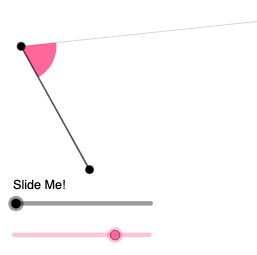
Loading the math board and drawing, please wait…
This example dynamically demonstrates the combination of geometric transformations and logarithmic functions, showcasing relationships between rotated, scaled, and intersecting shapes. Core mathematical concepts include geometric transformations (rotation, dilation), logarithmic functions, vectors, and coordinate geometry. Construction highlights from the summary involve commands/objects like Segment, Rotate, Ray, Point, Intersect, Circle, Polygon, CircleSector, Angle, Dilate, Vector, Translate. Suitable for high school and above learners to understand geometric transformation principles and logarithmic function applications.
GeoGebra Commands & Parameters
Segment(B, A) → gRotate(A, ((-a) * pi / 180), B) → A'Ray(B, A') → lRotate(B, (a * pi / 180), A) → B'Ray(A, B') → fPoint(f) → CRay(A, C) → kIntersect(k, l) → FSegment(F, B) → qSegment(F, A) → hSegment(C, B) → iCircle(A, (0.25 * Min[{q, h, g}])) → cIntersect(c, g, 1) → DIntersect(c, h, 1) → EPolygon(A, B, F) → t1, m, n, pCircleSector(A, D, E) → dRay(B, A') → jAngle(B, A, C) → βDilate(A, If[0 < b ≤ 1, 1 - b, 0], B) → A'_{1}Vector(A, A'_{1}) → uTranslate(d, u) → d'Rotate(d', If[0 < b ≤ 1, (b * (pi - (a * pi / 180))), pi - (a * pi / 180)], A'_{1}) → d''Ray(A, F) → rDilate(A, If[1.75 < b ≤ 2.75, 2.75 - b, 0], F) → A'_{2}Dilate(B, If[1.75 < b ≤ 2.75, 2.75 - b, 0], F) → B'_{1}Segment(A, A'_{2}) → sSegment(B, B'_{1}) → t
AI Drawing Prompt Reference
Draw a dynamic geometric diagram: start with a base segment, then rotate its endpoints in opposite directions by the same angle to create two rays. Pick a point on one ray, connect it to the other endpoint, and intersect with the second ray to get a crossing point. Connect this crossing point to the three vertices to form a triangle. Inside the triangle, draw a circle centered at one vertex with radius proportional to the shortest side, intersecting two sides to form a sector. Then draw a ray from a vertexhol and construct a scaled point that varies with a parameter, translating and rotating the sector to a new position. Finally, draw segments from the crossing point to the two endpoints, and add two more scaled points connected by segments, illustrating geometric transformations and function relationships.
The prompt above was compiled from the original drawing commands and is for reference only.