
Geometric Transformation of Quadrilateral
Loading the math board and drawing, please wait…
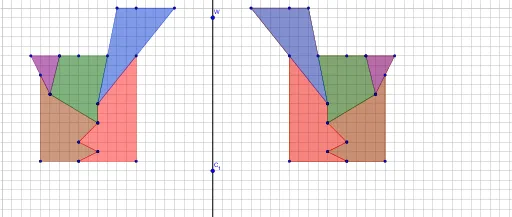
This example demonstrates the geometric transformation of a quadrilateral, particularly similarity transformation. It shows how to construct a quadrilateral with specific properties using transformation operations like mirroring. Commands used include Polygon, PointIn, Line, Mirror, etc. Suitable for middle school and above students or teachers to understand geometric transformations and similarity.
GeoGebra Commands & Parameters
Polygon(A, B, C, D, E, F, G) → poly1, a, b, c, d, e, f, gPolygon(I, J, K, L, M, N, O) → poly2, ı, j, k, l, m, n, oPolygon(Q, R, S, T, U, V) → poly3, q, r, s, t, u, vPolygon(Z, A_1, B_1) → t1, b_1, z_1, a_1Polygon(D_1, E_1, F_1, G_1) → q1, d_1, e_1, f_1, g_1PointIn(q1) → Pointq1PointIn(t1) → Pointt1PointIn(poly3) → Pointpoly3PointIn(poly2) → Pointpoly2PointIn(poly1) → Pointpoly1Line(W, C_1) → hMirror(A, h) → A'Mirror(B, h) → B'Mirror(C, h) → C'Mirror(D, h) → D'Mirror(E, h) → E'Mirror(F, h) → F'Mirror(G, h) → G'Polygon(A', B', C', D', E', F', G') → poly1', a', b', c', d', e', f', g'Mirror(I, h) → I'Mirror(J, h) → J'Mirror(K, h) → K'Mirror(L, h) → L'Mirror(M, h) → M'Mirror(N, h) → N'Mirror(O, h) → O'Polygon(I', J', K', L', M', N', O') → poly2', ı', j', k', l', m', n', o'Mirror(Q, h) → Q'Mirror(R, h) → R'Mirror(S, h) → S'Mirror(T, h) → T'Mirror(U, h) → U'Mirror(V, h) → V'Polygon(Q', R', S', T', U', V') → poly3', q', r', s', t', u', v'Mirror(Z, h) → Z'Mirror(A_1, h) → H_1Mirror(B_1, h) → I_1Polygon(Z', H_1, I_1) → t1', ı_1, z', h_1Mirror(D_1, h) → J_1Mirror(E_1, h) → K_1Mirror(F_1, h) → L_1Mirror(G_1, h) → M_1Polygon(J_1, K_1, L_1, M_1) → q1', j_1, k_1, l_1, m_1Polygon(K_1, M_1, Q', Z', F', E', M', N') → poly4, i, p, i_1, n_1, p_1, q_1, r_1, s_1
AI Drawing Prompt Reference
Draw a quadrilateral and create a similar quadrilateral through a reflection transformation to demonstrate the geometric transformation process. First, draw a quadrilateral, then use a line as a mirror to reflect the quadrilateral along this line, obtaining a new quadrilateral. Perform the same reflection operation on the second quadrilateral to observe the changes in the shape. Finally, combine all the quadrilaterals and the mirror line to clearly show the geometric relationship of the similarity transformation.
The prompt above was compiled from the original drawing commands and is for reference only.