
Geometric Investigation of Trig Identity
Loading the math board and drawing, please wait…
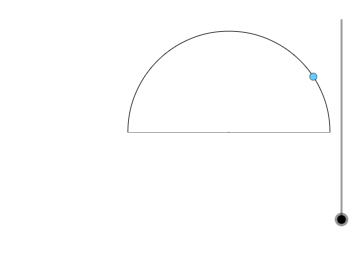
This example demonstrates trigonometric identities through dynamic geometry, revealing the intrinsic connection between cosine, sine, and geometric figures. Key concepts include trigonometric functions, geometric transformations, and vector operations. GeoGebra commands like Point, Rotate, Circle, Segment, OrthogonalLine, Intersect, Mirror, Polygon, Semicircle, Line, Dilate, Angle, CircleSector, RotateText, Vector, and Translate are used to construct the example. It is suitable for high school mathematics education, enhancing understanding of trigonometric identities and geometric intuition.
GeoGebra Commands & Parameters
Point(Ray[(0, 0), (1, 0)]) → BRotate(B, π / 4, A) → B'Circle(A, B) → cPoint(CircleArc[A, B, B']) → DRotate(D, Angle[B, A, D], A) → D'Segment(A, D') → fOrthogonalLine(D', xAxis) → gIntersect(g, xAxis) → EIntersect(h, yAxis) → FIntersect(g, h) → GMirror(D, yAxis) → D'_{1}OrthogonalLine(D'_{1}, xAxis) → iSegment(A, D'_{1}) → jIntersect(i, xAxis) → HPolygon(A, H, 4) → poly1, k, l, m, n, I, JPolygon(H, D'_{1}, 4) → poly2, p, q, r, s, K, LSemicircle(M, B) → dPolygon(A, E, G, F) → q1, a_1, e, g_1, f_1Line(D'_{1}, K) → tCircle(H, Distance[H, I]) → c_1Intersect(c_1, t, 2) → NDilate(A, If[0 < a ≤ 1, 1 - a, 0], D) → A'Dilate(A, If[0 < a ≤ 1, 1 - a, 0], D') → A'_{1}Segment(A, A'_{1}) → h_1Segment(A, A') → i_1Circle(A, 0.4) → d_1Intersect(d_1, i_1, 1) → OAngle(B, A, D) → αAngle(B, A, O) → βAngle(D, A, D') → γIntersect(d_1, xAxis, 2) → PRotate(P, If[2 < a ≤ 3, ((a - 2) * α), α], A) → P'CircleSector(A, P, P') → e_1Rotate(e_1, If[4 < a ≤ 5, ((a - 4) * α), α], A) → k_1Angle(D'_{1}, A, M) → δRotate(k_1, If[6 < a ≤ 7, ((a - 6) * (π - (2 * α))), π - (2 * α)], A) → p_1Dilate(A, If[7 < a ≤ 8, 8 - a, 0], D'_{1}) → A'_{2}Segment(A, A'_{2}) → j_1Dilate(D'_{1}, If[9 < a ≤ 10, 10 - a, 0], H) → QDilate(D', If[9 < a ≤ 10, 10 - a, 0], E) → D''Segment(D', D'') → l_1Segment(D'_{1}, Q) → m_1Dilate(A, If[9 < a ≤ 10, 10 - a, 0], E) → A'_{3}Dilate(A, If[9 < a ≤ 10, 10 - a, 0], H) → A'_{4}Segment(A, A'_{3}) → n_1Segment(A, A'_{4}) → q_1RotateText(text1, π / 2) → text2Rotate(H, If[13 < a ≤ 14, ((-(a - 13)) * π / 2), ((-π)) / 2], D'_{1}) → H'Dilate(D'_{1}, If[14 < a ≤ 15, 15 - a, 0], H) → RVector(D'_{1}, R) → uTranslate(D'_{1}, u) → STranslate(H', u) → H''Dilate(H, If[15 < a ≤ 16, 16 - a, 0], L) → H'_{1}Vector(H, H'_{1}) → vTranslate(D'_{1}, v) → TTranslate(Q, v) → Q'Rotate(A, If[17 < a ≤ 18, ((-(a - 17)) * π / 2), ((-π)) / 2], H) → A'_{5}Segment(H, A'_{5}) → b_1Dilate(H, If[18 < a ≤ 19, 19 - a, 0], I) → H'_{2}Vector(H, H'_{2}) → wTranslate(A, w) → A'_{6}Translate(A'_{4}, w) → USegment(A'_{6}, U) → f_2Dilate(I, If[19 < a ≤ 20, 20 - a, 0], J) → I'Vector(I, I') → u_1Translate(H, u_1) → H'_{3}Translate(A'_{5}, u_1) → VSegment(H'_{3}, V) → g_2Angle(F, A, D') → εRotate(D', If[20 < a ≤ 21, ((-(a - 20)) * ε), (-ε)], A) → D''_{1}Segment(A, D''_{1}) → i_2Dilate(A, If[21 < a ≤ 22, 22 - a, 0], F) → A'_{7}Vector(A, A'_{7}) → v_1Translate(A, v_1) → A'_{8}Translate(A'_{3}, v_1) → WSegment(A'_{8}, W) → j_2Dilate(F, If[22 < a ≤ 23, 23 - a, 0], G) → F'Vector(F, F') → w_1Translate(A, w_1) → A'_{9}Translate(D''_{1}, w_1) → ZSegment(A'_{9}, Z) → k_2Polygon(A, E, G, F) → q3, a_2, e_2, g_3, f_3Dilate(D'_{1}, If[26 < a ≤ 27, 27 - a, 0], N) → A_1Vector(D'_{1}, A_1) → u_2Translate(H', u_2) → H''_{1}Line(H''_{1}, L) → n_2OrthogonalLine(H, n_2) → p_2Intersect(n_2, p_2) → B_1Dilate(L, If[28 < a ≤ 29, 29 - a, 0], B_1) → L'Vector(L, L') → v_2Translate(H''_{1}, v_2) → C_1Dilate(H, If[30 < a ≤ 31, 31 - a, 0], A) → H'_{4}Vector(H, H'_{4}) → w_2Angle(B_1, H, I) → ζTranslate(N, w_2) → N'Translate(C_1, w_2) → D_1Translate(L', w_2) → L''Translate(H, w_2) → H'_{5}Polygon(N', D_1, L'', H'_{5}) → q5', n', r_2, l'', h'_{5}Rotate(N', If[30 < a ≤ 31, ((a - 30) * ζ), ζ], H'_{5}) → N''Rotate(D_1, If[30 < a ≤ 31, ((a - 30) * ζ), ζ], H'_{5}) → E_1Rotate(L'', If[30 < a ≤ 31, ((a - 30) * ζ), ζ], H'_{5}) → L'''Rotate(H'_{5}, If[30 < a ≤ 31, ((a - 30) * ζ), ζ], H'_{5}) → F_1Line(A, E) → b_2Circle(A, Distance[I, J]) → c_2Segment(A, B) → k_4Segment(A, M) → l_4Dilate(V_1, If[9 < a ≤ 10, 10 - a, 0], A) → W_1Rotate(A, If[11 < a ≤ 12, ((a - 11) * (π / 2 - (2 * α))), π / 2 - (2 * α)], A) → A'_{11}Rotate(A'_{1}, If[11 < a ≤ 12, ((a - 11) * (π / 2 - (2 * α))), π / 2 - (2 * α)], A) → A_2Segment(A'_{11}, A_2) → n_4Dilate(A, If[12 < a ≤ 13, 13 - a, 0], Z_1) → A'_{12}Vector(A, A'_{12}) → u_4Translate(A'_{11}, u_4) → B_2Translate(A_2, u_4) → C_2Segment(B_2, C_2) → m_4Rotate(B_2, If[13 < a ≤ 14, ((-(a - 13)) * π / 2), ((-π)) / 2], C_2) → D_2Rotate(C_2, If[13 < a ≤ 14, ((-(a - 13)) * π / 2), ((-π)) / 2], C_2) → E_2Segment(D_2, E_2) → p_4Dilate(C_2, If[14 < a ≤ 15, 15 - a, 0], Z_1) → F_2Vector(C_2, F_2) → v_4Translate(D_2, v_4) → G_2Translate(E_2, v_4) → H_2Segment(G_2, H_2) → q_4Dilate(C_2, If[15 < a ≤ 16, 16 - a, 0], D_2) → I_2Vector(C_2, I_2) → w_4Translate(B_2, w_4) → J_2Translate(C_2, w_4) → K_2Segment(J_2, K_2) → r_4Polygon(G_2, Z_1, C_2, D_2) → q8, s_4, z_1, t_4, a_4Rotate(U, If[23 < a ≤ 24, ((a - 23) * π), π], A'_{5}) → U'Rotate(H, If[23 < a ≤ 24, ((a - 23) * π / 2), π / 2], A'_{5}) → H'_{6}Rotate(A'_{5}, If[23 < a ≤ 24, ((a - 23) * π / 2), π / 2], A'_{5}) → M_2Segment(H'_{6}, M_2) → s_1Dilate(A'_{5}, If[24 < a ≤ 25, 25 - a, 0], H'_{6}) → L_2Vector(A'_{5}, L_2) → r_1Translate(H, r_1) → H'_{7}Translate(A'_{5}, r_1) → N_2Segment(H'_{7}, N_2) → t_1RotateText(text3, π / 2) → text5Circle(A, (2 * f_2)) → h_2Line(A'_{8}, W) → l_2Intersect(h_2, l_2, 1) → O_2Dilate(A'_{8}, If[28 < a ≤ 29, 29 - a, 0], O_2) → P_2Vector(A'_{8}, P_2) → m_2Translate(W, m_2) → W'Polygon(A, A'_{3}, W', P_2) → q2, a_5, a'_{3}, w', q_2Line(O_2, a'_{3}) → h_3OrthogonalLine(A'_{3}, h_3) → l_3Intersect(h_3, l_3) → Q_2Dilate(A, If[30 < a ≤ 31, 31 - a, 0], Q_2) → A'_{13}Vector(A, A'_{13}) → s_2Translate(O_2, s_2) → R_2Polygon(W', R_2, A'_{13}, A'_{3}) → q4, t_2, n_3, a'_{13}, c_3Line(W', A'_{3}) → d_3Dilate(W', If[32 < a ≤ 33, 33 - a, 0], N_2) → W''Vector(W', W'') → e_3Translate(W', e_3) → W''_{1}Translate(R_2, e_3) → S_2Translate(A'_{13}, e_3) → T_2Translate(A'_{3}, e_3) → U_2Polygon(W''_{1}, S_2, T_2, U_2) → q4', w''_{1}, h_4, b_4, c_4Line(W', f_2) → d_4Point(d_4) → V_2Angle(V_2, W', A'_{3}) → θRotate(W''_{1}, If[32 < a ≤ 33, ((-(a - 32)) * θ), (-θ)], W'') → W_2Rotate(S_2, If[32 < a ≤ 33, ((-(a - 32)) * θ), (-θ)], W'') → Z_2Rotate(T_2, If[32 < a ≤ 33, ((-(a - 32)) * θ), (-θ)], W'') → A_3Rotate(U_2, If[32 < a ≤ 33, ((-(a - 32)) * θ), (-θ)], W'') → B_3Polygon(W_2, Z_2, A_3, B_3) → q4'', e_4, z_2, g_5, h_5Circle(Z_1, (2 * f_2)) → d_2Line(C_2, p_4) → i_3Intersect(d_2, i_3) → G_1, M_1Line(G_2, i_3) → j_3Dilate(C_2, If[34 < a ≤ 35, 35 - a, 0], M_1) → H_1Vector(C_2, H_1) → u_3Translate(D_2, u_3) → I_1Polygon(I_1, H_1, Z_1, G_2) → q5, k_3, m_3, p_3, q_3Line(M_1, Z_1) → r_3Line(I_1, G_2) → s_3OrthogonalLine(G_2, s_3) → t_3Intersect(t_3, r_3) → J_1Dilate(Z_1, If[36 < a ≤ 37, 37 - a, 0], J_1) → K_1Vector(Z_1, K_1) → v_3Translate(M_1, v_3) → L_1Polygon(I_1, L_1, K_1, G_2) → q6, a_3, b_3, f_4, g_4Dilate(J_1, If[38 < a ≤ 39, 39 - a, 0], Z_2) → O_1Vector(J_1, O_1) → w_3Translate(I_1, w_3) → P_1Translate(L_1, w_3) → Q_1Translate(K_1, w_3) → R_1Translate(G_2, w_3) → S_1Polygon(P_1, Q_1, R_1, S_1) → q6', i_4, j_4, f_5, i_5Angle(A'_{3}, Z_1, M_1) → ηRotate(P_1, If[38 < a ≤ 39, ((-(a - 38)) * η), (-η)], O_2) → T_1Rotate(Q_1, If[38 < a ≤ 39, ((-(a - 38)) * η), (-η)], O_2) → U_1Rotate(R_1, If[38 < a ≤ 39, ((-(a - 38)) * η), (-η)], O_2) → C_3Line(Z_2, s_1) → j_5Point(j_5) → D_3Rotate(P_1, If[38 < a ≤ 39, ((-(a - 38)) * η), (-η)], R_1) → E_3Rotate(Q_1, If[38 < a ≤ 39, ((-(a - 38)) * η), (-η)], R_1) → F_3Rotate(R_1, If[38 < a ≤ 39, ((-(a - 38)) * η), (-η)], R_1) → G_3Rotate(S_1, If[38 < a ≤ 39, ((-(a - 38)) * η), (-η)], R_1) → H_3Polygon(E_3, F_3, G_3, H_3) → q6'', k_5, l_5, m_5, n_5
AI Drawing Prompt Reference
On a coordinate plane, start at the origin and mark a point on the positive x-axis. Rotate this point by 45 degrees around the origin to get a second point, and draw a circular arc centered at the origin passing through both points. Pick an arbitrary point on this arc, rotate it around the origin by the same angle as the first point, and connect the origin to this rotated point with a segment. From this rotated point, drop a perpendicular to the x-axis and mark its intersection with the axis. Mirror the arc point across the y-axis, drop another perpendicular to the x-axis from the mirrored point, and mark that intersection. Construct squares using the origin, these axis intersections, and the mirrored points. Draw a small circle centered at the origin, place a point on it, rotate it to form a sector, and add several auxiliary segments and angles to illustrate the trigonometric relationships. Finally, rotate a text label by 90 degrees.
The prompt above was compiled from the original drawing commands and is for reference only.