
Vector Decomposition with Trigonometry: Components, Magnitude and Angle
Loading the math board and drawing, please wait…
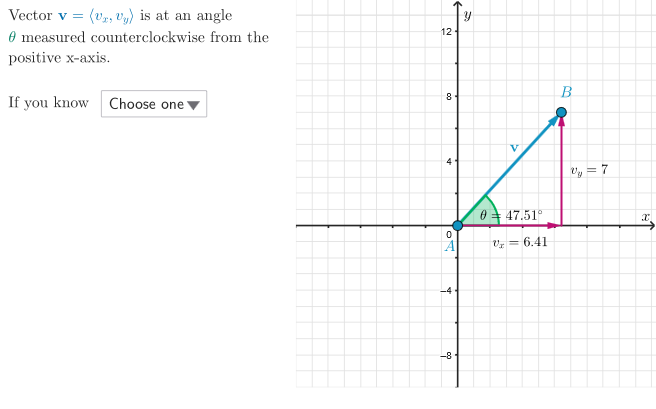
This GeoGebra example demonstrates how to take a given vector and—using trigonometry—determine its components (horizontal and vertical), its magnitude, and its direction/angle. It focuses on the geometric meaning behind trigonometric relationships: how the direction angle relates to the vector’s x- and y-components (via cosine/sine ideas), and how length corresponds to the magnitude of the vector. The construction uses GeoGebra commands and objects such as Vector (e.g., givenV, vecAX/vecBY and their origin-based versions vecAXO/vecBYO), Angle to compute and display the direction angle (theta, exactAng, rTheta), and Length to obtain the magnitude (mag, exactMag). Conditional logic with If and SelectedIndex supports switching or controlled updates of what is shown. Transformations like Translate and Midpoint help reposition vectors and define relevant points (including movedV and translated points A’, B’). Polygon and PointIn support the auxiliary geometric setup and selection checks (PP1–PP4, peep). The interface updates labels and readouts for components and angle/length (compX, compY, textVxVy, text1, lablX, lablY). Suitable for secondary-level to introductory college learning, especially for teaching vector representation with trigonometry and for interactive classroom demonstrations.
GeoGebra Commands & Parameters
Polygon({PP1, PP2, PP3, PP4}) → peepPointIn(peep) → BVector(A, B) → givenVIf(0 ≤ aniSli < 1, ((1 - aniSli) * A) + (aniSli * STAB), STAB) → AXVector(A, AX) → vecAXIf(1 ≤ aniSli ≤ 2, ((2 - aniSli) * STAB) + ((aniSli - 1) * B), STAB) → BYVector(STAB, BY) → vecBYVector(A, (0, 0)) → transVecTranslate(givenV, A') → movedVTranslate(vecAX, A') → vecAXOTranslate(vecBY, STAB + (transSli * transVec)) → vecBYOMidpoint(B, STAB) → MYAngle((x(A) + 10, y(A)), A, B) → thetaLength(givenV) → magSelectedIndex(ddMenu) → isAreEqual(round(atand(compY / compX), 4), theta) → exactAngAreEqual(mag, round(sqrt(compX^(2) + compY^(2)), 4)) → exactMag
AI Drawing Prompt Reference
Draw a diagram of vector decomposition showing a vector, its horizontal and vertical components, magnitude, and direction angle. Include a point, an angle measurement tool, and a length calculation tool. The construction order starts with the vector, then decomposes it into components, calculates magnitude and angle, and finally shows the relationships between these elements.
The prompt above was compiled from the original drawing commands and is for reference only.