
Geometric Definition of an Ellipse via Two Foci
Loading the math board and drawing, please wait…
In collections
COORDINATE GEOMETRY
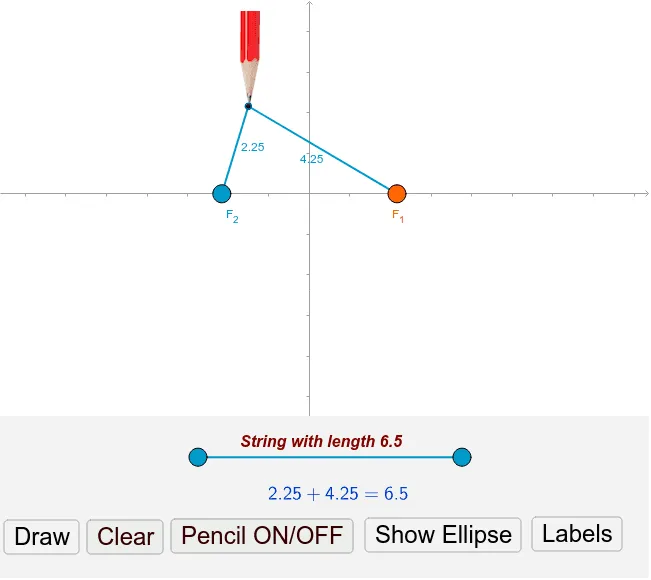
This example illustrates the geometric definition of an ellipse: the locus of points in the plane whose sum of distances to two fixed foci remains constant. It emphasizes how the ellipse emerges from distance constraints and highlights the role of focus geometry, constant-sum property, and constructive geometry to turn a definition into a visible curve. Key concepts include ellipse, foci, distance-based loci, and geometric construction methods; auxiliary objects such as vectors and midpoints support the relationships used in the construction. Construction-wise, the applet uses commands such as Intersect, Ray, Point, Mirror, Line, Segment, Circle, and Ellipse to create the needed geometric elements; Distance is used to measure distances to the foci; If is used for conditional logic tied to the constant-sum requirement; OrthogonalLine and Mirror enable perpendicular and symmetric constructions; Vector and Midpoint help form supporting segments and reference points, while Polygon and text/trace objects provide visualization. Suitable for upper secondary students to early university learners studying coordinate/analytic geometry, loci, and classical geometric constructions.
GeoGebra Commands & Parameters
Intersect(xAxis, yAxis) → ERay((0.01, 0), (1, 0)) → xxRay((0.01, 0), (0, 1)) → yyPoint(axis) → F_1Mirror(F_1, E) → F_2Line(B, xAxis) → iPoint(i) → DPoint(i) → CSegment(C, D) → aaCircle(F_2, a) → eCircle(F_1, a) → dIntersect(e, d) → P, G, ,Ellipse(F_2, F_1, P) → fPoint(f) → RDistance(E, F_1) → cSegment(F_2, R) → bSegment(R, F_1) → gIf(aa > (2 * c), true, false) → shPolygon(Corner[1], Corner[2], (x(Corner[2]), y(Corner[2]) + (0.28 * Distance[Corner[3], Corner[2]])), (x(Corner[4]), y(Corner[1]) + (0.28 * Distance[Corner[3], Corner[2]]))) → Bottom, j, k, l, mLine(F_1, F_2) → nOrthogonalLine(E, n) → pIntersect(f, n) → A, KIntersect(f, p) → L, MPoint(K, Vector[((UnitVector[p] * 1.2) * a)]) → K1Mirror(K1, p) → K1'Vector(K1, K) → uVector(K1', A) → vSegment(K1, K1') → qMidpoint(q) → NPoint(M, Vector[(-(((UnitVector[n] * 1.28) * a)))]) → M1Mirror(M1, n) → M1'Segment(M1, M1') → rVector(M1', L) → wVector(M1, M) → sMidpoint(r) → QIf(y(M) > 0, M, L) → POIf(y(M) < 0, M, L) → NE
AI Drawing Prompt Reference
Draw an ellipse with two foci. The sum of distances from any point on the ellipse to the two foci is constant. Construct by first drawing the foci, then a line connecting them, and a perpendicular line as an auxiliary. Find intersection points to determine the ellipse's endpoints. Use the foci and endpoints to define the ellipse shape. Add auxiliary lines like perpendicular and symmetric lines to help locate the vertices.
The prompt above was compiled from the original drawing commands and is for reference only.