
Geometric Addition of 2D Vectors via Construction
Loading the math board and drawing, please wait…
In collections
Vectors in 2D
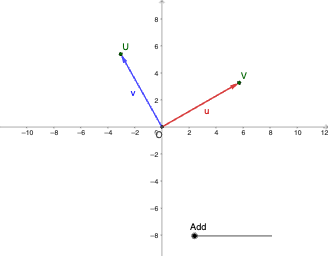
This example demonstrates how to geometrically add two 2D vectors by constructing the resultant (sum) as a new vector based on their directions and magnitudes. It focuses on the key ideas of vector addition—especially the geometric interpretation behind combining vectors (e.g., parallelogram/translation viewpoint)—and how to locate the correct endpoints using intersection points. The construction uses GeoGebra commands such as Intersect, Vector, Circle, and Line to determine intermediate points and to build the final vectors. Objects referenced (e.g., O, V, U, and auxiliary points like u, v, w, D, a–j, E, F, etc.) are used to represent endpoints, constructed points, and intermediate steps, culminating in the resultant vector configuration. Suitable for middle school to early high school students learning vectors and geometric construction, and for interactive classroom demonstrations or self-study to build intuition for the vector addition rule.
GeoGebra Commands & Parameters
Intersect(xAxis, yAxis) → OVector(O, V) → uVector(O, U) → vCircle(O, b) → cLine(V, O) → gIntersect(c, g, 1) → EVector(O, E) → dLine(E, v) → fCircle(E, Segment[O, U]) → eIntersect(e, f, 2) → FVector(E, F) → h
AI Drawing Prompt Reference
Draw a geometric construction for adding two 2D vectors on the same coordinate plane. Use the origin O as the common tail. Mark endpoints V and U to define vector u from O to V and vector v from O to U. Construct a circle centered at O with radius equal to the length from O to U, then draw the line through V and O and find its intersection with the circle at E. Form the intermediate vector d from O to E. Through E, draw a line in the direction of v, then draw a circle centered at E with radius equal to the segment length from O to U. Find the second intersection of this circle with the line at F, and finally draw vector h from E to F as the resulting sum, keeping the auxiliary circles and lines that locate E and F.
The prompt above was compiled from the original drawing commands and is for reference only.