
3.4.7 Museo de Onda: Azulejo 7
Loading the math board and drawing, please wait…
In collections
geometriadinamica.es
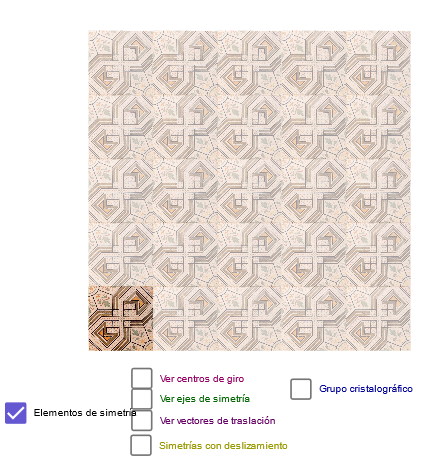
This example demonstrates the geometric construction of complex tile patterns, highlighting symmetry and transformation. It involves core mathematical concepts like differential equations, conic sections, algebra, MCM and MCD, and the unit circle. Key GeoGebra commands used include Line, Point, OrthogonalLine, Intersect, Midpoint, Mirror, Min, Rotate, Vector, and Translate. Suitable for high school mathematics education, aiding students in understanding geometric transformations and symmetry in artistic design.
GeoGebra Commands & Parameters
Line(A, B) → bLine(G, b) → ePoint(e) → JOrthogonalLine(J, e) → hOrthogonalLine(G, e) → fPoint(f) → HOrthogonalLine(H, f) → gIntersect(g, h) → EMidpoint(E, H) → IMidpoint(I, E) → B_1Midpoint(G, J) → DMidpoint(J, E) → FMidpoint(H, G) → KMidpoint(D, I) → LMidpoint(K, L) → MMidpoint(L, F) → NMidpoint(F, J) → OMidpoint(J, D) → PMidpoint(G, D) → QMidpoint(K, G) → RMidpoint(Q, M) → SMidpoint(L, D) → TMidpoint(P, N) → UMidpoint(F, E) → VMidpoint(K, H) → WMidpoint(W, V) → ZMidpoint(H, I) → A_1Midpoint(N, B_1) → C_1Midpoint(Z, W) → D_1Midpoint(D, U) → E_1Midpoint(U, J) → F_1Midpoint(T, Q) → G_1Midpoint(S, G) → H_1Midpoint(S, K) → I_1Midpoint(M, T) → J_1Midpoint(T, N) → K_1Midpoint(N, O) → L_1Midpoint(F, C_1) → M_1Midpoint(C_1, L) → N_1Midpoint(L, D_1) → O_1Midpoint(D_1, K) → P_1Midpoint(H, D_1) → Q_1Midpoint(D_1, I) → R_1Midpoint(I, C_1) → S_1Midpoint(C_1, E) → T_1Mirror(F_1, h) → U_1Mirror(L_1, h) → V_1Mirror(M_1, h) → W_1Mirror(T_1, h) → Z_1Mirror(B_1, h) → A_2Mirror(L_1, h) → C_2Line(Q, A_2) → dLine(F, d) → iLine(C_1, d) → kLine(S_1, k) → lLine(R_1, L_1) → jLine(D_1, j) → mLine(M, j) → nLine(I, j) → pLine(S, A_1) → tLine(E_1, N_1) → c_1Line(F_1, M_1) → d_1Line(G_1, R_1) → e_1Line(W_1, P_1) → g_1Line(Q_1, Z_1) → h_1Mirror(T, m) → T'Mirror(K_1, m) → I_2Mirror(T, m) → T'_1Mirror(L, m) → L'Mirror(T, m) → T'_2Mirror(U, m) → U'_1Mirror(T, m) → T'_3Point(b) → A1Min(90, ((a - 1) * 90)) → r1Rotate(T, ((-r1))°, T) → T'_7Rotate(U'_1, ((-r1))°, T) → D_{12}Rotate(T'_3, ((-r1))°, T) → E_{12}Rotate(U, ((-r1))°, T) → U'_3Rotate(T, ((-r1))°, T) → T'_8Rotate(T, ((-r1))°, T'_8) → T'_9Rotate(T'_2, ((-r1))°, T) → I_{12}Rotate(T'_1, ((-r1))°, T) → T_{12}Rotate(L', ((-r1))°, T) → L''_2Rotate(L, ((-r1))°, T) → L'_2Midpoint(C_1, E) → K_{20}Rotate(U'_1, 270°, L') → D_{21}Rotate(D_{21}, 270°, L') → G_{21}Rotate(G_{21}, 270°, L') → M_{21}Line(U'_1, D_{21}) → n_1Mirror(U'_1, n_1) → V_{21}Mirror(M_{21}, n_1) → D_{22}Mirror(D_{21}, n_1) → M_{24}Mirror(G_{21}, n_1) → P_{24}Min(180, ((a - 1) * 180)) → r2Min(270, ((a - 1) * 270)) → r3Rotate(T, r1°, T) → T'_4Rotate(T, r2°, T) → T'_5Rotate(T, r3°, T) → T'_6Rotate(L, r1°, T) → L'_1Rotate(K_1, r1°, T) → Q_3Rotate(L, r2°, T) → L'_3Rotate(K_1, r2°, T) → Z_3Rotate(L, r3°, T) → L'_4Rotate(K_1, r3°, T) → H_4Min(180, ((a - 5.5) * 180)) → r4Intersect(t, i) → H_{15}Midpoint(H_{15}, D) → J_{15}Vector(S, D) → uVector(S, L) → wVector(U, P) → zVector(U, O) → u_1Translate(pic1, u_1) → pic1'Translate(pic1', z) → pic1''Translate(pic1, z) → pic1'_1Translate(pic1'_1, z) → pic2Translate(pic2, z) → pic2'Translate(pic2', z) → pic2''Translate(pic2'', u_1) → pic2'''Translate(pic2''', u_1) → pic3Translate(pic2', u_1) → pic2''_1Translate(pic2''_1, u_1) → pic4Translate(pic2, u_1) → pic2'_1Translate(pic3, u_1) → pic3'Translate(pic3', u_1) → pic3''Translate(pic4, u_1) → pic4'Translate(pic4', u_1) → pic4''Translate(pic2'_1, u_1) → pic5Translate(pic5, u_1) → pic5'Translate(pic5', u_1) → pic5''Translate(pic1'', u_1) → pic1'''Translate(pic1''', u_1) → pic6Translate(pic6, u_1) → pic6'Translate(pic1', u_1) → pic1''_1Translate(pic1''_1, u_1) → pic7Translate(pic7, u_1) → pic7'Midpoint(Q, S) → CMidpoint(S, M) → B_2Midpoint(M, D_1) → D_2Midpoint(D, T) → E_2Midpoint(T, L) → F_2Midpoint(L, Z) → G_2Midpoint(G_1, J_1) → H_2Midpoint(J_1, O_1) → J_2Midpoint(O_1, R_1) → K_2Midpoint(E_1, F_1) → L_2Midpoint(U, N) → M_2Midpoint(N, C_1) → N_2Midpoint(T_1, M_1) → O_2Midpoint(M_1, L_1) → P_2Midpoint(L_1, F_1) → Q_2Midpoint(J, O) → R_2Midpoint(O, F) → S_2Midpoint(F, V) → T_2Line(E_2, i) → qLine(C, d) → rLine(B_2, k) → sLine(S_2, p) → a_1Line(Q_2, j) → b_1Line(L_2, m) → f_1Line(E_2, n) → i_1Line(T_2, p) → j_1Line(L_2, i) → k_1Line(D_2, l) → l_1Intersect(r, b_1) → U_2Intersect(q, f_1) → V_2Intersect(s, a_1) → W_2
AI Drawing Prompt Reference
Draw a complex tile pattern with multiple symmetric points and lines. Start by drawing two lines b and e, then take point J on e and draw two perpendicular lines h and f through J. Continue by finding midpoints of E and H, and so on, to construct multiple points. Finally, use mirroring operations to generate symmetric points and form a complex geometric pattern.
The prompt above was compiled from the original drawing commands and is for reference only.