
Geometric Construction of a Regular Pentagon
Loading the math board and drawing, please wait…
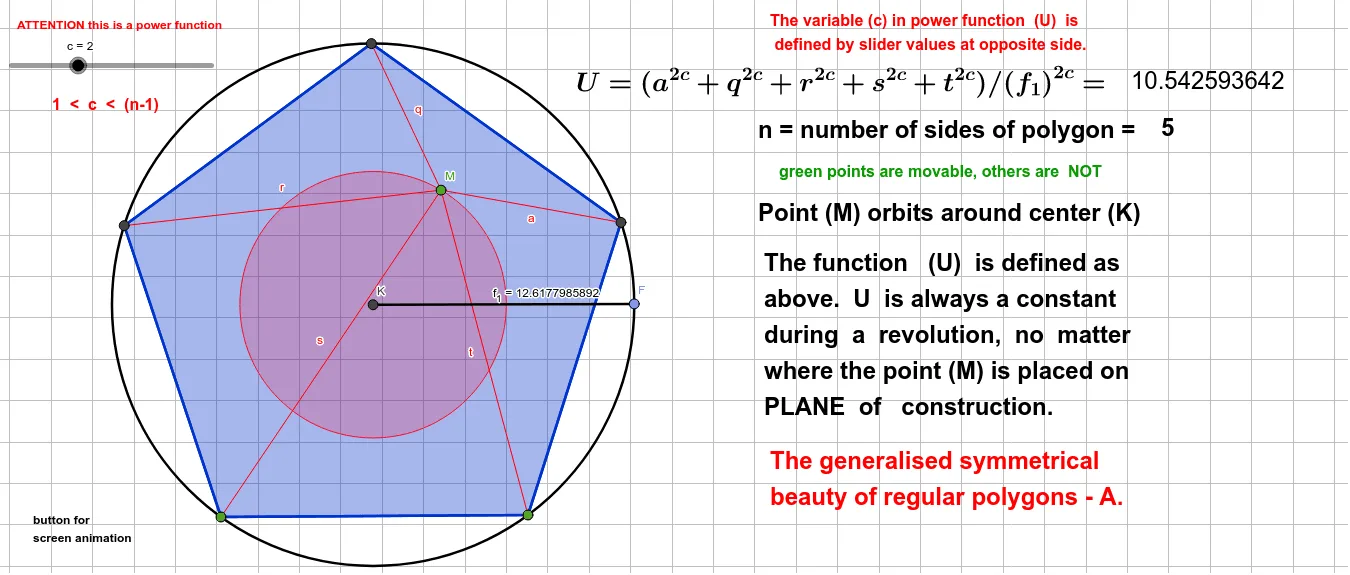
This example demonstrates the geometric construction of a regular pentagon. Key mathematical concepts include geometric transformations, symmetry, and properties of circles. Using GeoGebra commands such as Polygon, LineBisector, and Intersect, the construction process is clearly illustrated. Suitable for middle school and above students and teachers to understand and learn about geometric transformations and symmetry.
GeoGebra Commands & Parameters
Polygon(A, B, 5) → poly1, f, g, h, i, j, C, D, ELineBisector(E, D) → kLineBisector(E, A) → lLineBisector(D, C) → mLineBisector(C, B) → nLineBisector(A, B) → pIntersect(k, m) → KCircle(K, D) → dCircle(K, L) → ePoint(e) → MSegment(M, D) → qSegment(M, E) → rSegment(M, A) → sSegment(M, B) → tSegment(M, C) → aPoint(d) → FSegment(K, F) → f_1
AI Drawing Prompt Reference
Draw a regular pentagon by first constructing a pentagon with points A, B, C, D, and E. Then, find the intersection point K of the perpendicular bisectors of segments ED, EA, DC, CB, and AB. Use K as the center to draw circles with radii equal to the distance between K and D, and K and L, and find their intersection point M. Connect points M, D, E, A, and B to form the sides of the regular pentagon.
The prompt above was compiled from the original drawing commands and is for reference only.