
Geometric Construction for Subtracting Vectors (2)
Loading the math board and drawing, please wait…
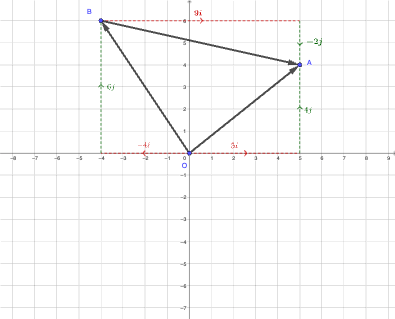
This example visually demonstrates how vector subtraction can be represented geometrically as adding the opposite vector, letting learners track the resulting direction and position in the plane. The key math ideas include vector representation and operations (subtraction via inverse vectors), constructing orthogonal lines, determining intersection points, and using line segments and midpoints to organize the geometry. Construction-wise, GeoGebra generates vectors (Vector) tied to key points, builds auxiliary perpendicular lines (OrthogonalLine), finds required points using intersections (Intersect), and uses segments and their midpoints (Segment, Midpoint) to obtain intermediate geometric locations that support the vector-sum/subtraction interpretation. The figure is centered on points such as B, A, O and vectors such as u and v, with additional labeled intersections and derived points to clearly show how the subtraction result emerges from the constructed configuration. Suitable for middle/high school and early university instruction, especially for teaching the geometric meaning of vector operations and supporting intuitive understanding through dynamic diagrams.
GeoGebra Commands & Parameters
Vector(O, A) → uVector(O, B) → vOrthogonalLine(B, xAxis) → fIntersect(f, xAxis) → ESegment(O, E) → gSegment(E, B) → hMidpoint(O, E) → FMidpoint(B, E) → GOrthogonalLine(A, xAxis) → iIntersect(i, xAxis) → HSegment(O, H) → jSegment(H, A) → kMidpoint(H, O) → IMidpoint(A, H) → JVector(B, A) → wMidpoint(O, A) → KMidpoint(B, O) → LOrthogonalLine(B, yAxis) → lOrthogonalLine(A, xAxis) → mIntersect(l, m) → B_{1}Segment(B, B_{1}) → nSegment(B_{1}, A) → pMidpoint(B, B_{1}) → MMidpoint(B_{1}, A) → N
AI Drawing Prompt Reference
Draw a geometric diagram to demonstrate the geometric meaning of vector subtraction by adding the opposite vector. Start by plotting two vectors, then construct perpendicular lines to the x-axis, find their intersections, and connect key points to form auxiliary line segments. Next, locate the midpoints of the segments, build perpendicular lines to the y-axis and x-axis, and find their intersection points. Finally, connect these points, labeling midpoints and intersections clearly to show the result of vector subtraction.
The prompt above was compiled from the original drawing commands and is for reference only.