
G_6.03 Special Parallelograms
Loading the math board and drawing, please wait…
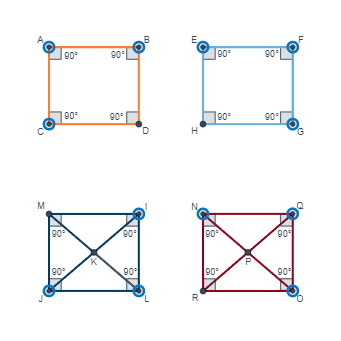
This example demonstrates the construction and properties of special parallelograms. Key mathematical concepts include parallelograms, vectors, geometric construction, and coordinate geometry. Construction involves GeoGebra commands such as Segment, OrthogonalLine, Point, Intersect, Polygon, Line, Midpoint, Circle, and Angle. Suitable for middle or high school mathematics learning to understand geometric properties and vector applications.
GeoGebra Commands & Parameters
Segment(A, B) → fOrthogonalLine(A, f) → gOrthogonalLine(B, f) → hPoint(g) → COrthogonalLine(C, g) → iIntersect(h, i) → DPolygon(D, B, A, C) → q1, d, b, a, cSegment(E, F) → jSegment(F, G) → kLine(G, j) → lLine(E, k) → mIntersect(l, m) → HPolygon(E, F, G, H) → q2, e, f_1, g_1, h_1Segment(I, J) → nMidpoint(J, I) → KCircle(K, L) → pSegment(K, L) → qLine(L, K) → rIntersect(p, r, 2) → MPolygon(M, I, L, J) → q3, m_1, i_1, l_1, j_1Segment(M, L) → sSegment(N, O) → tMidpoint(N, O) → PCircle(P, N) → c_1Point(c_1) → QLine(P, Q) → k_1Intersect(c_1, k_1, 2) → RPolygon(N, Q, O, R) → q4, n_1, q_1, o, r_1Segment(R, Q) → p_1Angle(A, B, D) → parA1Angle(B, D, C) → parA2Angle(D, C, A) → parA3Angle(C, A, B) → parA4Angle(H, E, F) → parB1Angle(E, F, G) → parB2Angle(F, G, H) → parB3Angle(G, H, E) → parB4Angle(J, M, I) → parC1Angle(M, I, L) → parC2Angle(I, L, J) → parC3Angle(L, J, M) → parC4Angle(R, N, Q) → parD1Angle(N, Q, O) → parD2Angle(Q, O, R) → parD3Angle(O, R, N) → parD4
AI Drawing Prompt Reference
Draw a figure consisting of two parallelograms. The first parallelogram is formed by points A, B, C, and D, where A and B are the starting points, and C and D are points perpendicular to AB. The second parallelogram is formed by points E, F, G, and H, with E and F as starting points and G and H perpendicular to EF. The two parallelograms are connected through points D and H. Ensure the figure is clear and lines are distinct, showing the construction and relationships of the parallelograms.
The prompt above was compiled from the original drawing commands and is for reference only.