
Fraction Addition Demonstration by Daniel Mentrard
Loading the math board and drawing, please wait…
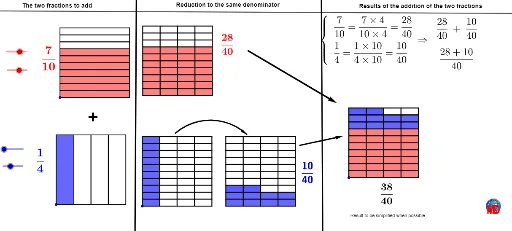
This example visually demonstrates the addition of fractions through geometric transformations, illustrating the process of fraction addition. It involves core mathematical concepts such as fraction operations, geometric transformations, vector and polygon constructions. Key GeoGebra commands and objects used include Mod, Segment, Translate, Rotate, Sequence, Polygon, and Vector to achieve precise geometric constructions and dynamic demonstrations. Suitable for middle school and above mathematics education, aiding in understanding the connection between fraction addition and geometric transformations, and enhancing spatial reasoning skills.
GeoGebra Commands & Parameters
Mod((q * m), p) → qqSegment(A, B) → aSegment(A, D) → bSegment(D, C) → cSegment(C, B) → dTranslate(E, Vector[A, B]) → FRotate(F, 90°, E) → HRotate(E, 90°, H) → GSegment(E, F) → eSegment(F, G) → fSegment(G, H) → gSegment(H, E) → hSequence(Segment[A + ((i * w / p), 0), A + ((i * w / p), w)], i, 1, p - 1) → list1Sequence(Segment[E + ((i * w / p), 0), E + ((i * w / p), w)], i, 1, p - 1) → list2Sequence(Segment[A + (0, (i * w / m)), A + (w, (i * w / m))], i, 1, m - 1) → list3Sequence(Segment[E + (0, (i * w / m)), E + (w, (i * w / m))], i, 1, m - 1) → list4Polygon(E, E + (w, 0), E + (w, (n / m * w)), E + (0, (n / m * w))) → poly1, e_1, i, j, kPolygon(A, A + ((q / p * w), 0), A + ((q / p * w), w), A + (0, w)) → poly2, a_1, l, r, s_1Polygon(I, I + (w, 0), I + (w, (n / m * w)), I + (0, (n / m * w))) → poly3, i_1, s, t, b_1Sequence(Segment[I + (0, (i * w / m)), I + (w, (i * w / m))], i, 1, m - 1) → liste1Sequence(Segment[M + ((i * w / p), 0), M + ((i * w / p), w)], i, 1, p - 1) → liste2Polygon(I, J, K, L) → poly4, i_2, j_1, k_1, l_1Polygon(M, M + ((q / p * w), 0), M + ((q / p * w), w), M + (0, w)) → poly5, m_1, c_1, d_1, f_1Polygon(M, N, O, P) → poly6, m_2, n_1, o_1, p_1Vector(E, Q) → uTranslate(G, u) → G'Translate(H, u) → H'Segment(G', H') → g'Translate(list2, u) → list2'Translate(F, u) → F'Translate(G, u) → G'_1Segment(F', G'_1) → f'Translate(H, u) → H'_1Translate(E, u) → E'Segment(H'_1, E') → h'Translate(E, u) → E'_1Translate(F, u) → F'_1Segment(E'_1, F'_1) → e'Translate(poly1, u) → poly1'Translate(list4, u) → list4'Vector(A, T) → vTranslate(C, v) → C'Translate(B, v) → B'Segment(C', B') → d'Translate(list3, v) → list3'Translate(A, v) → A'Translate(B, v) → B'_1Segment(A', B'_1) → a'Translate(list1, v) → list1'Translate(D, v) → D'Translate(C, v) → C'_1Segment(D', C'_1) → c'Translate(A, v) → A'_1Translate(D, v) → D'_1Segment(A'_1, D'_1) → b'Polygon(V, W, B', T) → poly8, v_1, w_1, b'_1, t_1Polygon(Z, B_1, A_1, V) → poly9, z, b_2, a_2, v_2Vector(T, R) → u_1Translate(V, u_1) → V'Translate(W, u_1) → W'Translate(B', u_1) → B''Translate(T, u_1) → T'Polygon(V', W', B'', T') → poly8', v', w', b'', t'Translate(Z, u_1) → Z'Translate(B_1, u_1) → STranslate(A_1, u_1) → C_1Translate(V, u_1) → V'_1Polygon(Z', S, C_1, V'_1) → poly9', z', s_2, c_2, v'_1CircumcircleArc(D_1, E_1, F_1) → g_1Point(g_1) → G_1Vector(G_1, F_1) → z_1Line(H_1, I_1) → h_1Line(J_1, K_1) → q_1Segment(W', B'') → r_1Segment(V', W') → d_2Segment(W', B'') → f_2Segment(V'_1, T') → g_2Segment(V'_1, Z') → h_2Segment(S, C_1) → j_2Vector(L_1, M_1) → u_2Vector(N_1, O_1) → w_2Sequence(Segment[V'_1 + ((i * w / p), 0), Z' + ((i * w / p), 0)], i, 1, p) → liste42Sequence(Segment[T' + ((i * w / p), 0), V' + ((i * w / p), 0)], i, 1, p) → liste41Translate(P_1, u_1) → Q_1Segment(Z', Q_1) → e_2Segment(W', G') → k_2Sequence(Segment[T' + (0, (i * w / m)), T' + (w, (i * w / m))], i, 1, pp) → liste40Line(R_1, S_1) → l_2