
Four Mutually Tangent Spheres and the Radius of the Fifth Tangent Sphere
Loading the math board and drawing, please wait…
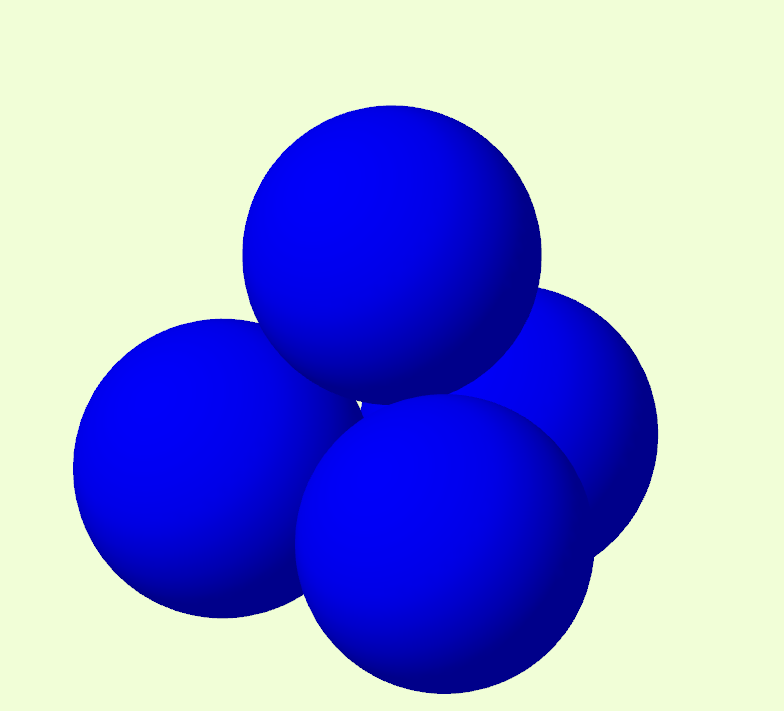
This GeoGebra example demonstrates a classic solid geometry problem: four spheres of equal radius R are mutually tangent to each other, forming a symmetric tetrahedral arrangement, and the task is to find the radius of a fifth sphere that is tangent to all four. The core mathematical concepts involve sphere tangency, spatial distance calculations, and exploiting symmetry to simplify the problem. The construction uses GeoGebra commands such as Sphere to create the spheres, Intersect and Distance to determine centers and tangency conditions, and Rotate, Dilate, and other transformations to build the symmetric configuration. The solution can be derived through geometric reasoning or algebraic equations. This example is suitable for high school or university-level solid geometry instruction, as well as for mathematical modeling or competition training, helping students understand tangency and distance relationships in 3D space.
GeoGebra Commands & Parameters
Intersect(Circle[O3, 5.1961524227], LineBisector[O3, O4], 2) → A4Intersect(OrthogonalLine[A4, Line[O3, O4]], OrthogonalLine[O3, Line[A4, O4]]) → OOAngle(O3, OO, O4) → αRotate(O_4, (-α), Line[O, yAxis]) → O_3Rotate(O_3, 120*°, O - (0, 0, ((0.25 * M) * h))) → O_1Rotate(O_3, -120*°, O - (0, 0, ((0.25 * M) * h))) → O_2Length(Segment[O_1, O_2]) → dSphere(O_1, (0.5 * d)) → φ_1Sphere(O_2, (0.5 * d)) → φ_2Sphere(O_3, (0.5 * d)) → φ_3Sphere(O_4, (0.5 * d)) → φ_4Pyramid(O_1, O_2, O_3, O_4) → a, грань4, ребро1, грань3, грань2, грань1, ребро6, ребро5, ребро4, ребро2, ребро3Intersect(Line[O_4, O_1], φ_1, 1) → A_1Intersect(Line[O_4, O_2], φ_2, 1) → A_2Intersect(Line[O_4, O_3], φ_3, 1) → A_3Intersect(Line[O, O_1], φ_1, 2) → B_1Intersect(Line[O, O_2], φ_2, 2) → B_2Intersect(Line[O, O_3], φ_3, 2) → B_3Intersect(Line[O, O_4], φ_4, 2) → B_4Sphere(O, (d * ((0.25 * k6) + 0.5))) → ΩSphere(O, (d * ((0.25 * k6) - 0.5))) → ωIntersect(Line[O_1, O_2], φ_1, 2) → A_4Intersect(Line[O_2, O_3], φ_2, 2) → A_5Intersect(Line[O_3, O_1], φ_3, 2) → A_6Distance(O, O_1) → OO1Distance(O_2, O_1) → O2O1Dilate(O, 0.8164965809277261, O_1) → O'Dilate(O, f, O_2) → O'_1Dilate(O, f, O_3) → O'_2Dilate(O, f, O_4) → O'_3Segment(O, O_1) → gSegment(O_1, B_1) → iLine(C, xAxis) → lPoint(l) → DSphere(O_1, (0.5 * d)) → p1Sphere(O_2, (0.5 * d)) → p2Sphere(O_3, (0.5 * d)) → p3Sphere(O_4, (0.5 * d)) → p4RotateText("\copyright T.C.\;\&\;uStas", 90*°) → надпись1
AI Drawing Prompt Reference
Draw four equal-radius spheres that are mutually tangent, forming a symmetric tetrahedral arrangement. Then find and depict the fifth sphere that is tangent to all four. Show the symmetric geometric structure, labeling the radii of all spheres and their tangency relationships to understand spatial distance and tangency in 3D space.
The prompt above was compiled from the original drawing commands and is for reference only.