
Platonic Solids and Spheres by uStas
Loading the math board and drawing, please wait…
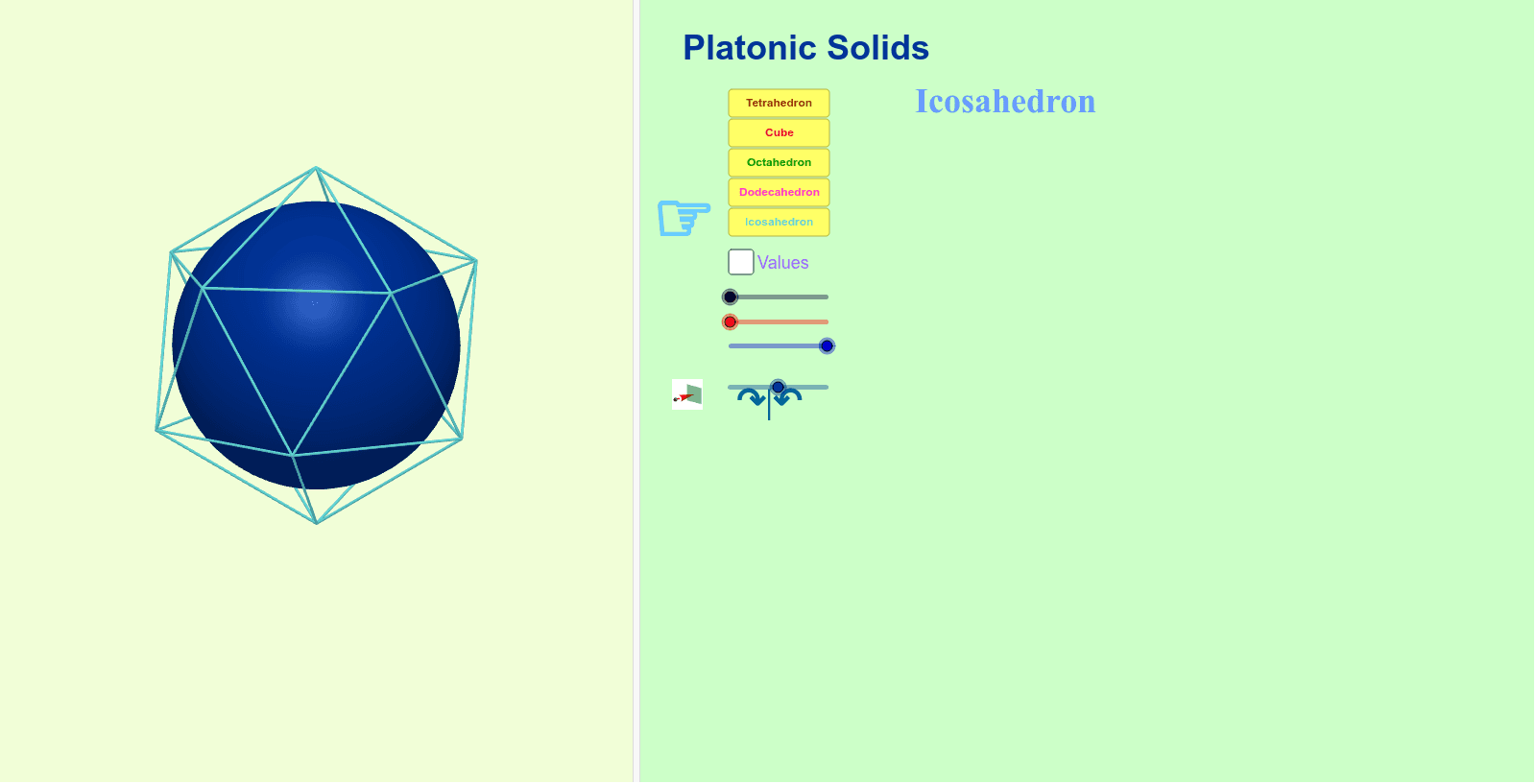
This example demonstrates the geometric relationships and properties of five Platonic solids (Tetrahedron, Cube, Octahedron, Dodecahedron, Icosahedron) and spheres. Key math concepts include solid geometry, polygon construction, vectors, rotation, intersection calculations, and orthogonal planes. GeoGebra commands used are Polygon, Tetrahedron, Midpoint, Point, Cube, Intersect, OrthogonalPlane, PointIn, Segment, Vector, Dodecahedron, Sphere, OrthogonalLine, Icosahedron, Octahedron, AngularBisector. Suitable for high school and above students learning 3D space geometry and properties of polyhedra.
GeoGebra Commands & Parameters
Polygon(C, B, A) → многоугольник1, a_1, c, bTetrahedron(A, B, Vector[(-UnitVector[многоугольник1])]) → d_1, D, реброAE, реброDE, реброBE, E, граньABD, граньADE, граньABE, граньBDE, реброAD, реброAB, реброBDMidpoint(A, C) → FPoint(Circle[J, Distance[I, J], Segment[I, J]]) → KCube(I, J, K) → f, L, граньKLPO, граньMNOP, реброIL, реброIJ, реброJK, реброKL, реброIM, реброLP, реброMP, реброMN, M, реброJN, реброNO, реброKO, реброOP, N, O, P, граньIJKL, граньILPM, граньIJNM, граньJKONIntersect(zAxis, граньMNOP) → QMidpoint(Q, R) → SdOrthogonalPlane(Td, zAxis) → i_1PointIn(i_1) → UPointIn(i_1) → VSegment(U, V) → jOrthogonalPlane(V, j) → k_1PointIn(k_1) → WVector(V, W) → vDodecahedron(U, V, v) → l, Z, I_1, J_1, K_1, L_1, M_1, N_1, O_1, P_1, Q_1, грань1, A_1, грань3, грань2, грань4, грань5, грань6, грань10, грань11, грань7, грань8, грань9, B_1, грань12, ребро1, реброUV, реброVZ, ребро4, ребро6, ребро2, ребро8, ребро16, ребро18, C_1, ребро17, ребро9, ребро3, ребро10, ребро11, ребро5, ребро12, ребро13, ребро7, ребро14, D_1, ребро15, ребро22, ребро28, ребро23, ребро25, ребро19, ребро24, ребро20, ребро26, ребро21, E_1, ребро27, F_1, G_1, H_1Midpoint(P_1, V) → OdSphere(Od, P_1) → adOrthogonalLine(Od, грань3) → gIntersect(g, грань3) → S_1Sphere(Od, S_1) → mdOrthogonalPlane(Ti, zAxis) → ePointIn(e) → GPointIn(e) → HSegment(G, H) → hOrthogonalPlane(H, h) → nPointIn(n) → SVector(H, S) → wIcosahedron(G, H, w) → o_1, T, C_2, граньGHT, грань14, грань16, грань15, грань13, грань18, грань19, грань17, грань20, R_1, грань21, грань24, грань25, грань30, грань27, грань29, грань31, грань28, грань26, грань23, T_1, грань22, реброGT, реброGH, реброHT, ребро30, ребро36, ребро31, ребро44, ребро29, ребро38, U_1, ребро32, ребро34, ребро39, ребро33, ребро41, ребро35, ребро37, ребро42, ребро45, ребро43, V_1, ребро50, ребро51, ребро52, ребро55, ребро46, ребро53, ребро49, ребро54, ребро48, ребро47, W_1, ребро40, Z_1, A_2, B_2Midpoint(A_2, T) → OiSphere(Oi, A_2) → pikOrthogonalLine(Oi, грань16) → qIntersect(q, грань16) → D_2Sphere(Oi, D_2) → riOrthogonalPlane(To, zAxis) → aPointIn(a) → E_2PointIn(a) → F_2Segment(E_2, F_2) → mOrthogonalPlane(F_2, m) → pPointIn(p) → G_2Vector(F_2, G_2) → rOctahedron(E_2, F_2, r) → s, H_2, грань36, грань38, грань39, ребро57, ребро56, ребро60, ребро59, ребро64, ребро58, ребро66, I_2, ребро61, ребро62, ребро65, ребро63, ребро67, J_2, K_2, грань32, грань34, грань35, грань33, грань37Midpoint(реброAB) → L_2AngularBisector(E, L_2, D) → b_1Intersect(b_1, zAxis) → M_2Sphere(M_2, D) → ctSphere(M_2, R) → etOrthogonalLine(To, грань35) → c_1Intersect(c_1, грань35) → N_2Sphere(To, N_2) → eoSphere(To, F_2) → e_1Sphere(Sd, R) → fk_1Sphere(Sd, L) → fkPointIn(ct) → O_2Segment(O_2, Td) → g_1
AI Drawing Prompt Reference
Draw five Platonic solids: the tetrahedron, cube, octahedron, dodecahedron, and icosahedron. Also draw some spheres to show their spatial relationships. The construction order includes: first drawing a polygon, then constructing the tetrahedron; next constructing the cube; then using rotation and intersection calculations to obtain the octahedron, dodecahedron, and icosahedron; finally drawing spheres to show the positions and relationships of these solids in three-dimensional space.
The prompt above was compiled from the original drawing commands and is for reference only.