
Formation of a Standing Wave
Loading the math board and drawing, please wait…
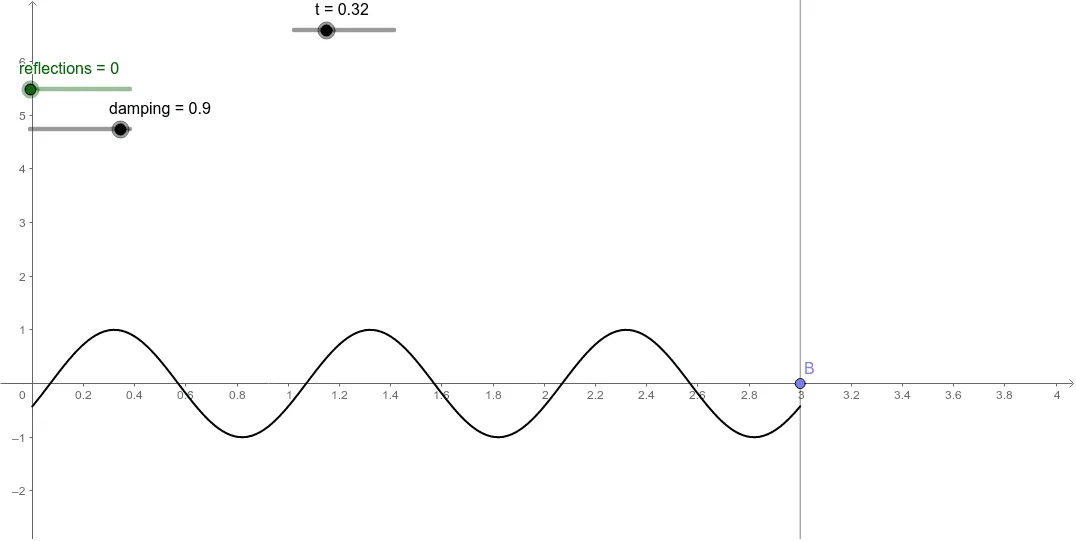
This example demonstrates how reflections combine to create a standing wave, involving wave superposition, reflection properties, sine functions, and phase differences. It uses GeoGebra commands like Point, OrthogonalLine, Sequence, and Sum to visualize the phenomenon, making it suitable for high school physics and mathematics education.
GeoGebra Commands & Parameters
Point(xAxis) → BOrthogonalLine(B, xAxis) → aSequence(If[0 ≤ x ≤ x(B), ((damping^(n) * A) * cos(((2 * π) * ((((2 * floor((n + 1) / 2)) * x(B)) + ((-1)^(n) * x)) / λ - t / T + n / 2))))], n, 0, reflections) → list1Sum(list1) → h