
First Polygonal Numbers
Loading the math board and drawing, please wait…
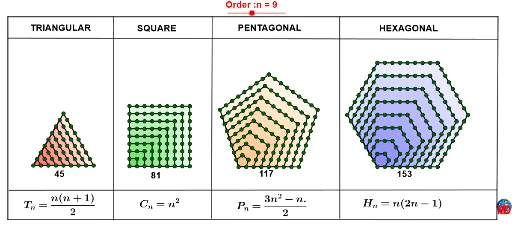
This example demonstrates the concept of first polygonal numbers. By constructing polygons, students can visually understand the generation process of polygonal numbers. Commands such as Sequence, Join, Polygon, Point, and Segment are used, suitable for middle school and above students to learn the properties and generation methods of polygonal numbers.
GeoGebra Commands & Parameters
Sequence(Vector[A, A + (cos((i * (360°) / 3)), sin((i * (360°) / 3)))], i, 0, 3 - 1) → list1bSequence(Vector[B, B + (cos((i * (360°) / 4)), sin((i * (360°) / 4)))], i, 0, 4 - 1) → list2bSequence(Vector[C, C + (cos((i * (360°) / 5)), sin((i * (360°) / 5)))], i, 0, 5 - 1) → list3bSequence(Vector[D, D + (cos((i * (360°) / 6)), sin((i * (360°) / 6)))], i, 0, 6 - 1) → list4bSequence(Vector[Sum[Take[list1b, 1, i]]], i, 1, 3) → list1cSequence(Vector[Sum[Take[list2b, 1, i]]], i, 1, 4) → list2cSequence(Vector[Sum[Take[list3b, 1, i]]], i, 1, 5) → list3cSequence(Vector[Sum[Take[list4b, 1, i]]], i, 1, 6) → list4cJoin({{A + (0, 0)}, Sequence[Sequence[Sequence[A + (0, 0) + (i * Element[list1c, t]) + (j * Element[list1b, t + 1]), j, 0, i], i, 1, m - 1], t, 1, 1]}) → list1Join({{B + (0, 0)}, Sequence[Sequence[Sequence[B + (0, 0) + (i * Element[list2c, t]) + (j * Element[list2b, t + 1]), j, 0, i], i, 1, m - 1], t, 1, 2]}) → list2Join({{C + (0, 0)}, Sequence[Sequence[Sequence[C + (0, 0) + (i * Element[list3c, t]) + (j * Element[list3b, t + 1]), j, 0, i], i, 1, m - 1], t, 1, 3]}) → list3Join({{D + (0, 0)}, Sequence[Sequence[Sequence[D + (0, 0) + (i * Element[list4c, t]) + (j * Element[list4b, t + 1]), j, 0, i], i, 1, m - 1], t, 1, 4]}) → list4Sequence(Polygon[A + (0, 0), A + (i, 0), 3], i, 1, m - 1) → liste1Sequence(Polygon[A + (0, 0), A + (i, 0), 3], i, 1, m - 1) → l2Sequence(Polygon[B + (0, 0), B + (i, 0), 4], i, 1, m - 1) → liste2Sequence(Polygon[B + (0, 0), B + (i, 0), 4], i, 1, m - 1) → l3Sequence(Polygon[C + (0, 0), C + (i, 0), 5], i, 1, m - 1) → liste3Sequence(Polygon[C + (0, 0), C + (i, 0), 5], i, 1, m - 1) → l4Sequence(Polygon[D + (0, 0), D + (i, 0), 6], i, 1, m - 1) → liste4Sequence(Polygon[D + (0, 0), D + (i, 0), 6], i, 1, m - 1) → l5Polygon(E, F, G, H) → q1, e_1, f, g, hPoint(e_1) → IPoint(g) → JSegment(I, J) → iPoint(e_1) → KSegment(K, L) → jPoint(e_1) → NSegment(M, N) → kPoint(h) → OPoint(f) → PSegment(O, P) → nPoint(f) → RSegment(Q, R) → p
AI Drawing Prompt Reference
Draw multiple regular polygons to illustrate the increasing number of sides. First, create polygons with 3, 4, 5, and 6 sides, and connect their vertices to form closed shapes. Then, generate new polygons by summing the vertex vectors of these polygons, showing the increase in the number of polygons. Finally, combine these polygons into a large, complex shape composed of multiple smaller polygons, visually demonstrating the generation process of polygonal numbers.
The prompt above was compiled from the original drawing commands and is for reference only.