
The Big Wheel Challenge: Probability Intuition
Loading the math board and drawing, please wait…
In collections
Wahrscheinlichkeitsrechnung - Einführung
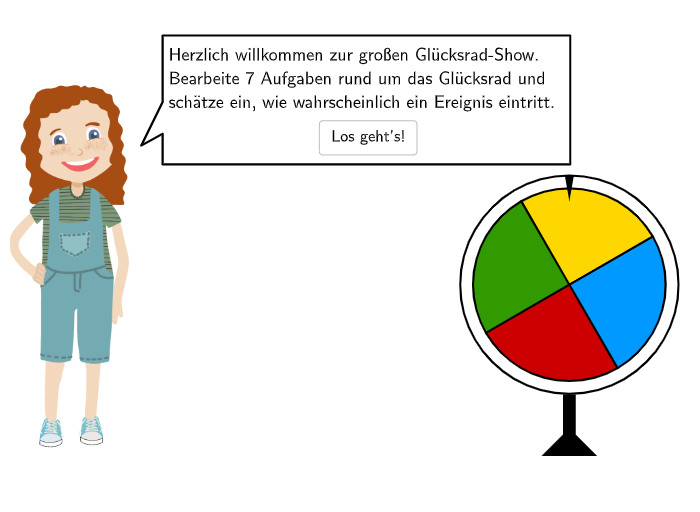
This interactive GeoGebra activity, titled 'The Big Wheel Challenge', simulates a spinning wheel game to help students develop an intuitive understanding of probability. It focuses on core concepts such as random events, equally likely outcomes, and quantifying uncertainty using probability. The construction uses commands like RandomElement, If, Element, Remove, Join, Point, IndexOf, Textfield, Circle, Sequence, CircleSector, Polygon, PolyLine, and Text to generate random questions, build the wheel with sectors, and manage interactive elements. Suitable for grades 7-8, it can be shared via Google Classroom or GeoGebra Lesson for classroom practice, emphasizing the use of intuitive probability to assess likelihood.
GeoGebra Commands & Parameters
RandomElement(1…3) → Cat1If(Cat1 ≠ 1, 1, RandomElement[{2, 3}]) → Cat2Element(Remove[1…3, {Cat1, Cat2}], 1) → Cat3Remove(1…7, Join[{Set1, Set2}]) → Set3If(shuffled, Join[{Set1, Set2, Set3}], 1…numberOfQuestions) → randomQuestionsElement(randomQuestions, Mod[questionCount - 1, Length[randomQuestions]] + 1) → randomQuestionIf(questionCount ≟ 0 ∨ showGoal, einteilung0, EinteilungsListe(randomQuestion)) → einteilungIf(randomQuestion ≟ 5, 90, 60) → indexJoin({Sequence[MP + ((2 * radius / 3) * (cos(((-index))° - (360° * (Sum[einteilung, k] - einteilung(k) / 2) / Sum[einteilung])), sin(((-index))° - (360° * (Sum[einteilung, k] - einteilung(k) / 2) / Sum[einteilung])))), k, 1, Length[einteilung]] + (-0.5, 0.48), Reverse[Sequence[StartStar + (k * (MP + ((-radius) - 1, 0) - StartStar)), k, 0, 1, 0.05]]}) → PosStarListPoint(PosStarList) → PosStarIndexOf(PosStar, PosStarList) → StarIndexIf(randomQuestion ≟ 1, correct1, randomQuestion ≟ 6, correct6, randomQuestion ≟ 7, correct7, false, randomQuestion ≟ 2, correct2, randomQuestion ≟ 3, correct3, randomQuestion ≟ 4, correct4, randomQuestion ≟ 5, correct5) → correctTextfield(input) → inputBoxCircle(MP, radius) → glücksrad1Circle(MP, radius + 0.3) → glücksrad2Sequence(MP + (radius * (cos(360° - k°), sin(360° - k°))), k, 1, 360) → PGRListSequence(MP + (radius * (cos(((-index))° - (360° * Sum[einteilung, k] / Sum[einteilung])), sin(((-index))° - (360° * Sum[einteilung, k] / Sum[einteilung])))), k, 1, Length[einteilung]) → PosGRListSequence(Segment[PosGRList(k), MP], k, 1, Length[PosGRList]) → SegListCircleSector(MP, PosGRList(1), PosGRList(Length[PosGRList])) → sek1CircleSector(MP, PosGRList(2), PosGRList(1)) → sek2CircleSector(MP, PosGRList(3), PosGRList(2)) → sek3CircleSector(MP, PosGRList(4), PosGRList(3)) → sek4CircleSector(MP, PosGRList(5), PosGRList(4)) → sek5CircleSector(MP, PosGRList(6), PosGRList(5)) → sek6CircleSector(MP, PosGRList(7), PosGRList(6)) → sek7Polygon(PosStar, PosStar + (1, 0), PosStar + (1, -0.96), PosStar + (0, -0.96)) → polyStar, posstar, f, g, hPolyLine({PosSB, Corner[txt001, 1] + (0.25 * (Corner[txt001, 4] - Corner[txt001, 1])), Corner[txt001, 1], Corner[txt001, 2] + (0.2, 0), Corner[txt001, 3] + (0.2, 0.15), Corner[txt001, 4] + (0, 0.15), Corner[txt001, 1] + (0.25 * (Corner[txt001, 4] - Corner[txt001, 1])) + (0, 0.75), PosSB}) → sb00Circle(MP1, radius2) → gr11Circle(MP1, (radius2 * 1.13)) → gr12Circle(MP2, radius2) → gr21Circle(MP3, radius2) → gr31Circle(MP4, radius2) → gr41Circle(MP2, (radius2 * 1.13)) → gr22Circle(MP3, (radius2 * 1.13)) → gr32Circle(MP4, (radius2 * 1.13)) → gr42Sequence(MP1 + (radius2 * (cos((-(indexGR1°)) - (360° * Sum[einteilungGR1, k] / Sum[einteilungGR1])), sin((-(indexGR1°)) - (360° * Sum[einteilungGR1, k] / Sum[einteilungGR1])))), k, 1, Length[einteilungGR1]) → PosGR1ListSequence(Segment[PosGR1List(k), MP1], k, 1, Length[PosGR1List]) → SegList1If(randomQuestion ≟ 1 ∨ randomQuestion ≟ 6, {30, 20, 5, 45}, {25, 12.5, 12.5, 25, 25}) → einteilungGR2Sequence(MP2 + (radius2 * (cos((-(indexGR2°)) - (360° * Sum[einteilungGR2, k] / Sum[einteilungGR2])), sin((-(indexGR2°)) - (360° * Sum[einteilungGR2, k] / Sum[einteilungGR2])))), k, 1, Length[einteilungGR2]) → PosGR2ListSequence(Segment[PosGR2List(k), MP2], k, 1, Length[PosGR2List]) → SegList2If(randomQuestion ≟ 1 ∨ randomQuestion ≟ 6, {25, 25, 25, 12.5, 12.5}, {1, 1, 1, 1}) → einteilungGR3If(randomQuestion ≟ 3, 25, 60) → indexGR4If(randomQuestion ≟ 1 ∨ randomQuestion ≟ 6, {25, 25, 50}, {1 / 3, 1 / 4, 5 / 36, 5 / 36, 5 / 36}) → einteilungGR4Sequence(MP3 + (radius2 * (cos(((-indexGR3))° - (360° * Sum[einteilungGR3, k] / Sum[einteilungGR3])), sin(((-indexGR3))° - (360° * Sum[einteilungGR3, k] / Sum[einteilungGR3])))), k, 1, Length[einteilungGR3]) → PosGR3ListSequence(MP4 + (radius2 * (cos(((-indexGR4))° - (360° * Sum[einteilungGR4, k] / Sum[einteilungGR4])), sin(((-indexGR4))° - (360° * Sum[einteilungGR4, k] / Sum[einteilungGR4])))), k, 1, Length[einteilungGR4]) → PosGR4ListSequence(Segment[PosGR3List(k), MP3], k, 1, Length[PosGR3List]) → SegList3Sequence(Segment[PosGR4List(k), MP4], k, 1, Length[PosGR4List]) → SegList4CircleSector(MP1, PosGR1List(1), PosGR1List(Length[PosGR1List])) → sek11CircleSector(MP1, PosGR1List(2), PosGR1List(1)) → sek12CircleSector(MP1, PosGR1List(3), PosGR1List(2)) → sek13CircleSector(MP1, PosGR1List(4), PosGR1List(3)) → sek14CircleSector(MP3, PosGR3List(1), PosGR3List(Length[PosGR3List])) → sek32CircleSector(MP3, PosGR3List(2), PosGR3List(1)) → sek31CircleSector(MP3, PosGR3List(3), PosGR3List(2)) → sek33CircleSector(MP3, PosGR3List(4), PosGR3List(3)) → sek34CircleSector(MP3, PosGR3List(5), PosGR3List(4)) → sek35CircleSector(MP2, PosGR2List(1), PosGR2List(Length[PosGR2List])) → sek21CircleSector(MP2, PosGR2List(2), PosGR2List(1)) → sek22CircleSector(MP2, PosGR2List(3), PosGR2List(2)) → sek23CircleSector(MP2, PosGR2List(4), PosGR2List(3)) → sek24CircleSector(MP2, PosGR2List(5), PosGR2List(4)) → sek25CircleSector(MP4, PosGR4List(1), PosGR4List(Length[PosGR4List])) → sek41CircleSector(MP4, PosGR4List(2), PosGR4List(1)) → sek42CircleSector(MP4, PosGR4List(3), PosGR4List(2)) → sek43CircleSector(MP4, PosGR4List(4), PosGR4List(3)) → sek44CircleSector(MP4, PosGR4List(5), PosGR4List(4)) → sek45Text("\textsf{✘}", MP1 + (0, (-radius2) - GRHöhe2 - 1.25), false, true, 0, 0) → FB11Text(If[randomQuestion ≟ 3, "\textsf{✓}", "\textsf{✘}"], MP2 + (0, (-radius2) - GRHöhe2 - 1.25), false, true, 0, 0) → FB12Text(If[randomQuestion ≟ 6, "\textsf{✓}", "\textsf{✘}"], MP3 + (0, (-radius2) - GRHöhe2 - 1.25), false, true, 0, 0) → FB13Text(If[randomQuestion ≟ 1, "\textsf{✓}", "\textsf{✘}"], MP4 + (0, (-radius2) - GRHöhe2 - 1.25), false, true, 0, 0) → FB14Text("\textsf{✘}", Midpoint[Corner[txtOptionSC2, 1], Corner[txtOptionSC2, 4]] + (8, 0.15), false, true, 0, 0) → FB22Text(If[randomQuestion ≟ 2, "\textsf{✓}", "\textsf{✘}"], Midpoint[Corner[txtOptionSC1, 1], Corner[txtOptionSC1, 4]] + (8, 0.15), false, true, 0, 0) → FB21Text(If[randomQuestion ≟ 7, "\textsf{✓}", "\textsf{✘}"], Midpoint[Corner[txtOptionSC3, 1], Corner[txtOptionSC3, 4]] + (8, 0.15), false, true, 0, 0) → FB23If(randomQuestion ∈ {1, 3, 6}, optionGR1 ∨ optionGR2 ∨ optionGR3 ∨ optionGR4, randomQuestion ∈ {2, 7}, optionSC1 ∨ optionSC2 ∨ optionSC3, randomQuestion ≟ 4, StarIndex ∈ (1…Length[einteilung4]), randomQuestion ≟ 5, StarIndex ∈ (1…Length[einteilung5]), true) → clickableBtnValidatePolyLine({PosSB, Corner[txtGoal, 1] + (0.25 * (Corner[txtGoal, 4] - Corner[txtGoal, 1])), Corner[txtGoal, 1], Corner[txtGoal, 2] + (0.2, 0), Corner[txtGoal, 3] + (0.2, 0.15), Corner[txtGoal, 4] + (0, 0.15), Corner[txtGoal, 1] + (0.25 * (Corner[txtGoal, 4] - Corner[txtGoal, 1])) + (0, 0.75), PosSB}) → sbGoalText(If[correct, "\textsf{✓ Richtig}", "\textsf{✘ Falsch}"], MP4 + (radius2, (-radius2) - GRHöhe2 - 2.25) + (-6.15, 0), false, true, 0, 0) → txtFeedback136Text(If[correct, "\textsf{✓ Richtig}", "\textsf{✘ Falsch}"], (0.2, 0.15) + (1, 0), false, true, 1, 0) → txtFeedback27
AI Drawing Prompt Reference
Draw a central “big wheel” spinner: place a main circle with a circle center, and add an additional slightly offset concentric circle to show the wheel boundary. Subdivide the wheel by defining several points on the circumference and connect consecutive boundary rays from the center to form multiple wedge (sector) regions arranged around the full circle; render these sectors with clear outlines so each slice is visually distinct. Around the wheel, add a fixed arrow/indicator-like polyline composed of connected segments with a few bend points, positioned relative to the same center. Include a text input box style label near the wheel and add small text annotations to mark the different options corresponding to the wheel sectors.
The prompt above was compiled from the original drawing commands and is for reference only.