
Exterior Angles of Polygons: Car Turning Metaphor Demo
Loading the math board and drawing, please wait…
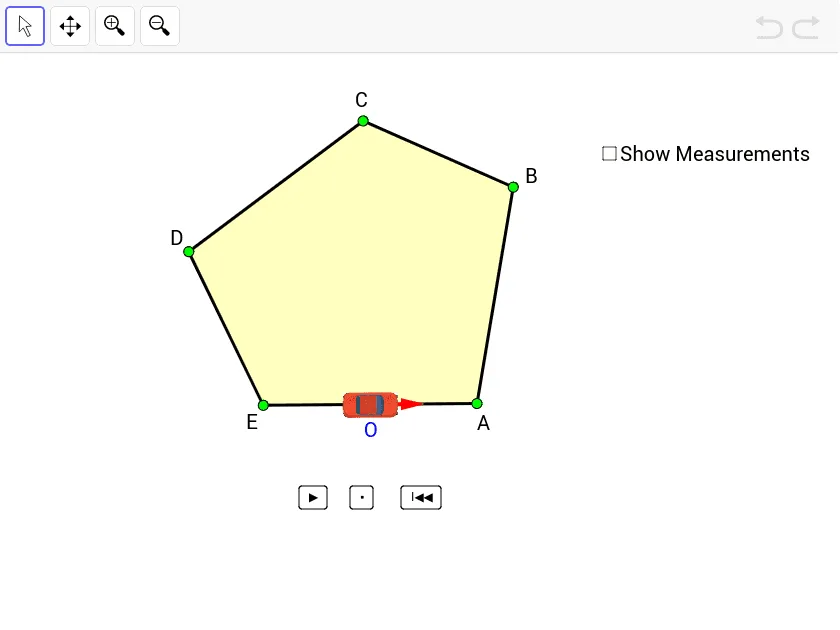
This GeoGebra example demonstrates the exterior angles of polygons through the metaphor of a car traveling along the sides of a polygon, where the turning angles at vertices correspond to exterior angles. Core mathematical concepts include polygon exterior angles, the exterior angle sum theorem (360° for convex polygons), supplementary relationships between interior and exterior angles, convex polygon properties, and angle measurement through rotation. The construction uses GeoGebra commands from the summary: Polygon to build the shape, Rotate for vertex rotation, Vector and Translate to simulate movement along sides, Angle to label interior and exterior angles, OrthogonalLine and Segment for auxiliary lines, plus If conditional logic, Midpoint, and Point to control key positions. Suitable for middle school geometry classes and high school review, this interactive resource helps students intuitively understand why the sum of exterior angles is invariant across different polygons.
GeoGebra Commands & Parameters
Rotate((x(P1) + (x(A) - x(E)) / Distance[E, A], y(P1) + (y(A) - y(E)) / Distance[E, A]), Min[Max[t - 1, 0], 1] * (180° - Angle[B, A, E]), P1) → P1'Rotate((x(P2) + (x(B) - x(A)) / Distance[A, B], y(P2) + (y(B) - y(A)) / Distance[A, B]), Min[Max[t - 3, 0], 1] * (180° - Angle[C, B, A]), P2) → P2'Rotate((x(P3) + (x(C) - x(B)) / Distance[B, C], y(P3) + (y(C) - y(B)) / Distance[B, C]), Min[Max[t - 5, 0], 1] * (180° - Angle[D, C, B]), P3) → P3'Rotate((x(P4) + (x(D) - x(C)) / Distance[C, D], y(P4) + (y(D) - y(C)) / Distance[C, D]), Min[Max[t - 7, 0], 1] * (180° - Angle[E, D, C]), P4) → P4'Rotate((x(P5) + (x(E) - x(D)) / Distance[E, D], y(P5) + (y(E) - y(D)) / Distance[E, D]), Min[Max[t - 9, 0], 1] * (180° - Angle[A, E, D]), P5) → P5'Polygon(E, A, B, C, D) → poly1, a_1, b_1, c_1, d_1, e_1If(t ≤ 2, P1, If[t ≤ 4, P2, If[t ≤ 6, P3, If[t ≤ 8, P4, If[t ≤ 10, P5, P6]]]]) → PIf(t ≤ 2, P1', If[t ≤ 4, P2', If[t ≤ 6, P3', If[t ≤ 8, P4', If[t ≤ 10, P5', P6']]]]) → P'Vector(P, P') → uAngle(P1', P1, (x(P1) + (x(A) - x(E)) / Distance[E, A], y(P1) + (y(A) - y(E)) / Distance[E, A])) → αAngle(P2', P2, (x(P2) + (x(B) - x(A)) / Distance[A, B], y(P2) + (y(B) - y(A)) / Distance[A, B])) → βAngle(P3', P3, (x(P3) + (x(C) - x(B)) / Distance[B, C], y(P3) + (y(C) - y(B)) / Distance[B, C])) → γAngle(P4', P4, (x(P4) + (x(D) - x(C)) / Distance[C, D], y(P4) + (y(D) - y(C)) / Distance[C, D])) → δAngle(P5', P5, (x(P5) + (x(E) - x(D)) / Distance[E, D], y(P5) + (y(E) - y(D)) / Distance[E, D])) → εOrthogonalLine(P, u) → fPoint(f) → FMidpoint(F, P') → GVector(G, P) → vTranslate(P, v) → P'_1Translate(P', v) → P''Segment(A, (x(A) + (x(A) - x(E)) / Distance[E, A], y(A) + (y(A) - y(E)) / Distance[E, A])) → gSegment(B, (x(B) + (x(B) - x(A)) / Distance[A, B], y(B) + (y(B) - y(A)) / Distance[A, B])) → hSegment(C, (x(C) + (x(C) - x(B)) / Distance[B, C], y(C) + (y(C) - y(B)) / Distance[B, C])) → iSegment(D, (x(D) + (x(D) - x(C)) / Distance[C, D], y(D) + (y(D) - y(C)) / Distance[C, D])) → jSegment(E, (x(E) + (x(E) - x(D)) / Distance[D, E], y(E) + (y(E) - y(D)) / Distance[D, E])) → kMidpoint(a_1) → OAngle((x(A) + (x(A) - x(E)) / Distance[E, A], y(A) + (y(A) - y(E)) / Distance[E, A]), A, B) → aAngle((x(B) + (x(B) - x(A)) / Distance[A, B], y(B) + (y(B) - y(A)) / Distance[A, B]), B, C) → bAngle((x(C) + (x(C) - x(B)) / Distance[B, C], y(C) + (y(C) - y(B)) / Distance[B, C]), C, D) → cAngle((x(D) + (x(D) - x(C)) / Distance[C, D], y(D) + (y(D) - y(C)) / Distance[C, D]), D, E) → dAngle((x(E) + (x(E) - x(D)) / Distance[D, E], y(E) + (y(E) - y(D)) / Distance[D, E]), E, A) → eIf((t ≥ 1) ∧ (t < 2), α, If[t ≥ 2, a, 0*°]) → α'If((t ≥ 3) ∧ (t < 4), β, If[t ≥ 4, b, 0*°]) → β'If((t ≥ 5) ∧ (t < 6), γ, If[t ≥ 6, c, 0*°]) → γ'If((t ≥ 7) ∧ (t < 8), δ, If[t ≥ 7, d, 0*°]) → δ'If((t ≥ 9) ∧ (t < 10), ε, If[t ≥ 9, e, 0*°]) → ε'
AI Drawing Prompt Reference
Draw a convex polygon to illustrate its exterior and interior angles. Rotate each vertex to simulate a car turning, showing that the sum of exterior angles is always 360 degrees. Add auxiliary lines to indicate direction, label exterior and interior angles, and display the turning angles at each vertex. The figure should clearly show the polygon shape, rotated vertex positions, and angle labels, suitable for geometry education.
The prompt above was compiled from the original drawing commands and is for reference only.