
Cone & Cylinder from Revolution
Loading the math board and drawing, please wait…
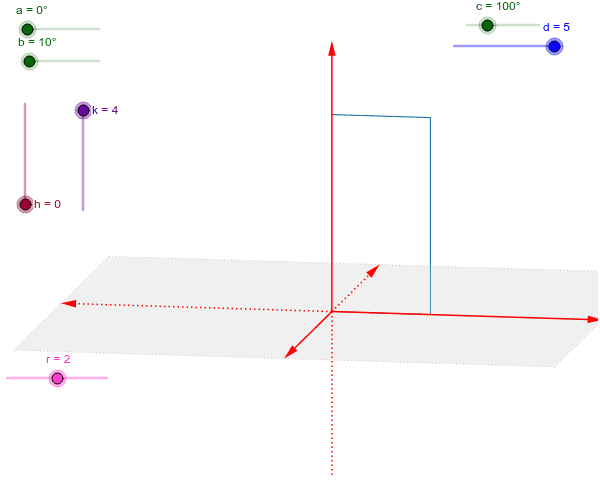
This example demonstrates the creation of solids of revolution, specifically a cone and a cylinder, by rotating a 2D shape. Key math concepts include solids of revolution, volume calculation, and integral applications in calculus. GeoGebra commands and objects used in the construction are Vector, Polygon, Sequence, and CurveCartesian. Suitable for high school and above students studying solid geometry, calculus, and understanding volume formulas for rotational solids.
GeoGebra Commands & Parameters
Vector(1.1 * d * W_x) → uVector(1.1 * d * W_y) → vVector(1.1 * d * W_z) → wPolygon(1.1 * d * (W_x + W_y), 1.1 * d * (-W_x + W_y), 1.1 * d * (-W_x - W_y), 1.1 * d * (W_x - W_y)) → poly1, g, i, j, lSequence(r * cos(0.125 * i) * W_x + r * sin(0.125 * i) * W_y, i, 0, p) → list1Sequence(r * cos(0.125 * i) * W_x + r * sin(0.125 * i) * W_y + k * W_z, i, 0, p) → list3CurveCartesian(x(r * cos(0.125 * i) * W_x + r * sin(0.125 * i) * W_y), y(r * cos(0.125 * i) * W_x + r * sin(0.125 * i) * W_y), i, 0, p) → e_1CurveCartesian(x(r * cos(0.125 * t) * W_x + r * sin(0.125 * t) * W_y + k * W_z), y(r * cos(0.125 * t) * W_x + r * sin(0.125 * t) * W_y + k * W_z), t, 0, p) → e_2Sequence(Segment[A, Element[list1, i]], i, 1, p + 1) → list2Sequence(Segment[Element[list1, i], Element[list3, i]], i, 1, p + 1) → list4Sequence(Segment[(0, 0) + k * W_z, Element[list3, i]], i, 1, p + 1) → list5