
Exploring Regular Polygon Phenomena
Loading the math board and drawing, please wait…
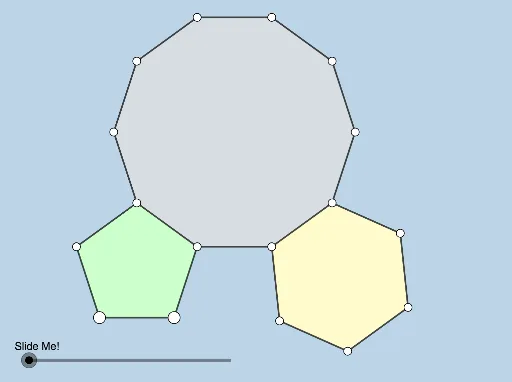
This example demonstrates the combination of three regular polygons and the very interesting phenomena they generate. It involves core mathematical concepts such as geometric construction, transformation, vector, angle, and coordinate geometry. The construction utilizes commands and objects like Polygon, Segment, Angle, Midpoint, Dilate, Rotate, Vector, Line, Point, and Translate in GeoGebra. It is suitable for high school and above students to explore geometric transformations and polygon properties, ideal for teaching demonstrations or research purposes.
GeoGebra Commands & Parameters
Polygon(A, B, 5) → poly1, f, g, h, i, j, C, D, EPolygon(D, C, 10) → poly2, k, a, F, G, H, I, J, K, L, M, l, m, n, p, q, r, s, tSegment(E, H) → bSegment(E, M) → cSegment(M, H) → j_1Angle(E, M, H) → αAngle(H, E, M) → δSegment(E, D) → eSegment(D, C) → f_1Segment(C, B) → g_1Segment(B, A) → h_1Segment(A, E) → i_1Segment(C, F) → k_1Segment(F, G) → l_1Segment(G, H) → m_1Segment(H, I) → n_1Segment(I, J) → p_1Segment(J, K) → q_1Segment(K, L) → r_1Segment(L, M) → s_1Midpoint(j_1) → NPolygon(G, F, 6) → poly3, t_1, R, a_1, b_1, c_1, d_1, e_1, O, P, QSegment(M, D) → f_2Segment(B, R) → r_2Segment(F, O) → g_2Segment(O, P) → h_2Segment(P, Q) → i_2Segment(Q, R) → j_2Segment(R, G) → k_2Dilate(E, If[0 < u ≤ 1, 1 - u, 0], M) → E'Segment(E, E') → l_2Dilate(M, If[1 < u ≤ 2, 2 - u, 0], N) → M'Segment(M, M') → m_2Dilate(N, If[2 < u ≤ 3, 3 - u, 0], H) → N'Segment(N, N') → n_2Rotate(E, If[4 < u ≤ 5, (((u - 4) * 3) * π / 5), (3 * π / 5)], M) → E'_1Rotate(E', If[4 < u ≤ 5, (((u - 4) * 3) * π / 5), (3 * π / 5)], M) → E''Segment(E'_1, E'') → p_2Rotate(E'_1, If[5 < u ≤ 6, ((u - 5) * π), π], E'_1) → SRotate(E'', If[5 < u ≤ 6, ((u - 5) * π), π], E'_1) → E'''Segment(S, E''') → q_2Dilate(B, If[6 < u ≤ 7, 7 - u, 0], R) → B'Segment(B, B') → s_2Dilate(H, If[8 < u ≤ 9, 9 - u, 0], R) → H'Vector(H, H') → vLine(R, q_2) → t_2Point(t_2) → TAngle(T, R, B) → εTranslate(S, v) → S'Translate(E''', v) → USegment(S', U) → a_2Translate(E'_1, v) → VTranslate(E'', v) → E'''_1Segment(V, E'''_1) → b_2Rotate(S', If[8 < u ≤ 9, ((u - 8) * ε), ε], U) → S''Rotate(U, If[8 < u ≤ 9, ((u - 8) * ε), ε], U) → U'Segment(S'', U') → c_2Rotate(V, If[8 < u ≤ 9, ((u - 8) * ε), ε], U) → V'Rotate(E'''_1, If[8 < u ≤ 9, ((u - 8) * ε), ε], U) → WSegment(V', W) → d_2
AI Drawing Prompt Reference
Draw three regular polygons: a pentagon and a decagon sharing a vertex, and a hexagon connected to part of the decagon. Connect the last vertex of the pentagon to the first vertex of the decagon, and the midpoint of the decagon to the last vertex of the pentagon. Calculate and mark the angles between these vertices, and identify key midpoints and vectors. Perform scaling and rotation transformations on the pentagon, and draw the transformed shapes.
The prompt above was compiled from the original drawing commands and is for reference only.