
Equivalent Fractions Visualized: Understanding Fraction Equality
Loading the math board and drawing, please wait…
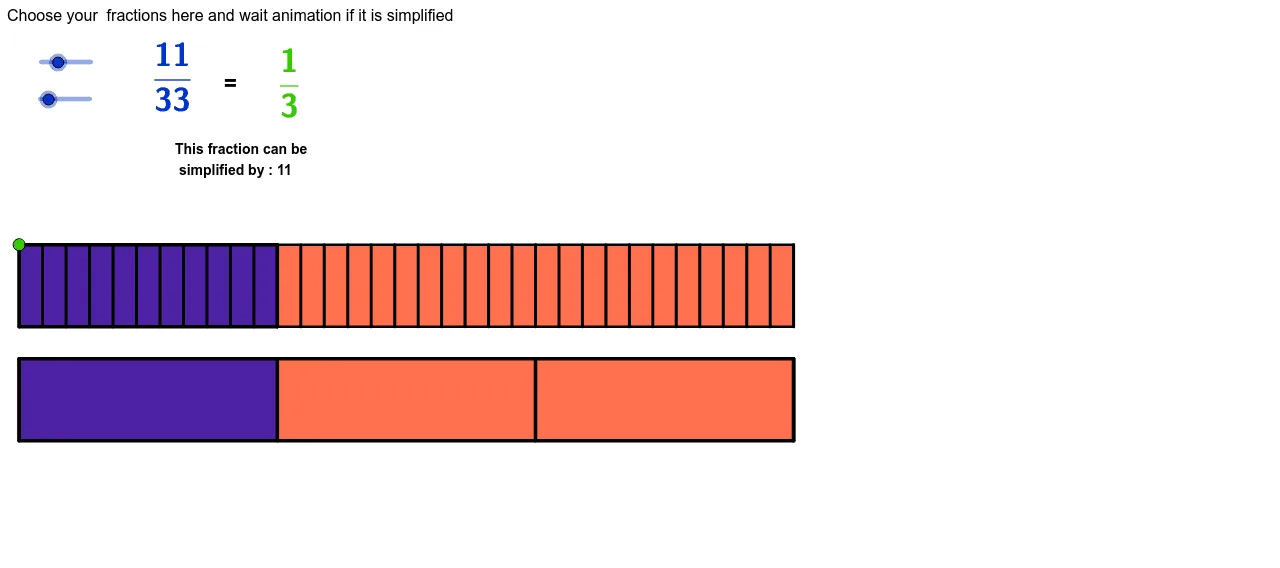
① This GeoGebra example dynamically demonstrates the concept of equivalent fractions, such as 1/2 and 2/4, by showing that they represent the same proportion of a whole area or length. ② Core mathematical concepts include fraction equivalence, simplification, common denominators, and the geometric interpretation of fractions as parts of a whole. ③ Construction highlights: The applet uses GCD to compute greatest common divisors for simplification, RandomNormal and RandomBinomial to generate random data, Sequence and Polygon to build shapes, Line and Segment for auxiliary constructions, If for conditional display, and multiple text objects (texte8, texte10, etc.) to show fraction expressions and values dynamically. ④ This resource is suitable for upper elementary to middle school students learning fractions, and for teachers demonstrating fraction equivalence visually. It also touches on arithmetic mean and trapezium area, making it a versatile teaching tool.
GeoGebra Commands & Parameters
GCD(n_1, d_1) → hSegment(A, B) → aRandomNormal(2, 4) → cRandomBinomial(2, 3) → bBinomial(4, 2) → dSequence((x(D) + i * a / d_1, y(D)), i, 0, d_1) → PointbasSequence((x(A) + i * a / d_1, y(A)), i, 0, d_1) → PointhautSequence(Segment[Element[Pointhaut, i], Element[Pointbas, i]], i, 1, d_1 + 1) → liste1Polygon(A, B, C, D) → Total, a_2, b_1, c_1, d_4Polygon(A, D, Element[Pointbas, n_1 + 1], Element[Pointhaut, n_1 + 1]) → Morceau, a_1, d_3, i, jPolygon(E, F, H, G) → poly1, e, f_1, h_1, g_1Sequence((x(G) + i * e / (d_1 / h), y(G)), i, 0, d_1 / h) → L2Sequence((x(E) + i * e / (d_1 / h), y(E)), i, 0, d_1 / h) → L3Sequence(Segment[Element[L3, i], Element[L2, i]], i, 1, d_1 / h + 1) → liste2Polygon(E, G, Element[L2, n_1 / h + 1], Element[L3, n_1 / h + 1]) → poly2, e_1, g, f, kLine(A, yAxis) → lIf(h * h ≟ 1, 0, 5) → Vitesse
AI Drawing Prompt Reference
Draw two adjacent rectangles representing equivalent fractions. The left rectangle is divided vertically into equal parts, with one portion shaded and labeled with a fraction. The right rectangle is divided into more parts, with the corresponding proportional portion shaded and labeled with an equivalent fraction. Below each rectangle, draw a horizontal segment with equally spaced division points, connected by vertical lines to form a grid. Use sliders to control numerator and denominator, dynamically showing simplified fractions and greatest common divisor. Include polygons, segments, and text labels for visual comparison.
The prompt above was compiled from the original drawing commands and is for reference only.