
Learning Equivalent Fractions by Francis Kin Fun Tsang
Loading the math board and drawing, please wait…
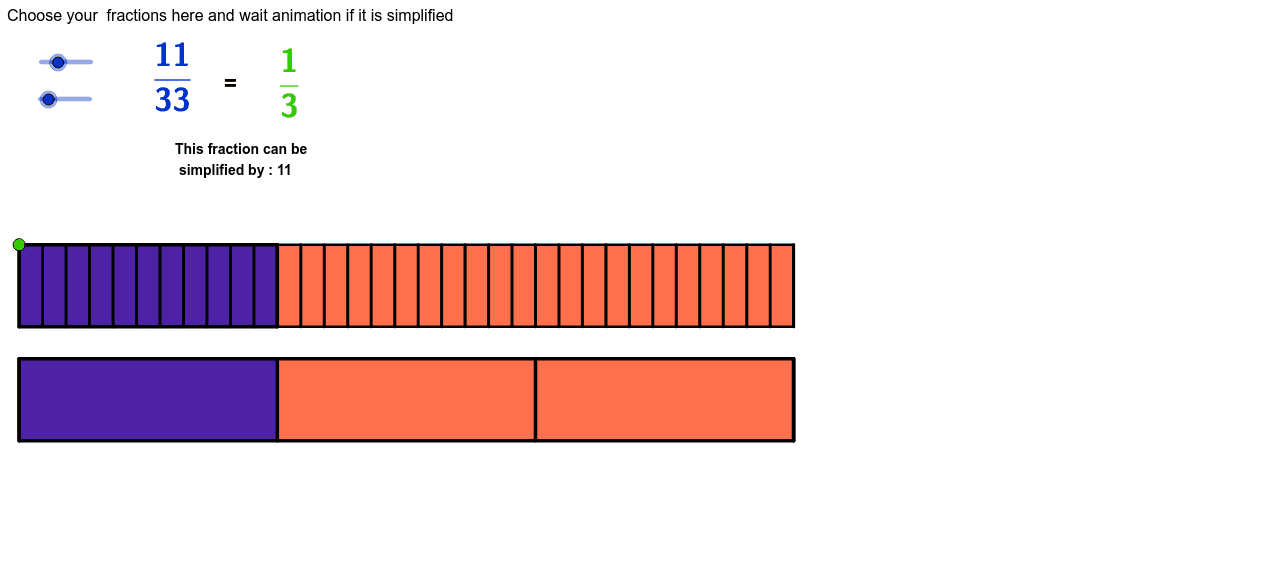
This example demonstrates the concept of equivalent fractions through interactive visualization, showing how different fraction forms can be converted into one another. Key math concepts include the fundamental properties of fractions, simplification and finding common denominators, and the application of the Greatest Common Divisor (GCD). GeoGebra commands used in construction are: GCD for calculating the greatest common divisor, Segment for drawing line segments, RandomNormal/RandomBinomial for generating random data, Sequence for creating sequences, Polygon/Line for constructing geometric shapes, and If for conditional statements. Suitable for middle school and above students to understand fraction equivalence transformations and geometric representations, enhancing mathematical intuition.
GeoGebra Commands & Parameters
GCD(n_1, d_1) → hSegment(A, B) → aRandomNormal(2, 4) → cRandomBinomial(2, 3) → bBinomial(4, 2) → dSequence((x(D) + i * a / d_1, y(D)), i, 0, d_1) → PointbasSequence((x(A) + i * a / d_1, y(A)), i, 0, d_1) → PointhautSequence(Segment[Element[Pointhaut, i], Element[Pointbas, i]], i, 1, d_1 + 1) → liste1Polygon(A, B, C, D) → Total, a_2, b_1, c_1, d_4Polygon(A, D, Element[Pointbas, n_1 + 1], Element[Pointhaut, n_1 + 1]) → Morceau, a_1, d_3, i, jPolygon(E, F, H, G) → poly1, e, f_1, h_1, g_1Sequence((x(G) + i * e / (d_1 / h), y(G)), i, 0, d_1 / h) → L2Sequence((x(E) + i * e / (d_1 / h), y(E)), i, 0, d_1 / h) → L3Sequence(Segment[Element[L3, i], Element[L2, i]], i, 1, d_1 / h + 1) → liste2Polygon(E, G, Element[L2, n_1 / h + 1], Element[L3, n_1 / h + 1]) → poly2, e_1, g, f, kLine(A, yAxis) → lIf(h * h ≟ 1, 0, 5) → Vitesse
AI Drawing Prompt Reference
Draw a geometric representation of equivalent fractions, including a fraction's numerator and denominator, use line segments to represent the value of the fraction, apply randomly generated normal and binomial distribution data, demonstrate the process of simplifying and finding common denominators, use the greatest common divisor (GCD) to calculate and apply, finally construct geometric shapes with polygons and line segments to show the equivalence transformation of fractions.
The prompt above was compiled from the original drawing commands and is for reference only.