
All Patterns of the 3D Cube
Loading the math board and drawing, please wait…
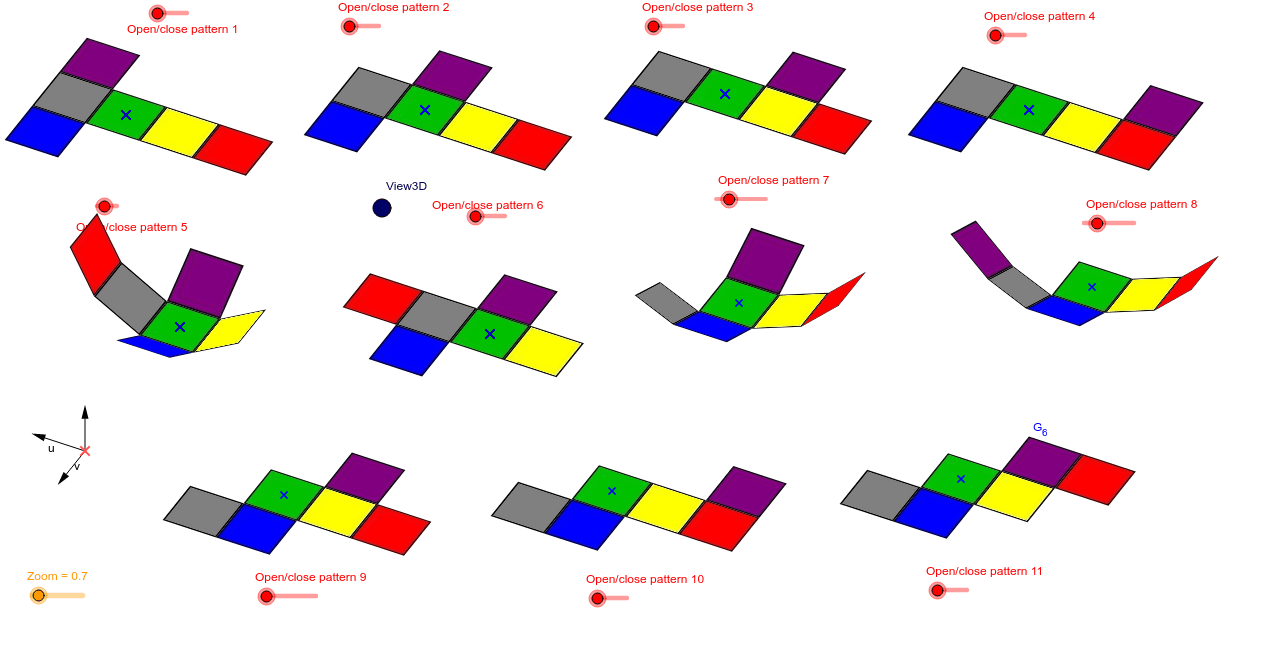
This example demonstrates various patterns and structures of a 3D cube, involving core mathematical concepts like solid geometry, coordinate geometry, trigonometry, and vector operations. It uses GeoGebra commands such as Vector, OrthogonalLine, Mirror, and Polygon for construction. Suitable for high school students and math enthusiasts exploring properties and transformations of three-dimensional shapes.
GeoGebra Commands & Parameters
Vector(B_1, X) → uVector(B_1, Z) → wOrthogonalLine(View3D, yAxis) → aOrthogonalLine(View3D, xAxis) → b_2Vector(B_1, Y) → vMirror(J_1, V) → K_1Mirror(I_1, V) → L_1Polygon(K_1, L_1, J_1, I_1) → poly1, k_2, l_2, j_2, i_2Mirror(N_1, W) → S_1Mirror(M_1, W) → T_1Mirror(O_1, C) → U_1Mirror(C_1, C) → V_1Mirror(P_1, F_5) → W_1Mirror(F_1, F_5) → Z_1Mirror(R_1, Q) → A_2Mirror(Q_1, Q) → D_2Polygon(N_1, T_1, S_1, M_1) → poly2, n_2, t_1, s_1, m_2Polygon(F_1, P_1, Z_1, W_1) → poly3, f_2, p_2, z_1, w_1Polygon(C_1, O_1, V_1, U_1) → poly4, c_2, o_2, v_1, u_1Polygon(Q_1, R_1, D_2, A_2) → poly5, q_2, r_2, d_2, a_2Polygon(E_2, I_1, K_1, G_2) → poly6, e_2, i_3, k_3, g_2Polygon(H_2, I_2, I_1, E_2) → poly7, h_2, i_4, i_5, e_3Polygon(K_1, L_1, K_2, J_2) → poly8, k_4, l_3, k_5, j_3Polygon(J_1, L_2, M_2, L_1) → poly9, j_4, l_4, m_3, l_5Polygon(N_2, E_2, G_2, O_2) → poly10, n_3, e_4, g_3, o_3Polygon(R_2, S_1, M_1, P_2) → poly11, r_3, s_2, m_4, p_3Polygon(T_2, S_2, M_1, P_2) → poly12, t_2, s_3, m_5, p_4Polygon(R_2, S_1, U_2, V_2) → poly13, r_4, s_4, u_2, v_2Polygon(N_1, W_2, Z_2, T_1) → poly14, n_4, w_2, z_2, t_3Polygon(W_2, A_3, B_3, Z_2) → poly15, w_3, a_3, b_3, z_3Polygon(C_3, F_1, W_1, D_3) → poly16, c_4, f_3, w_4, d_4Polygon(C_3, E_3, F_3, F_1) → poly17, c_5, e_5, f_4, f_5Polygon(P_1, G_3, H_3, Z_1) → poly18, p_5, g_4, h_3, z_4Polygon(G_3, I_3, J_3, H_3) → poly19, g_5, i_6, j_5, h_4Polygon(Z_1, K_3, L_3, H_3) → poly20, z_5, k_6, l_6, h_5Polygon(M_3, Q_1, A_2, N_3) → poly21, m_6, q_1, a_4, n_5Polygon(M_3, P_3, O_3, Q_1) → poly22, m_7, p_6, o_1, q_3Polygon(R_1, Q_3, R_3, D_2) → poly23, r_5, q_4, r_6, d_5Polygon(A_2, D_2, S_3, T_3) → poly24, a_5, d_6, s_5, t_4Polygon(Q_3, U_3, V_3, R_3) → poly25, q_5, u_3, v_3, r_7Polygon(W_3, C_1, U_1, Z_3) → poly26, w_5, c_6, u_4, z_6Polygon(B_4, A_4, C_1, W_3) → poly27, b_4, a_6, c_7, w_6Polygon(O_1, C_4, D_4, V_1) → poly28, o_4, c_8, d_7, v_4Polygon(C_4, E_4, F_4, D_4) → poly29, c_9, e_7, f_7, d_8Polygon(D_4, F_4, G_4, H_4) → poly30, d_9, f_8, g_6, h_6Mirror(H, A) → FMirror(E, A) → GPolygon(E, H, G, F) → poly31, e_8, h_7, g_7, f_9Polygon(M_4, E, H, N_4) → poly32, m_8, e_9, h_8, n_6Polygon(H, J_4, L_4, G) → poly33, h_9, j_6, l_7, g_8Polygon(G, O_4, P_4, F) → poly34, g_9, o_5, p_7, f_{10}Polygon(F, S, R, E) → poly35, f_{11}, s_9, r_8, e_{10}Polygon(S, K_4, I_4, R) → poly36, s_6, k_7, i_7, r_9Mirror(D, B) → D'Mirror(I, B) → I'Polygon(I', D', N, O) → poly37, i', d', n, o_6Polygon(I', D', I, D) → poly38, i'_1, d'_1, i, d_1Polygon(D, I, P, T) → poly39, d_3, i_1, p, tPolygon(A_1, D, T, U) → poly40, a_1, d_{10}, t_5, u_5Polygon(D', J, K, I) → poly41, d'_2, j, k_1, i_8Polygon(J, L, M, K) → poly42, j_1, l, m, k_8Mirror(E_1, D_1) → H_1Mirror(G_1, D_1) → B_2Polygon(E_1, G_1, H_1, B_2) → poly43, e_1, g_1, h_1, b_1Polygon(H_1, C_2, F_2, G_1) → poly44, h_{10}, c_1, f_1, g_{10}Polygon(C_2, Q_2, Q_4, F_2) → poly45, c_{10}, q_6, q_7, f_6Polygon(G_1, R_4, S_4, E_1) → poly46, g_{11}, r_1, s_7, e_6Polygon(T_4, E_1, S_4, U_4) → poly47, t_6, e_{11}, s_8, u_6Polygon(W_4, T_4, U_4, V_4) → poly48, w_7, t_7, u_7, v_5Mirror(B_5, Z_4) → C_5Mirror(A_5, Z_4) → D_5Polygon(D_5, E_5, J_5, K_5) → poly49, d_{11}, e_{12}, j_7, k_9Polygon(C_5, D_5, B_5, A_5) → poly50, c_{11}, d_{12}, b_5, a_7Polygon(D_5, E_5, G_5, B_5) → poly51, d_{13}, e_{13}, g_{12}, b_6Polygon(E_5, H_5, I_5, G_5) → poly52, e_{14}, h_{11}, i_9, g_{13}Polygon(A_5, B_5, L_5, M_5) → poly53, a_8, b_7, l_1, m_1Polygon(M_5, N_5, O_5, A_5) → poly54, m_9, n_1, o_7, a_9Mirror(R_5, P_5) → S_5Mirror(Q_5, P_5) → T_5Polygon(Q_5, S_5, T_5, R_5) → poly55, q_8, s_{10}, t_8, r_{10}Polygon(T_5, U_5, V_5, S_5) → poly56, t_9, u_8, v_6, s_{11}Polygon(U_5, W_5, Z_5, V_5) → poly57, u_9, w_8, z_7, v_7Polygon(B_6, A_6, W_5, U_5) → poly58, b_8, a_{10}, w_9, u_{10}Polygon(Q_5, S_5, C_6, D_6) → poly59, q_9, s_{12}, c_{12}, d_{14}Polygon(F_6, Q_5, D_6, E_6) → poly60, f_{12}, q_{10}, d_{15}, e_{15}Mirror(H_6, G_6) → J_6Mirror(I_6, G_6) → K_6Polygon(U_6, T_6, Q_6, J_6) → poly61, u_{11}, t_{10}, q_{11}, j_8Polygon(H_6, K_6, J_6, I_6) → poly62, h_{12}, k_{10}, j_9, i_{10}Polygon(I_6, J_6, Q_6, P_6) → poly63, i_{11}, j_{10}, q_{12}, p_1Polygon(I_6, L_6, M_6, H_6) → poly64, i_{12}, l_8, m_{10}, h_{13}Polygon(M_6, N_6, O_6, H_6) → poly65, m_{11}, n_7, o_8, h_{14}Polygon(Q_6, R_6, S_6, T_6) → poly66, q_{13}, r_{11}, s_{13}, t_{11}
AI Drawing Prompt Reference
Draw various patterns and structures of a 3D cube, showcasing core mathematical concepts like solid geometry, coordinate geometry, trigonometry, and vector operations. Start by constructing basic vectors of the cube, then use orthogonal lines and mirror operations to create symmetric patterns, and finally connect multiple points into polygons to form complex geometric structures, highlighting the cube's symmetry and spatial relationships.
The prompt above was compiled from the original drawing commands and is for reference only.