
Egg-Shaped Surface: Continuous Construction with Exponential and Trigonometric F
Loading the math board and drawing, please wait…
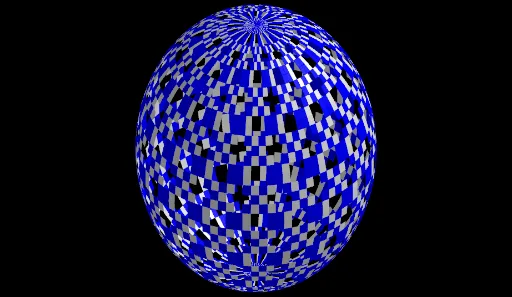
This GeoGebra example demonstrates a three-dimensional egg-shaped surface generated by combining exponential and trigonometric functions, showcasing continuous surface construction over real numbers. Core mathematical concepts include exponential functions, trigonometric functions, continuity, and parametric surfaces, involving function composition and spatial geometry in the real domain. Construction highlights: using GeoGebra commands such as Join, Sphere, and Sequence, along with objects p, h_1, R, B_1, Zoom, O, g, k, n, liste3, e, h, q, i, liste1, liste4, and image1, the surface is built by generating sequences of points and connecting them, possibly employing spheres or scaling transformations to shape the egg-like contour. Suitable for high school to university students learning 3D function graphs, parametric surfaces, or mathematical modeling, and useful for teachers demonstrating the intuitive process of constructing continuous surfaces from functions.
GeoGebra Commands & Parameters
Join(Sequence[Sequence[O + (((R * cos(i)) * cos(j)), ((R * cos(i)) * sin(j)), (h_1 * sin(i))), j, 0, 6.28319, π / n], i, 0, 6.28319, π / n]) → liste3Sphere(O, R - 0.1) → iSequence(Polygon[Element[liste3, i], Element[liste3, i + 1], Element[liste3, i + 1 + (2 * n) + e], Element[liste3, i + e + (2 * n)]], i, 1, Length[liste3], h) → liste1Sequence(Polygon[Element[liste3, i], Element[liste3, i - 1], Element[liste3, i - 1 + (2 * n) + e], Element[liste3, i + e + (2 * n)]], i, 1, Length[liste3], h) → liste4