
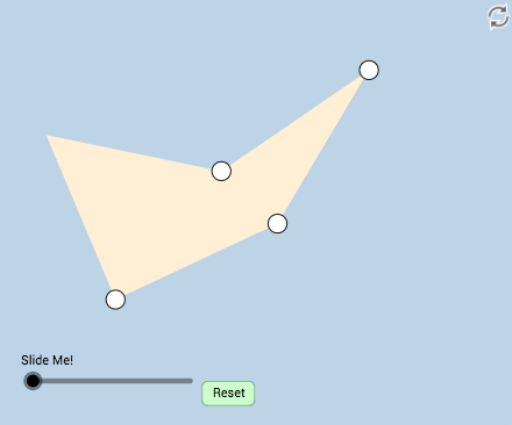
Dynamic & Modifiable Equilateral Polygon Illustrator
Loading the math board and drawing, please wait…
In collections
Congruence (CO) Cluster
Congruence (Vol 1)
Congruence (Vol 1) Over 80 Resources
Geometry (Congruence) Volume 1
CCSS High School: Geometry (Congruence) Volume 1 S N ATTAR
CCSS High School: Geometry (Congruence) Volume 1
CCSS High School: Geometry (Congruence) Volume 1
CCSS High School: Geometry (Congruence) Volume 1
CCSS High School: Geometry (Congruence) Volume 1
CCSS High School: Geometry (Congruence) Volume 1
CCSS High School: Geometry (Congruence) Volume 1
CCSS High School: Geometry (Congruence) Volume 1
CCSS High School: Geometry (Congruence) Volume 1
CCSS High School: Geometry (Congruence) Volume 1
CCSS High School: Geometry (Congruence) Volume 1
CCSS High School: Geometry (Congruence) Volume 1
Polygons & Angles
Polygons & Angles
Polygons & Angles ( s n attar)
Polygons & Angles
Congruence: Volume 1 - Chapter 1
Congruence: Volume 1 - Chapter 1
This example demonstrates the dynamic construction and modification of equilateral polygons with a definition writing prompt. It involves core mathematical concepts like polygon construction, ratios, angles, rotation, and transformation. Key GeoGebra commands/objects used include Circle, Segment, Point, Intersect, Polygon, Dilate, Angle, and Rotate. Suitable for high school mathematics teaching, aiding in geometric construction, transformation studies, and concept comprehension.
GeoGebra Commands & Parameters
Circle(A, B) → cSegment(A, B) → fCircle(B, f) → dPoint(d) → CCircle(C, f) → eSegment(B, C) → gPoint(e) → DSegment(C, D) → hCircle(D, f) → kIntersect(c, k, 1) → EPolygon(A, B, C, D, E) → poly1, a, b, c_1, d_1, e_1Segment(A, B) → iSegment(B, C) → jSegment(C, D) → lSegment(D, E) → mSegment(E, A) → nDilate(B, If[0 < o ≤ 1, 1 - o, 0], A) → A'Segment(B, A') → pAngle(B, A, E) → αAngle(A, E, D) → βAngle(E, D, C) → γAngle(D, C, B) → δRotate(B, If[1 < o ≤ 2, ((o - 1) * α), α], A) → B'Rotate(A', If[1 < o ≤ 2, ((o - 1) * α), α], A) → A''Segment(B', A'') → p'Rotate(B', If[2 < o ≤ 3, ((o - 2) * β), β], E) → B''Rotate(A'', If[2 < o ≤ 3, ((o - 2) * β), β], E) → A'''Segment(B'', A''') → p''Rotate(B'', If[3 < o ≤ 4, ((o - 3) * γ), γ], D) → B'''Rotate(A''', If[3 < o ≤ 4, ((o - 3) * γ), γ], D) → FSegment(B''', F) → p'''Rotate(B''', If[4 < o ≤ 5, ((o - 4) * δ), δ], C) → GRotate(F, If[4 < o ≤ 5, ((o - 4) * δ), δ], C) → F'Segment(G, F') → q