
Nature's Symmetry: Polygon Rotation and Geometric Exploration
Loading the math board and drawing, please wait…
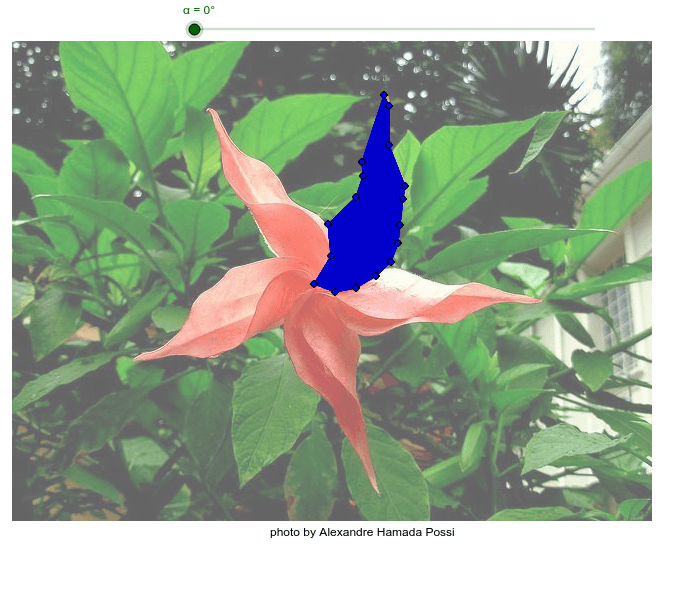
This GeoGebra activity demonstrates symmetry as observed in nature, guiding students to recognize and analyze symmetrical patterns in geometric contexts. The core mathematical concepts include symmetry, polygon rotation, and rotation angles, alongside related topics such as quadratic equations, percentages, sine functions, squares, and pyramids. The construction uses GeoGebra commands Polygon and Rotate, applied to multiple points (A through Q) and polygon poly1, generating rotated counterparts (e.g., A'_1) to create symmetric configurations. This resource is suitable for middle and high school mathematics, serving as an interactive tool for teaching geometric symmetry, fostering cross-disciplinary connections between math and nature, and encouraging exploratory learning.
GeoGebra Commands & Parameters
Polygon(A, B, K, L, M, N, O, P, Q, C, D, E, F, G, H, I, J) → poly1, a, j, k, l, m, n, o, p, q, b, c, d, e, f, g, h, iRotate(A, α, A) → A'_1Rotate(B, α, A) → B'_1Rotate(C, α, A) → C'_1Rotate(D, α, A) → D'_1Rotate(E, α, A) → E'_1Rotate(F, α, A) → F'_1Rotate(G, α, A) → G'_1Rotate(H, α, A) → H'_1Rotate(I, α, A) → I'_1Rotate(J, α, A) → J'_1Rotate(K, α, A) → K'_1Rotate(L, α, A) → L'_1Rotate(M, α, A) → M'_1Rotate(N, α, A) → N'_1Rotate(O, α, A) → O'_1Rotate(P, α, A) → P'_1Rotate(Q, α, A) → Q'_1Polygon(A'_1, B'_1, K'_1, L'_1, M'_1, N'_1, O'_1, P'_1, Q'_1, C'_1, D'_1, E'_1, F'_1, G'_1, H'_1, I'_1, J'_1) → poly1'_1, a', j', k', l', m', n', o', p', q', b', c', d', e', f', g', h', i'Rotate(A, (2 * α), A) → A'_2Rotate(B, (2 * α), A) → B'_2Rotate(C, (2 * α), A) → C'_2Rotate(D, (2 * α), A) → D'_2Rotate(E, (2 * α), A) → E'_2Rotate(F, (2 * α), A) → F'_2Rotate(G, (2 * α), A) → G'_2Rotate(H, (2 * α), A) → H'_2Rotate(I, (2 * α), A) → I'_2Rotate(J, (2 * α), A) → J'_2Rotate(K, (2 * α), A) → K'_2Rotate(L, (2 * α), A) → L'_2Rotate(M, (2 * α), A) → M'_2Rotate(N, (2 * α), A) → N'_2Rotate(O, (2 * α), A) → O'_2Rotate(P, (2 * α), A) → P'_2Rotate(Q, (2 * α), A) → Q'_2Polygon(A'_2, B'_2, K'_2, L'_2, M'_2, N'_2, O'_2, P'_2, Q'_2, C'_2, D'_2, E'_2, F'_2, G'_2, H'_2, I'_2, J'_2) → poly1'_2, a'_1, j'_1, k'_1, l'_1, m'_1, n'_1, o'_1, p'_1, q'_1, b'_1, c'_1, d'_1, e'_1, f'_1, g'_1, h'_1, i'_1Rotate(A, (3 * α), A) → A'_3Rotate(B, (3 * α), A) → B'_3Rotate(C, (3 * α), A) → C'_3Rotate(D, (3 * α), A) → D'_3Rotate(E, (3 * α), A) → E'_3Rotate(F, (3 * α), A) → F'_3Rotate(G, (3 * α), A) → G'_3Rotate(H, (3 * α), A) → H'_3Rotate(I, (3 * α), A) → I'_3Rotate(J, (3 * α), A) → J'_3Rotate(K, (3 * α), A) → K'_3Rotate(L, (3 * α), A) → L'_3Rotate(M, (3 * α), A) → M'_3Rotate(N, (3 * α), A) → N'_3Rotate(O, (3 * α), A) → O'_3Rotate(P, (3 * α), A) → P'_3Rotate(Q, (3 * α), A) → Q'_3Polygon(A'_3, B'_3, K'_3, L'_3, M'_3, N'_3, O'_3, P'_3, Q'_3, C'_3, D'_3, E'_3, F'_3, G'_3, H'_3, I'_3, J'_3) → poly1'_3, a'_2, j'_2, k'_2, l'_2, m'_2, n'_2, o'_2, p'_2, q'_2, b'_2, c'_2, d'_2, e'_2, f'_2, g'_2, h'_2, i'_2Rotate(A, (4 * α), A) → A'Rotate(B, (4 * α), A) → B'Rotate(C, (4 * α), A) → C'Rotate(D, (4 * α), A) → D'Rotate(E, (4 * α), A) → E'Rotate(F, (4 * α), A) → F'Rotate(G, (4 * α), A) → G'Rotate(H, (4 * α), A) → H'Rotate(I, (4 * α), A) → I'Rotate(J, (4 * α), A) → J'Rotate(K, (4 * α), A) → K'Rotate(L, (4 * α), A) → L'Rotate(M, (4 * α), A) → M'Rotate(N, (4 * α), A) → N'Rotate(O, (4 * α), A) → O'Rotate(P, (4 * α), A) → P'Rotate(Q, (4 * α), A) → Q'Polygon(A', B', K', L', M', N', O', P', Q', C', D', E', F', G', H', I', J') → poly1', a'_3, j'_3, k'_3, l'_3, m'_3, n'_3, o'_3, p'_3, q'_3, b'_3, c'_3, d'_3, e'_3, f'_3, g'_3, h'_3, i'_3
AI Drawing Prompt Reference
Draw an irregular 17‑vertex polygon, then create three rotated copies of it about one of its vertices using angles α, 2α, and 3α, so that four congruent polygons overlap and display rotational symmetry; include a slider to vary α and observe the symmetry change. The construction shows how successive rotations generate a symmetric pattern reminiscent of natural forms for educational exploration.
The prompt above was compiled from the original drawing commands and is for reference only.