
Dynamic Illustration of Geometric Relations in a Triangle with Isosceles Triangl
Loading the math board and drawing, please wait…
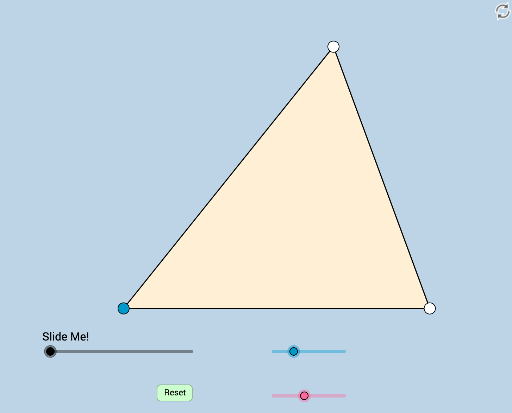
This GeoGebra example dynamically illustrates a relationship that exists within a triangle when isosceles triangles are constructed outward on each of its sides. The core mathematical concepts involve properties of isosceles triangles, internal and external angles, rotation and reflection transformations, and the use of vectors in geometric proofs. The construction uses GeoGebra commands such as Segment, Rotate, Angle, Ray, Point, Min, Intersect, Circle, Dilate, Polygon, CircleSector, Vector, Translate, Line, and Midpoint to build the original triangle and the attached isosceles triangles, with sliders or dynamic points allowing real-time exploration of the relationships. It is suitable for high school and above students to investigate geometric transformations and vector applications, and can serve as a classroom demonstration or a self-guided exploration tool.
GeoGebra Commands & Parameters
Segment(A, B) → fRotate(B, (a * π / 180), A) → B'Angle(B, A, B') → αRay(A, B') → gPoint(g) → CSegment(B, C) → hAngle(C, B, A) → βMin(α, β) → bRotate(B, c, A) → B'_1Angle(B, A, B'_1) → γRay(A, B'_1) → iRotate(A, (-c), B) → A'Angle(A', B, A) → δRay(B, A') → jIntersect(i, j) → DRotate(C, c, A) → C'Angle(C, A, C') → εRotate(A, (-c), C) → A'_1Angle(A'_1, C, A) → ζRay(A, C') → kRay(C, A'_1) → lIntersect(l, k) → ERotate(C, (-c), B) → C'_1Angle(C'_1, B, C) → ηRotate(B, c, C) → B'_2Angle(B, C, B'_2) → θ_1Ray(C, B'_2) → mRay(B, C'_1) → nIntersect(m, n) → FSegment(A, D) → pSegment(D, B) → qMin({p, q, f}) → dCircle(A, (0.3 * d)) → eIntersect(e, f, 1) → GIntersect(i, p) → HIntersect(i, p) → IIntersect(i, p) → JIntersect(i, p) → KIntersect(e, i, 1) → LSegment(A, C) → rDilate(A, If[0 < o ≤ 1, 1 - o, 0], D) → A'_2Dilate(B, If[0 < o ≤ 1, 1 - o, 0], D) → B'_3Dilate(A, If[1 < o ≤ 2, 2 - o, 0], E) → A'_3Dilate(C, If[1 < o ≤ 2, 2 - o, 0], E) → C'_2Dilate(B, If[2 < o ≤ 3, 3 - o, 0], F) → B'_4Dilate(C, If[2 < o ≤ 3, 3 - o, 0], F) → C'_3Segment(A, A'_2) → sSegment(B, B'_3) → tSegment(A, A'_3) → f_1Segment(C, C'_2) → g_1Segment(B, B'_4) → h_1Segment(C, C'_3) → i_1Polygon(A, B, C) → poly1, c_1, a_1, b_1Rotate(G, If[3 < o ≤ 4, ((o - 3) * γ), γ], A) → G'CircleSector(A, G, G') → d_1Dilate(A, If[4 < o ≤ 5, 5 - o, 0], B) → A'_4Vector(A, A'_4) → uTranslate(d_1, u) → e_1Line(B, r) → j_1Line(B, s) → k_1Point(k_1) → MRotate(e_1, If[5 < o ≤ 6, ((o - 5) * (π - γ)), π - γ], B) → p_1Dilate(B, If[6 < o ≤ 7, 7 - o, 0], C) → B'_5Vector(B, B'_5) → vTranslate(p_1, v) → q_1Line(C, t) → l_1Point(l_1) → NAngle(N, C, E) → θRotate(q_1, If[7 < o ≤ 8, ((o - 7) * θ), θ], C) → r_1Midpoint(h) → OMidpoint(r) → PDilate(B, If[8 < o ≤ 9, 9 - o, 0], O) → B'_6Vector(B, B'_6) → wTranslate(p_1, w) → s_1Rotate(s_1, If[9 < o ≤ 10, ((-(o - 9)) * β), (-β)], O) → t_1Dilate(C, If[8 < o ≤ 9, 9 - o, 0], P) → C'_4Vector(C, C'_4) → u_1Translate(r_1, u_1) → c_2Rotate(c_2, If[9 < o ≤ 10, ((-(o - 9)) * (π - γ)), γ - π], P) → d_2Dilate(P, If[10 < o ≤ 11, 11 - o, 0], A) → P'Dilate(O, If[10 < o ≤ 11, 11 - o, 0], B) → O'Vector(P, P') → v_1Vector(O, O') → w_1Translate(d_2, v_1) → e_2Translate(t_1, w_1) → f_2Dilate(F, If[11 < o ≤ 12, 12 - o, 0], D) → F'Vector(F, F') → m_1Translate(C, m_1) → C'_5Translate(C'_3, m_1) → QSegment(C'_5, Q) → n_1Dilate(E, If[12 < o ≤ 13, 13 - o, 0], D) → E'Vector(E, E') → u_2Translate(C, u_2) → C'_6Translate(C'_2, u_2) → RSegment(C'_6, R) → g_2