
Dynamic Geometry Problem in a Regular Octagon (GoGeometry 168)
Loading the math board and drawing, please wait…
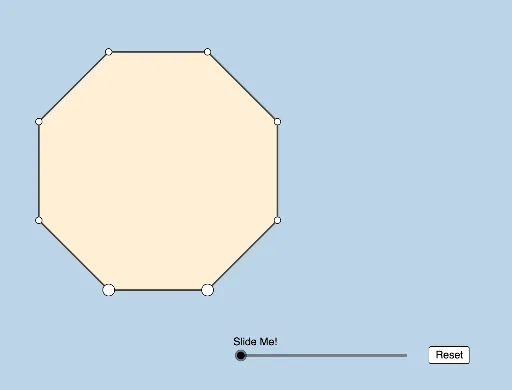
① This interactive GeoGebra example dynamically illustrates a geometry problem posed by Antonio Gutierrez (GoGeometry), centered on a regular octagon. ② Core mathematical concepts include properties of regular polygons, rotation, dilation (homothety), perpendicularity, parallelism, angle relationships, and equivalence of geometric constructions. ③ Construction highlights: using GeoGebra commands such as Polygon, Segment, Rotate, Dilate, Angle, Intersect, OrthogonalLine, Point, Ray, Line, Vector, and Translate, the applet builds a regular octagon with auxiliary segments, intersection points, perpendicular lines, and translated vectors, producing multiple derived objects (e.g., poly1', A', B', etc.) for dynamic manipulation. ④ Suitable for middle/high school geometry classes, math competition training, or teachers creating interactive demonstrations to explore symmetry and angle properties of regular octagons.
GeoGebra Commands & Parameters
Polygon(A, B, 8) → poly1, f, D, E, F, G, H, g, h, i, j, k, l, m, CSegment(H, A) → nSegment(A, B) → pSegment(B, C) → qSegment(C, D) → rSegment(D, E) → sSegment(E, F) → tSegment(F, G) → aSegment(G, H) → bRotate(poly1, If[0 < c ≤ 1, (c * π / 4), π / 4], Center[Circle[A, B, C]]) → poly1'Rotate(A, If[0 < c ≤ 1, (c * π / 4), π / 4], Center[Circle[A, B, C]]) → A'Rotate(B, If[0 < c ≤ 1, (c * π / 4), π / 4], Center[Circle[A, B, C]]) → B'Segment(A', B') → p'Rotate(B, If[0 < c ≤ 1, (c * π / 4), π / 4], Center[Circle[A, B, C]]) → B'_1Rotate(C, If[0 < c ≤ 1, (c * π / 4), π / 4], Center[Circle[A, B, C]]) → C'Segment(B'_1, C') → q'Rotate(C, If[0 < c ≤ 1, (c * π / 4), π / 4], Center[Circle[A, B, C]]) → C'_1Rotate(D, If[0 < c ≤ 1, (c * π / 4), π / 4], Center[Circle[A, B, C]]) → D'Segment(C'_1, D') → r'Rotate(D, If[0 < c ≤ 1, (c * π / 4), π / 4], Center[Circle[A, B, C]]) → D'_1Rotate(E, If[0 < c ≤ 1, (c * π / 4), π / 4], Center[Circle[A, B, C]]) → E'Segment(D'_1, E') → s'Rotate(E, If[0 < c ≤ 1, (c * π / 4), π / 4], Center[Circle[A, B, C]]) → E'_1Rotate(F, If[0 < c ≤ 1, (c * π / 4), π / 4], Center[Circle[A, B, C]]) → F'Segment(E'_1, F') → t'Rotate(F, If[0 < c ≤ 1, (c * π / 4), π / 4], Center[Circle[A, B, C]]) → F'_1Rotate(G, If[0 < c ≤ 1, (c * π / 4), π / 4], Center[Circle[A, B, C]]) → G'Segment(F'_1, G') → a'Rotate(G, If[0 < c ≤ 1, (c * π / 4), π / 4], Center[Circle[A, B, C]]) → G'_1Rotate(H, If[0 < c ≤ 1, (c * π / 4), π / 4], Center[Circle[A, B, C]]) → H'Segment(G'_1, H') → b'Rotate(H, If[0 < c ≤ 1, (c * π / 4), π / 4], Center[Circle[A, B, C]]) → H'_1Rotate(A, If[0 < c ≤ 1, (c * π / 4), π / 4], Center[Circle[A, B, C]]) → A'_1Segment(H'_1, A'_1) → n'Dilate(E, If[1 < c ≤ 2, 2 - c, 0], B) → E'_2Segment(E, E'_2) → dAngle(E, B, A) → αSegment(G, C) → eIntersect(d, e) → IDilate(G, If[2 < c ≤ 3, 3 - c, 0], I) → G'_2Segment(G, G'_2) → f_1Dilate(I, If[3 < c ≤ 4, 4 - c, 0], C) → I'Segment(I, I') → g_1OrthogonalLine(D, q') → h_1Point(h_1) → JAngle(C, D, J) → βRotate(B'_1, If[6 < c ≤ 7, ((-(c - 6)) * π / 3), ((-π)) / 3], C) → KRotate(C', If[6 < c ≤ 7, ((-(c - 6)) * π / 3), ((-π)) / 3], C) → C''Segment(K, C'') → q''Rotate(K, If[7 < c ≤ 8, ((-(c - 7)) * π), (-π)], C'') → K'Rotate(C'', If[7 < c ≤ 8, ((-(c - 7)) * π), (-π)], C'') → C'''Segment(K', C''') → q'''Rotate(D, ((-π)) / 3, C) → D'_2Ray(C, D'_2) → i_1Dilate(K', If[8 < c ≤ 9, 9 - c, 0], D) → K''Segment(K', K'') → j_1Dilate(H, If[9 < c ≤ 10, 10 - c, 0], I) → H'_2Segment(H, H'_2) → k_1Line(I, j_1) → l_1Point(l_1) → LAngle(L, I, H) → γDilate(D, If[11 < c ≤ 12, 12 - c, 0], I) → D'_3Vector(D, D'_3) → uTranslate(K', u) → K''_1Translate(K'', u) → K'''Segment(K''_1, K''') → m_1Rotate(K''_1, If[12 < c ≤ 13, ((c - 12) * (π + γ)), π + γ], I) → MRotate(K''', If[12 < c ≤ 13, ((c - 12) * (π + γ)), π + γ], I) → NSegment(M, N) → n_1
AI Drawing Prompt Reference
Draw a regular octagon and rotate it around its center. First, draw the regular octagon, then connect adjacent vertices. Next, rotate the octagon around the center to generate the rotated octagon. Further construct lines connecting the rotated vertices and original vertices, and create a series of auxiliary lines and points. Finally, construct perpendicular lines and angles to complete the dynamic geometry problem illustration.
The prompt above was compiled from the original drawing commands and is for reference only.