
Dynamic Geometry Animation 185: Parallelogram with Differential Equation and Lin
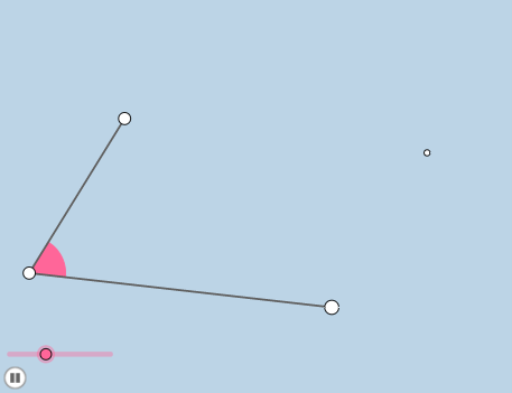
Loading the math board and drawing, please wait…
In collections
Congruence (CO) Cluster
Congruence (Vol 2)
CCSS High School: Geometry (Congruence) Volume 2
CCSS High School: Geometry (Congruence) Volume 2
CCSS High School: Geometry (Congruence) Volume 2
Geometry (Congruence) Volume 2
CCSS High School: Geometry (Congruence) Volume 2
CCSS High School: Geometry (Congruence) Volume 2
CCSS High School: Geometry (Congruence) Volume 2
CCSS High School: Geometry (Congruence) Volume 2
CCSS High School: Geometry (Congruence) Volume 2
CCSS High School: Geometry (Congruence) Volume 2
CCSS High School: Geometry (Congruence) Volume 2
Gail LeBlancCCSS High School: Geometry (Congruence) Volume 2
This example demonstrates a dynamic geometric animation driven by differential equations and linear functions, where a parallelogram, angles, and line segments continuously evolve under slider control, producing complex transformations. Core mathematical concepts include parallelogram properties, angle and segment relationships, differential equations (such as step functions), and the influence of linear functions on geometric parameters. The construction uses GeoGebra commands such as Rotate, Angle, Ray, Line, Point, Intersect, Segment, Min, Circle, Dilate, CircleSector, Vector, Polygon, and Translate, involving objects like points A, B, C, D, E, F, G, H, I, J, K, S and auxiliary elements (a, α, f, g, h, etc.). Suitable for high school and above to explore dynamic geometry and function modeling, and for teachers to demonstrate how parameter changes affect geometric structures.
GeoGebra Commands & Parameters
Rotate(B, a°, A) → B'Angle(B, A, B') → αRay(A, B) → fRay(A, B') → gLine(B, g) → hPoint(g) → CLine(C, f) → iIntersect(h, i) → DSegment(C, D) → jSegment(A, B) → kSegment(B, D) → lSegment(A, C) → mMin(m, k) → bCircle(C, (0.2 * b)) → dCircle(A, (0.2 * b)) → eCircle(B, (0.2 * b)) → pCircle(D, (0.2 * b)) → cIntersect(e, k, 1) → EIntersect(e, m, 1) → FIntersect(p, k, 1) → GIntersect(p, l, 1) → HIntersect(d, g, 2) → IRay(C, I) → qIntersect(c, h, 2) → JRay(D, J) → rIntersect(c, i, 2) → KRay(D, K) → sDilate(A, If[0 < o ≤ 1, 1 - o, 0], B) → A'Segment(A, A') → tRotate(E, If[1 < o ≤ 2, ((o - 1) * α), α], A) → E'CircleSector(A, E, E') → c_1Dilate(A, If[2 < o ≤ 3, 3 - o, 0], C) → A'_1Vector(A, A'_1) → uSegment(A, A'_1) → f_1Dilate(C, If[3 < o ≤ 4, 4 - o, 0], D) → C'Vector(C, C') → vSegment(C, C') → g_1Dilate(D, If[4 < o ≤ 5, 5 - o, 0], B) → D'Segment(D, D') → h_1Polygon(A, B, D, C) → poly1, a_1, b_1, d_2, c_2Dilate(A, If[5.5 < o ≤ 6.5, 6.5 - o, 0], C) → A'_2Vector(A, A'_2) → wTranslate(A, w) → A'_3Translate(A', w) → A''Dilate(A, If[6.5 < o ≤ 7.5, 7.5 - o, 0], B) → A'_4Vector(A, A'_4) → u_1Translate(A, u_1) → A'_5Translate(A'_1, u_1) → LIntersect(d, i) → M, NIntersect(d, g) → O, PAngle(A, C, N) → βRotate(N, If[6.5 < o ≤ 7.5, ((-(o - 6.5)) * β), (-β)], C) → N'Dilate(C, If[7.5 < o ≤ 8.5, 8.5 - o, 0], B) → C'_1Vector(C, C'_1) → v_1Intersect(d, f_1) → Q,Intersect(d, g_1) → R,Rotate(R, If[5 < o ≤ 6, ((-(o - 5)) * (π - α)), (-(π - α))], C) → R'CircleSector(C, R', R) → d_1Dilate(A, If[6 < o ≤ 7, 7 - o, 0], D) → A'_6Vector(A, A'_6) → w_1Translate(c_1, w_1) → e_1Rotate(e_1, If[7 < o ≤ 8, ((-(o - 7)) * π), (-π)], D) → k_1Dilate(C, If[8 < o ≤ 9, 9 - o, 0], B) → C'_2Vector(C, C'_2) → i_1Translate(d_1, i_1) → p_1Rotate(p_1, If[9 < o ≤ 10, ((-(o - 9)) * π), (-π)], B) → q_1Dilate(A, If[11 < o ≤ 12, 12 - o, 0], C) → A'_7Vector(A, A'_7) → j_1Translate(c_1, j_1) → r_1Dilate(C, If[12 < o ≤ 13, 13 - o, 0], D) → C'_3Vector(C, C'_3) → l_1Translate(r_1, l_1) → s_1