
Dynamic Construction of Exterior Angles for a Polygon
Loading the math board and drawing, please wait…
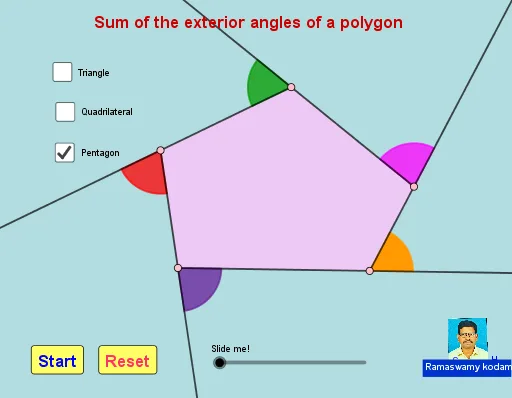
This example demonstrates how the exterior angles of a polygon can be constructed and visualized along its edges using geometric primitives and interactive construction steps. It focuses on the definition and measurement of exterior angles, the way angles can be represented via rays and angle sectors, and how supporting constructions can be generated through similarity-style operations. Key concepts include polygon exterior angles, angle construction, and using geometric transformations to obtain corresponding rays/angle regions. Construction is built with GeoGebra commands such as Ray (to set the exterior direction), Point and Polygon (to define vertices and the polygon), Circle plus Intersect (to place auxiliary intersection points), and CircleSector (to render the angle region clearly). Dilate and Translate are used to create corresponding/adjusted configurations, while Vector emphasizes directional information for the exterior-angle rays. The objects (e.g., labeled points like A, B, C, and additional helper points) organize the construction so students can verify relationships by visual and dynamic inspection. Suitable for middle-school geometry through early contest preparation, especially for teaching exterior-angle ideas and geometric construction skills.
GeoGebra Commands & Parameters
Ray(A, B) → fRay(B, C) → gRay(C, A) → hCircle(A, 1.5) → cCircle(B, 1.5) → dCircle(C, 1.5) → eIntersect(c, h) → D, EIntersect(c, f) → F,Intersect(d, f) → G, HIntersect(d, g) → I,Intersect(e, g) → J, KIntersect(e, h) → L,CircleSector(A, E, F) → kCircleSector(B, H, I) → pCircleSector(C, K, L) → qDilate(A, If[0 < a ≤ 1, 1 - a, 0], C) → A'Dilate(C, If[1 < a ≤ 2, 2 - a, 0], B) → C'Vector(A, A') → uTranslate(k, u) → k'Vector(C, C') → vTranslate(q, v) → q'Translate(k', v) → k''Ray(M, N) → iRay(N, O) → jRay(O, P) → lRay(P, M) → mCircle(M, 1.5) → rCircle(N, 1.5) → sCircle(P, 1.5) → tCircle(O, 1.5) → c_1Intersect(r, m) → Q, RIntersect(r, i) → S,Intersect(s, i) → T, UIntersect(s, j) → V,Intersect(c_1, j) → W, ZIntersect(c_1, l) → A_1,Intersect(t, l) → B_1, C_1Intersect(t, m) → D_1,CircleSector(M, R, S) → d_1CircleSector(N, U, V) → e_1CircleSector(O, Z, A_1) → f_1CircleSector(P, C_1, D_1) → g_1Dilate(M, If[0 < a ≤ 1, 1 - a, 0], P) → M'Dilate(P, If[1 < a ≤ 2, 2 - a, 0], O) → P'Dilate(O, If[2 < a ≤ 3, 3 - a, 0], N) → O'Vector(M, M') → wVector(P, P') → nVector(O, O') → u_1Translate(d_1, w) → h_1Translate(g_1, n) → k_1Translate(f_1, u_1) → p_1Translate(h_1, n) → q_1Translate(k_1, u_1) → r_1Translate(q_1, u_1) → s_1Ray(E_1, F_1) → i_1Ray(F_1, G_1) → j_1Ray(G_1, H_1) → l_1Ray(H_1, I_1) → m_1Ray(I_1, E_1) → n_1Circle(E_1, 1.5) → t_1Circle(I_1, 1.5) → c_2Circle(H_1, 1.5) → d_2Circle(G_1, 1.5) → e_2Circle(F_1, 1.5) → f_2Intersect(t_1, i_1) → J_1,Intersect(t_1, n_1) → K_1, L_1Intersect(c_2, n_1) → M_1,Intersect(c_2, m_1) → N_1, O_1Intersect(d_2, m_1) → P_1,Intersect(d_2, l_1) → Q_1, R_1Intersect(e_2, j_1) → S_1, T_1Intersect(e_2, l_1) → U_1,Intersect(f_2, i_1) → V_1, W_1Intersect(f_2, j_1) → Z_1,CircleSector(F_1, W_1, Z_1) → g_2CircleSector(G_1, T_1, U_1) → h_2CircleSector(H_1, R_1, P_1) → k_2CircleSector(I_1, O_1, M_1) → p_2CircleSector(E_1, L_1, J_1) → q_2Point(t_1) → A_2Dilate(E_1, If[0 < a ≤ 1, 1 - a, 0], I_1) → B_2Dilate(I_1, If[1 < a ≤ 2, 2 - a, 0], H_1) → C_2Dilate(H_1, If[2 < a ≤ 3, 3 - a, 0], G_1) → D_2Dilate(G_1, If[3 < a ≤ 4, 4 - a, 0], F_1) → E_2Vector(E_1, B_2) → v_1Vector(I_1, C_2) → w_1Vector(H_1, D_2) → a_1Vector(G_1, E_2) → b_1Translate(q_2, v_1) → r_2Translate(p_2, w_1) → s_2Translate(k_2, a_1) → t_2Translate(h_2, b_1) → c_3Translate(r_2, w_1) → d_3Translate(s_2, a_1) → e_3Translate(d_3, a_1) → f_3Translate(e_3, b_1) → g_3Translate(t_2, b_1) → h_3Translate(f_3, b_1) → k_3Polygon(E_1, F_1, G_1, H_1, I_1) → poly1, i_2, j_2, l_2, m_2, n_2Polygon(C, A, B) → t1, b_2, c_4, a_2Point(b_2) → F_2Polygon(M, N, O, P) → q1, m_3, n_3, o_2, p_3