
Drawing Similar Triangles
Loading the math board and drawing, please wait…
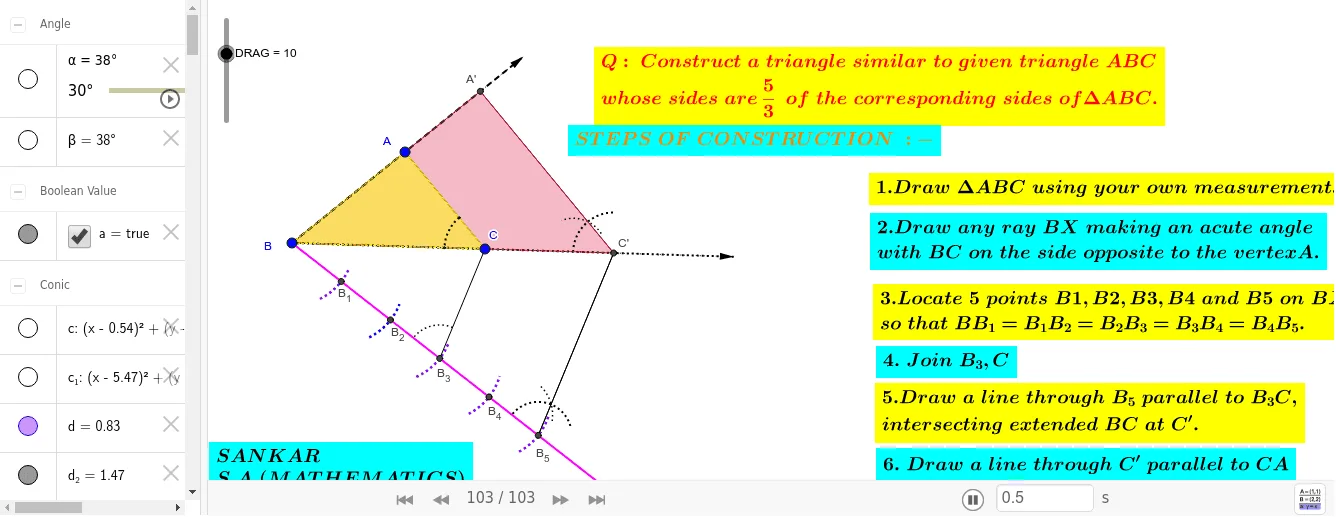
This example demonstrates how to draw similar triangles. Key mathematical concepts include the properties of similar triangles and geometric mean. Using GeoGebra commands such as Point, Segment, Rotate, etc., specific angles and side lengths are constructed to form similar triangles. Suitable for middle and high school students studying similar triangles.
GeoGebra Commands & Parameters
Point(Circle[B, DRAG]) → C_2Segment(B, C) → l_1Segment(B, A) → m_1Segment(C, A) → n_1Rotate(C_2, (-α), B) → B'Angle(B', B, C_2) → βVector(B, B') → uPoint(u) → X_1Circle(B, DRAG / 8) → cPoint(u) → XPoint(c) → C_1Point(c) → DCircleArc(B, C_1, D) → dSegment(B, B') → gIntersect(d, g, 1) → B_1Circle(B_1, DRAG / 8) → ePoint(e) → FPoint(e) → GCircleArc(B_1, F, G) → hIntersect(h, g) → B_2,Circle(B_2, DRAG / 8) → kPoint(k) → A_1Point(k) → ECircleArc(B_2, A_1, E) → pIntersect(p, g) → B_3,Circle(B_3, DRAG / 8) → qPoint(q) → IPoint(q) → JCircleArc(B_3, I, J) → rIntersect(r, g, 1) → B_4Circle(B_4, DRAG / 8) → sPoint(s) → KPoint(s) → LCircleArc(B_4, K, L) → tIntersect(t, g) → B_5,Circle(B_5, DRAG / 16) → c_1Intersect(c_1, g, 1) → MSegment(B_3, C) → f_2Line(B, C) → g_2Point(g_2) → H_1Line(B, A) → h_2Circle(B_3, DRAG / 16) → e_1Point(e_1) → NPoint(e_1) → OPoint(h_2) → I_1Segment(B, H_1) → i_2Vector(B, H_1) → vVector(B, I_1) → wPoint(u) → PCircle(B_3, P) → f_1Circle(B_5, Segment[B_3, P]) → g_1Intersect(f_1, f_2, 1) → QCircleArc(B_3, Q, P) → h_1Point(g_1) → RPoint(u) → J_1CircleArc(B_5, R, J_1) → d_2Circle(J_1, Segment[P, Q]) → e_2Point(e_2) → K_1Point(e_2) → L_1CircleArc(J_1, K_1, L_1) → k_2Line(B_5, f_2) → j_2Intersect(i_2, j_2) → M_1Segment(B_5, M_1) → b_1Circle(C, Segment[P, Q]) → p_2Intersect(i_2, b_1) → C'Circle(M_1, Segment[P, Q]) → p_1Intersect(p_2, n_1, 1) → UIntersect(p_2, l_1, 1) → VCircleArc(C, U, V) → q_1Point(p_1) → WIntersect(p_1, i_2, 1) → ZCircleArc(M_1, W, Z) → r_1Circle(Z, Segment[U, V]) → s_1Point(s_1) → D_1Point(s_1) → N_1CircleArc(Z, D_1, N_1) → t_1Line(M_1, n_1) → lPoint(w) → O_1Segment(B, O_1) → i_1Intersect(l, i_1) → A'_1Segment(B_5, M_1) → j_1Segment(M_1, A'_1) → a_1Intersect(i_1, a_1) → A'Polygon(A', B, C') → poly1, c', a', bPolygon(A, B, C) → poly2, c_2, a_2, b_2