
Drawing Lines of Symmetry with Polygon Mirroring in GeoGebra
Loading the math board and drawing, please wait…
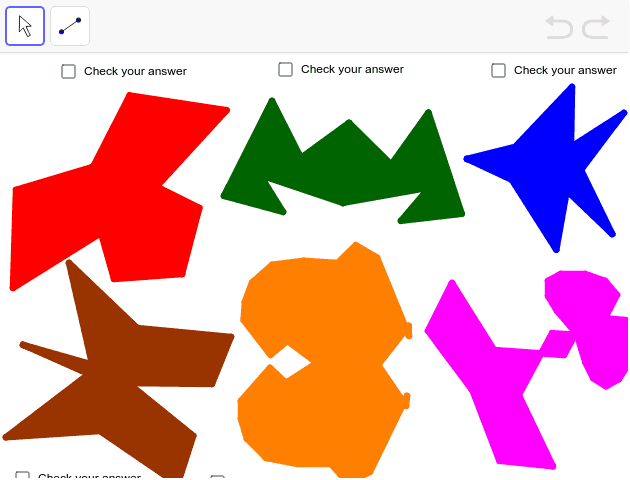
This GeoGebra example demonstrates how to construct polygons and their mirror images across a line of symmetry, offering a dynamic visualization of axial symmetry and reflection. The core mathematical concepts involved are symmetry, reflection transformation, polygons, and line segments. The construction uses the Polygon command to create polygon objects such as poly1, poly2, and poly3, the Mirror command to generate reflected figures across the symmetry axis, and the Segment command to draw the axis and related segments; points A through S and segment labels a–m, n–r are included. It is suitable for middle school and high school geometry instruction, classroom demonstrations of symmetric properties, and student-centered exploration of geometric transformations.
GeoGebra Commands & Parameters
Polygon(A, B, C, D, E, F) → poly1, a, b, c, d, e, fPolygon(G, H, I, J, K, L, M) → poly2, g, h, i, j, k, l, mPolygon(N, O, P, Q, R, S) → poly3, n, o, p, q, r, sPolygon(T, U, V, W, Z, A_1, B_1) → poly4, t, u, v, w, z, a_1, b_1Polygon(C_1, E_1, O_1, P_1, Q_1, R_1, F_1, H_1, I_1, J_1, K_1, L_1, M_1, N_1) → poly5, c_1, n_1, o_1, p_1, q_1, r_1, e_1, f_1, h_1, i_1, j_1, k_1, l_1, m_1Polygon(G_1, S_1, E_2, F_2, G_2, H_2, I_2, J_2, T_1, U_1, V_1, W_1, Z_1, B_2, C_2, D_2) → poly6, g_1, d_2, e_2, f_2, g_2, h_2, i_2, j_2, s_1, t_1, u_1, v_1, w_1, z_1, b_2, c_2Mirror(A, f) → A'Mirror(B, f) → B'Mirror(C, f) → C'Mirror(D, f) → D'Mirror(E, f) → E'Mirror(F, f) → F'Polygon(A', B', C', D', E', F') → poly1', a', b', c', d', e', f'Mirror(G, k) → G'Mirror(H, k) → H'Mirror(I, k) → I'Mirror(J, k) → J'Mirror(K, k) → K'Mirror(L, k) → L'Mirror(M, k) → M'Polygon(G', H', I', J', K', L', M') → poly2', g', h', i', j', k', l', m'Mirror(N, n) → N'Mirror(O, n) → O'Mirror(P, n) → P'Mirror(Q, n) → Q'Mirror(R, n) → R'Mirror(S, n) → S'Polygon(N', O', P', Q', R', S') → poly3', n', o', p', q', r', s'Mirror(T, v) → T'Mirror(U, v) → U'Mirror(V, v) → V'Mirror(W, v) → W'Mirror(Z, v) → Z'Mirror(A_1, v) → A_2Mirror(B_1, v) → K_2Polygon(T', U', V', W', Z', A_2, K_2) → poly4', t', u', v', w', z', a_2, k_2Mirror(C_1, r_1) → L_2Mirror(E_1, r_1) → M_2Mirror(F_1, r_1) → N_2Mirror(H_1, r_1) → O_2Mirror(I_1, r_1) → P_2Mirror(J_1, r_1) → Q_2Mirror(K_1, r_1) → R_2Mirror(L_1, r_1) → S_2Mirror(M_1, r_1) → T_2Mirror(N_1, r_1) → U_2Mirror(O_1, r_1) → V_2Mirror(P_1, r_1) → W_2Mirror(Q_1, r_1) → Z_2Mirror(R_1, r_1) → A_3Polygon(L_2, M_2, V_2, W_2, Z_2, A_3, N_2, O_2, P_2, Q_2, R_2, S_2, T_2, U_2) → poly5', l_2, u_2, v_2, w_2, z_2, a_3, m_2, n_2, o_2, p_2, q_2, r_2, s_2, t_2Mirror(G_1, h_2) → B_3Mirror(S_1, h_2) → C_3Mirror(T_1, h_2) → D_3Mirror(U_1, h_2) → E_3Mirror(V_1, h_2) → F_3Mirror(W_1, h_2) → G_3Mirror(Z_1, h_2) → H_3Mirror(B_2, h_2) → I_3Mirror(C_2, h_2) → J_3Mirror(D_2, h_2) → K_3Mirror(E_2, h_2) → L_3Mirror(F_2, h_2) → M_3Mirror(G_2, h_2) → N_3Mirror(H_2, h_2) → O_3Mirror(I_2, h_2) → P_3Mirror(J_2, h_2) → Q_3Polygon(B_3, C_3, L_3, M_3, N_3, O_3, P_3, Q_3, D_3, E_3, F_3, G_3, H_3, I_3, J_3, K_3) → poly6', b_3, k_3, l_3, m_3, n_3, o_3, p_3, q_3, c_3, d_3, e_3, f_3, g_3, h_3, i_3, j_3Segment(R_3, S_3) → d_1Segment(T_3, U_3) → r_3Segment(V_3, W_3) → s_3Segment(Z_3, A_4) → t_3Segment(B_4, D_1) → a_4Segment(C_4, D_4) → b_4