
Diagonals of a Kite by m.west
Loading the math board and drawing, please wait…
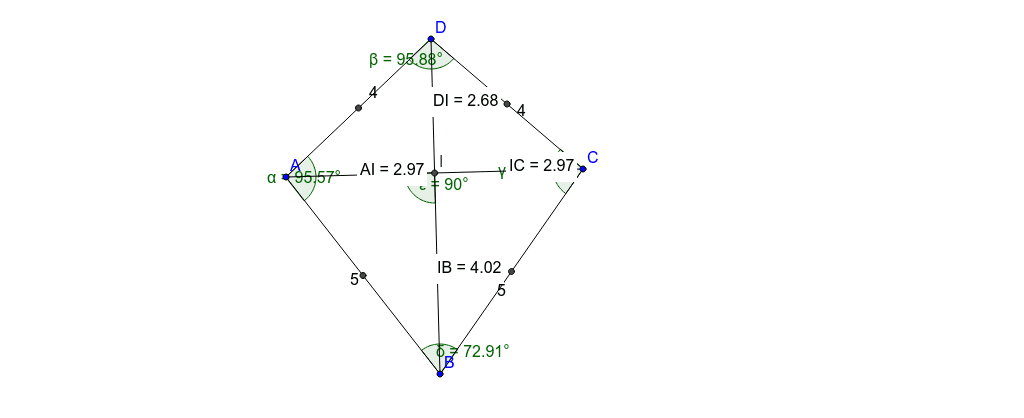
This example demonstrates the properties of the diagonals of a kite. Key mathematical concepts include the definition and properties of a kite. Construction highlights include using the Segment, Angle, Midpoint, Intersect, and Distance commands. Suitable for middle school and above students to learn geometric construction.
GeoGebra Commands & Parameters
Segment(A, D) → aSegment(D, C) → bSegment(C, B) → cSegment(A, B) → dAngle(B, A, D) → αAngle(A, D, C) → βAngle(D, C, B) → γAngle(C, B, A) → δMidpoint(A, D) → EMidpoint(D, C) → FMidpoint(C, B) → GMidpoint(B, A) → HSegment(D, B) → eSegment(C, A) → fIntersect(e, f) → IDistance(D, I) → distanceDIDistance(I, B) → distanceIBDistance(A, I) → distanceAIDistance(I, C) → distanceICAngle(f, e) → ε
AI Drawing Prompt Reference
Draw a kite-shaped figure. Mark four vertices as A, B, C, and D. Connect segments between A and D, A and B, A and C, and B and C. Find the intersection point I of these segments and calculate distances from I to each vertex. Ensure symmetry and label angles and segments.
The prompt above was compiled from the original drawing commands and is for reference only.