
Rhombus Diagonals by m.west
Loading the math board and drawing, please wait…
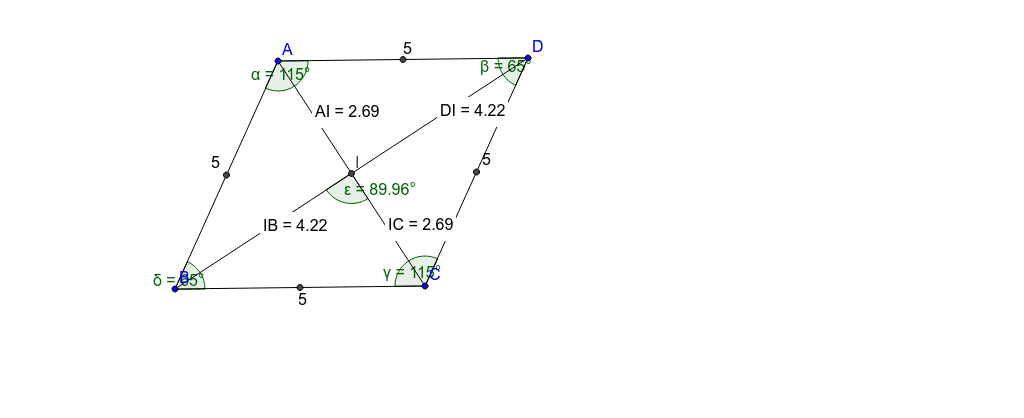
This example demonstrates the properties and relationships of diagonals in a rhombus. Key math concepts include perpendicular bisectors, angle bisectors, and distance calculations. It uses commands like Segment, Angle, Midpoint, Intersect, and Distance in GeoGebra, along with auxiliary points and text objects. Suitable for high school geometry and introductory calculus applications.
GeoGebra Commands & Parameters
Segment(A, D) → aSegment(D, C) → bSegment(C, B) → cSegment(A, B) → dAngle(B, A, D) → αAngle(A, D, C) → βAngle(D, C, B) → γAngle(C, B, A) → δMidpoint(A, D) → EMidpoint(D, C) → FMidpoint(C, B) → GMidpoint(B, A) → HSegment(D, B) → eSegment(A, C) → fIntersect(e, f) → IDistance(D, I) → distanceDIMidpoint(D, I) →Distance(I, B) → distanceIBMidpoint(I, B) →Distance(A, I) → distanceAIMidpoint(A, I) →Distance(I, C) → distanceICMidpoint(I, C) →Angle(e, f) → ε
AI Drawing Prompt Reference
Draw a rhombus ABCD, connect its diagonals AC and BD, and mark their intersection point I. Measure and label the lengths of segments DI, IB, AI, and IC, as well as the angle ε between diagonals AC and BD. Find the midpoints E, F, G, and H of the diagonals and measure their distances to point I.
The prompt above was compiled from the original drawing commands and is for reference only.