
Deriving the Volume Formula of a Pyramid with Geometric Construction
Loading the math board and drawing, please wait…
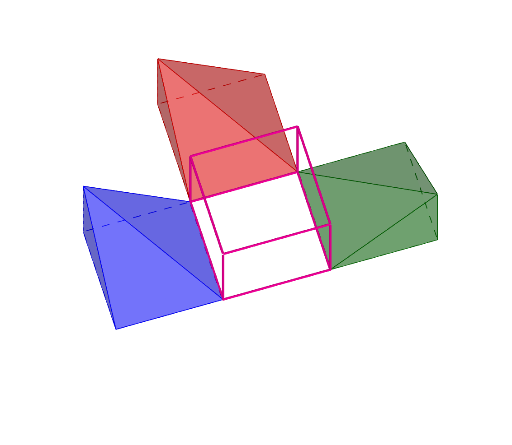
This GeoGebra example demonstrates how to derive the volume of a pyramid by building a clear geometric relationship between the pyramid and its base area and height. The key ideas are solid geometry (pyramid structure and base/side relationships), the volume-proportion principle for solids with equal bases and heights (commonly the 1/3 factor), and accompanying algebraic manipulation, including simplification that naturally leads to fractional coefficients in the final formula. Construction-wise, it uses GeoGebra commands such as Line to create auxiliary construction lines, Polygon to form the relevant faces/boundary shapes, and Segment to highlight critical edges. Rotate is used to align or replicate parts of the configuration via symmetry, producing equivalent geometric components needed for the derivation. The construction is supported by multiple labeled points (e.g., A, B, C, D and their rotated counterparts A′, B′, C′, D′, etc.), which encode the geometric dependencies used throughout the derivation. Suitable for middle school to early university instruction, classroom demonstrations, and STEM learning activities focused on understanding why the pyramid volume formula works, not just memorizing it.
GeoGebra Commands & Parameters
Line(E, F) → fRotate(A, a, f) → A'Rotate(B, a, f) → B'Rotate(D, a, f) → D'Line(F, G) → gRotate(C, a, g) → C'Rotate(B, a, g) → B'_{1}Rotate(D, a, g) → D'_{1}Polygon(G, F, B'_{1}, C') → q1, g_1, f_1, b'_{1}, c'Polygon(B'_{1}, D'_{1}, C') → t1, h, i, d'_{1}Polygon(F, B'_{1}, D'_{1}) → t2, j, f_2, kPolygon(D'_{1}, G, F) → t3, f_3, l, g_2Polygon(D'_{1}, C', G) → t4, g_3, m, nPolygon(A', B', F, E) → q2, a', b', f_4, ePolygon(D', A', B') → t5, p, d', qPolygon(F, B', D') → t6, r, f_5, sPolygon(E, D', A') → t7, t, e_1, b_{2}Polygon(F, E, D') → t8, c, f_6, e_2Line(C, G) → dRotate(H, a, d) → H'Rotate(E, a, d) → E'Rotate(F, a, d) → F'Rotate(D, a, d) → D'_{2}Polygon(G, H', E', F') → q3, g_4, h', e', f'Polygon(D'_{2}, H', E') → t9, h_1, d'_{2}, i_1Polygon(D'_{2}, F', E') → t10, j_1, k_1, l_1Polygon(D'_{2}, G, F') → t11, m_1, n_1, g_5Polygon(D'_{2}, G, H') → t12, p_1, q_1, g_6Segment(B, F) → r_1Segment(A, B) → s_1Segment(B, C) → t_1Segment(C, D) → a_1Segment(D, A) → b_1Segment(A, E) → c_1Segment(E, F) → d_1Segment(F, G) → h_2Segment(C, G) → l_2Segment(G, H) → i_2Segment(D, H) → j_2Segment(H, E) → k_2
AI Drawing Prompt Reference
Create a geometric construction diagram for deriving the volume of a pyramid. Start with a quadrilateral base and draw its boundary by connecting adjacent base vertices. Define the pyramid’s essential vertical/edge relationships by drawing the key edges and auxiliary lines that partition the visible lateral faces into several triangular regions. Then rotate part of the base-and-side configuration around a single axis to produce corresponding copied points and faces in equivalent positions. Trace multiple polygons to represent each partitioned face piece, layered on the same drawing. Finally, emphasize the critical edge relationships using highlighted segments that connect base vertices to important construction points and to the auxiliary axis-related connections.
The prompt above was compiled from the original drawing commands and is for reference only.