
120-Vertex Polyhedron from a Biscribed Pentakis Dodecahedron via Trisection of 1
Loading the math board and drawing, please wait…
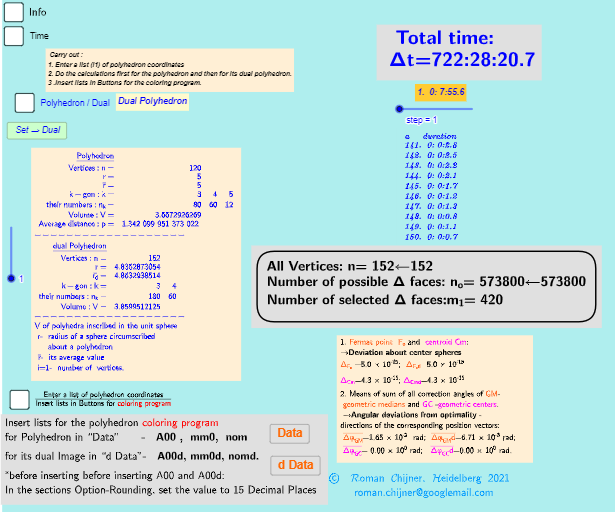
This example demonstrates how to construct and visualize a polyhedron with 120 vertices from a biscribed pentakis dodecahedron, specifically when the 10th-order segments are trisected. It highlights the geometric effect of enforcing a trisection rule on a highly structured, symmetric polyhedral configuration, and it supports quantitative checks by computing volume-related measures (e.g., comparing sphere-related volume terms and polyhedron volume terms). Key mathematical ideas include polyhedral construction from higher-order segment subdivision, symmetry/congruence-style equivalence between parts, parameterized geometry using indexed vectors/points, and length/range control through segment division. In GeoGebra, the construction workflow leverages commands such as Text and TableText for labeling and tabulating results, Sum for aggregating totals, If for conditional rules, Length/Sequence/Div for generating segment lengths and index sequences, and Element/IndexOf/First for extracting specific items from sequences. Max is used to obtain boundary or extremal parameters. Relevant objects include mm5/mm5a, m01/m02, txt_p and txtUm1 for annotations, r_m and r_d for radii/derived parameters, A00/A00_0 for intermediate parameters, and volume variables such as Volsphere, Vol, and Vol_r (and their suffixed variants) to connect geometry with computed quantities. Suitable for high school advanced geometry through undergraduate computational geometry visualization and parametric modeling.
GeoGebra Commands & Parameters
Text("" + p) → txt_pSum(Flatten[Sequence[Append[Sequence[Element[txt_p, i], i, m01(k), m02(k)], " "], k, 1, 5]]) → txtUm1If(bu0, A00, A00d) → A00_0Length(A00_0) → nLength(l2) → läl2Sequence(sgn(Determinant[{Element[A00_0, i1] - Element[A00_0, j], Element[A00_0, i2] - Element[A00_0, j], Element[A00_0, i3] - Element[A00_0, j]}]), j, 1, n) → l01Length(A00d) → zzzSum(Zip[(T * F), T, SysTimeAkt1, F, {1, 1000, 60000, 3600000, 86400000}]) → TimeAbs1Sum(Zip[(T * F), T, SysTimeAkt2, F, {1, 1000, 60000, 3600000, 86400000}]) → TimeAbs2Div(TimeRelab, 3600) → HDiv(TimeRelab - (H * 3600), 60) → MElement(ZwZeit, step) → text10TableText({Append["a duration", Last[ZwZeit, Min[10, Length[ZwZeit]]]]}, "v") → text2cLength(A00) → lm1If(Length[Unique[l01 \ {0}]] ≟ 1, 7, -7) → a7Sum(Zip[(T * F), T, SysTimeAkt0, F, {1, 1000, 60000, 3600000, 86400000}]) → TimeAbs0Div(TimeRelab0, 3600) → H0Div(TimeRelab0 - (H0 * 3600), 60) → M0Text("" + (TimeRelab0 - (H0 * 3600) - (M0 * 60))) → S0aText("" + (TimeRelab - (H * 3600) - (M * 60))) → SIndexOf(".", S) → indexIndexOf(".", S0a) → indexaFirst(S, index + 1) → txtSFirst(S0a, indexa + 1) → txtS0aIf(bu0, " ", "d") → txtbuoMax(Length[A00], Length[A00d]) → maxläElement(A00, 24) → m11TableText({{"\underline{Polyhedron}"}, Append["Vertices: n=", {Length[A00]}], Append["r=", {r}], Append["\bar{r}=", {r_m}], Append["k-gon : k=", mm5a], Append["their\; numbers: n_k=", mm7a], Append["Volume: V=", {Vol_r}], Append["Average\; distance: p=", {txtUm1}]}, "hr ") → text7TableText({{"\underline{dual\;Polyhedron}"}, Append["Vertices: n=", {Length[A00d]}], Append["r=", {r_d}], Append[" \bar{r_d}= ", {r_md}], Append["k-gon : k=", mm5ad], Append["their\; numbers: n_k=", mm7ad], Append["Volume: V=", {Vold_r}]}, "hr ") → text20
AI Drawing Prompt Reference
Draw a polyhedron with 120 vertices constructed from a biscribed pentakis dodecahedron by trisecting the 10th-order segments. Start by constructing a biscribed pentakis dodecahedron, then trisect the 10th-order segments to generate new vertices, forming the new polyhedron. Display the number of vertices, radius, average distance, number of edges, and volume of the polyhedron.
The prompt above was compiled from the original drawing commands and is for reference only.