
Deriving the Area of a Trapezium Using a Parallelogram
Loading the math board and drawing, please wait…
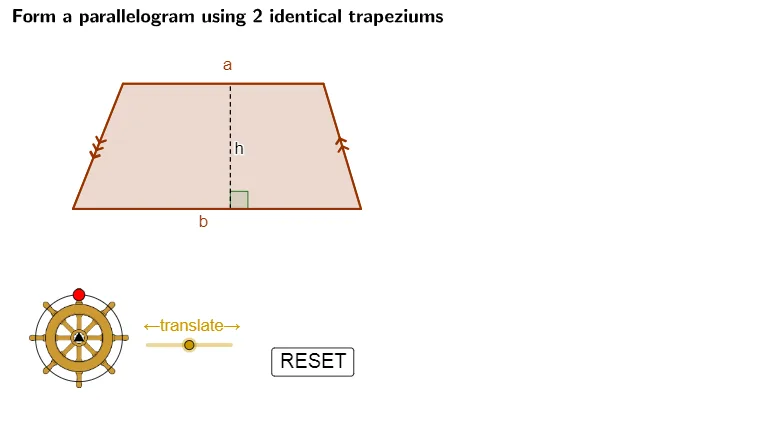
This GeoGebra example demonstrates how to derive the area formula of a trapezium by transforming it into a parallelogram through rotation and translation. The core mathematical concepts include the area of trapezium and parallelogram, the relationship between base, height, and area, as well as geometric transformations such as translation and rotation. The construction uses GeoGebra commands including Point, Line, Segment, Vector, Polygon, Angle, Circle, Rotate, Midpoint, Translate, and IsInRegion to build the trapezium, create the parallelogram, and verify the area equivalence. This interactive activity is suitable for middle or high school students to explore the geometric derivation of the area formula, enhancing their understanding of shape relationships and transformation-based reasoning.
GeoGebra Commands & Parameters
Point(Circle[A, l_{ab}]) → BLine(A, B) → a_1Point(a_1) → ESegment(E, F) → eVector(V1, V2) → uPolygon(A, B, C, D) → poly1, a, b, c, dAngle(a, e) → αCircle(W_o, sqrt(8)) → gPoint(g) → W_{2o}Point(g) → W_{1o}Point(g) → W_nCircle(W_o, sqrt(3)) → fPoint(f) → KLine(C, D) → c_1Line(E, F) → b_1Line(W_o, W_n) → w_iAngle(K, W_o, W_n) → βRotate(W_{1o}, (-β), W_o) → W_1Rotate(W_{2o}, (-β), W_o) → W_2Midpoint(E, F) → M_{EF}Rotate(A, (-β), M_{EF}) → A'_1Rotate(B, (-β), M_{EF}) → B'_1Rotate(C, (-β), M_{EF}) → C'_1Rotate(D, (-β), M_{EF}) → D'Polygon(A'_1, B'_1, C'_1, D') → poly1', a1, b1, c1, d1Translate(A'_1, u) → GTranslate(B'_1, u) → HTranslate(C'_1, u) → ITranslate(D', u) → D''Polygon(G, H, I, D'') → poly1'', a2, b2, c2, d2Circle(B, ε) → kIsInRegion(I, k) → snapBI
AI Drawing Prompt Reference
Draw a trapezoid and transform it into a parallelogram through rotation and translation to demonstrate the derivation of the area formula. Start by sketching the trapezoid, then find the midpoint of one side, rotate the trapezoid around this midpoint to make it parallel to the other side, forming a parallelogram. Next, translate the rotated trapezoid along one side of the parallelogram to confirm the area remains unchanged. Highlight the rotation angle, translation vector, and geometric relationships throughout the process.
The prompt above was compiled from the original drawing commands and is for reference only.