
Gradient Relations for Mutually Perpendicular Lines
Loading the math board and drawing, please wait…
In collections
Coordinate Geometry of Straight Lines (E Math)
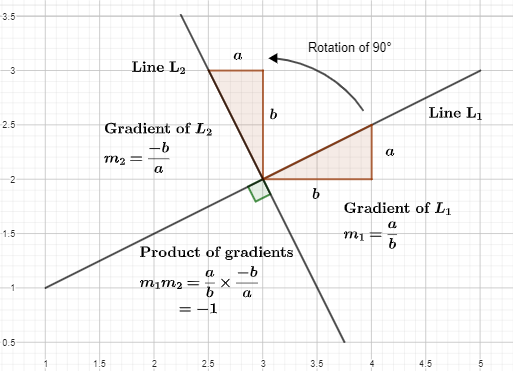
This example visually constructs two mutually perpendicular lines in a shared geometry/coordinate setting and demonstrates how their gradients (slopes) correspond consistently with the perpendicularity condition. The key mathematics includes the definition of line slope, the classic relationship between slopes of perpendicular lines (commonly expressed as a negative reciprocal product), and how angle measurement and orthogonality translate between geometric constraints and analytic properties in coordinate geometry. Construction highlights in GeoGebra: Segment to build the defining line segments (using objects such as A and B), Point to place and control critical points, OrthogonalLine to generate the line perpendicular to a given one (objects like c, d, e along with their primed counterparts), Polygon to assemble the overall shape and visualize structural relationships (including rhombus-like configuration), Rotate to align directions via rotation, Angle to measure and control the relevant angle (e.g., α and α′), and CircleArc to support angle visualization or intermediate construction steps. Text labels (text1–text4) are used to annotate key quantities. Suitable for middle/high school and early university learners in analytic geometry and geometric construction, especially for teaching and exploring slope–perpendicularity intuition.
GeoGebra Commands & Parameters
Segment(A, B) → fPoint(f) → COrthogonalLine(C, f) → gPoint(f) → EPolygon(C, D, E, F) → q1, c, d, e, f_1Rotate(C, 90°, C) → C'Rotate(D, 90°, C) → D'Rotate(E, 90°, C) → E'Rotate(F, 90°, C) → F'Polygon(C', D', E', F') → q1', c', d', e', f'Point(g) → GPoint(f) → HAngle(H, C, G) → αPolygon(C, D, E) → t1, e_1, c_1, d_1Polygon(C, D', E') → t2, h, c_2, iCircleArc(C, E, E') → kPoint(k) → IPoint(k) → JCircleArc(C, I, J) → pAngle(I, C, J) → βPoint(g) → KPoint(g) → LSegment(K, L) → j
AI Drawing Prompt Reference
Draw two mutually perpendicular lines, one horizontal segment and a perpendicular line through a point on it. Place several points on the horizontal segmenthol and construct a quadrilateral, then rotate it 90 degrees around the intersection point to form a second quadrilateral, creating a rhombus-like arrangement. Connect corresponding points with circular arcs and label the angle to show the slope relationship. Annotate that the product of slopes is negative one.
The prompt above was compiled from the original drawing commands and is for reference only.