
Graphing Parabolas via Geometric Construction
Loading the math board and drawing, please wait…
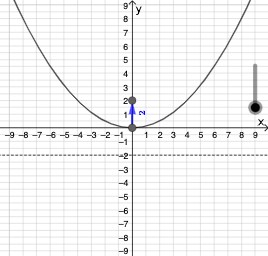
This example demonstrates how to graph parabolas on the coordinate plane using geometric construction tools. It highlights core ideas from quadratic functions and conic sections, emphasizing how geometric components correspond to the shape and features of a parabola. The construction uses GeoGebra commands such as Point, Line, Vector, Segment, and Polygon to build the necessary geometric primitives, while RotateText improves readability of labels. It also employs Random, Sequence, and RandomElement to vary parameters or select construction points, and uses If and Simplify to apply conditional logic and streamline expressions. Objects (e.g., points A, B, C, D, E and parameters like a, b, c, d) represent the variable elements that control the parabola’s configuration, and equations (eq1, eq2, eq3) encode constraints/relationships that determine the final curve. Suitable for middle-school through early university learning, it supports classroom teaching, inquiry-based exploration, and GeoGebra graphing practice by connecting geometric constructions to function graphs.
GeoGebra Commands & Parameters
Point(Segment[(h, y(C) + 10), (h, y(C) - 10)]) → DLine(A, B) → fVector(A, C) → uPolygon(A, C, B) → t1, b, a_1, cRotateText(text2, pi / 2) → text3Segment(A, C) → h_{1}Vector(C, D) → vVector((h, 0), A) → wVector((0, 0), (h, 0)) → jPoint(Segment[(x(C) - 10, k), (x(C) + 10, k)]) → EVector(A, E) → pPoint(q) → HPoint(eq3) → KRandom(0, 1) → choiceSequence(i, i, -8, 8, 1) → wholenosRandomElement(wholenos) → h_2RandomElement(wholenos) → k_2RandomElement(partnos) → p_2If(choice ≟ 0, (x - h_2)^(2) = ((4 * p_2) * (y - k_2)), (y - k_2)^(2) = ((4 * p_2) * (x - h_2))) → eq4Simplify(x - h_2) → rSimplify(y - k_2) → t
AI Drawing Prompt Reference
Draw a parabola on a coordinate plane using geometric construction methods. Create control points related to the focus and directrix on the axes, then use these points to construct vectors and polygons representing the geometric definition of the parabola. Generate a dynamic parabola equation that switches between horizontal form (y-k)²=4p(x-h) and vertical form (x-h)²=4p(y-k) based on randomly selected parameters. Show the vertex, focus, and directrix positions through geometric figures, demonstrating the relationship between the parabola and coordinate axes. Present a complete parabola image combining algebraic equations with geometric construction.
The prompt above was compiled from the original drawing commands and is for reference only.