
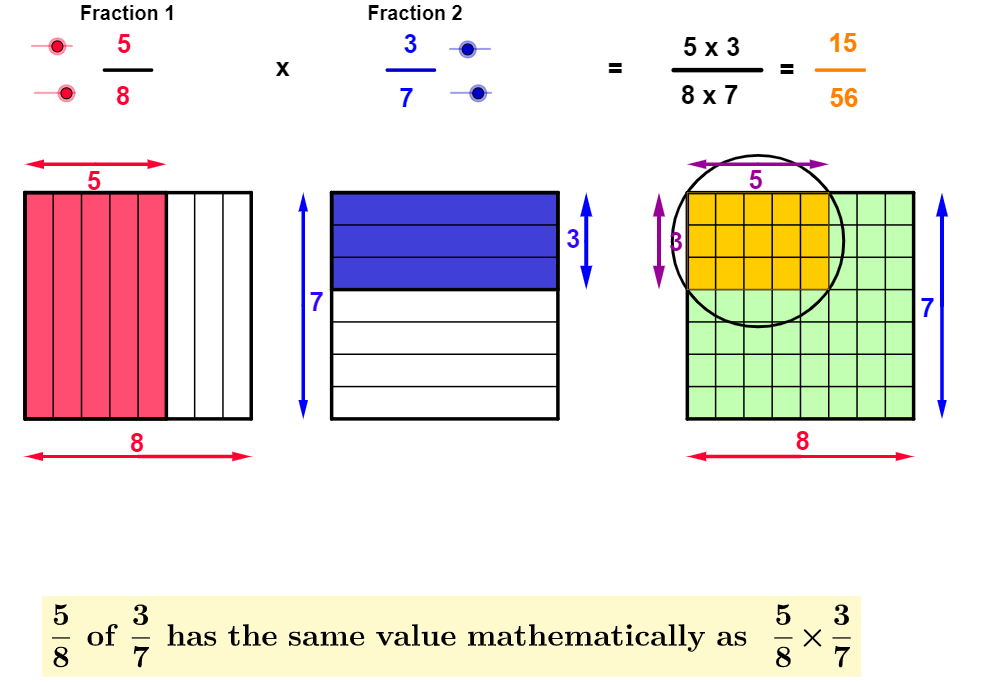
Visualization of Fraction Multiplication
Loading the math board and drawing, please wait…
In collections
Primary School Mathematics Collection
This example demonstrates fraction multiplication through geometric diagrams. Key mathematical concepts include fraction operations, geometric transformations, and proportionality. Construction involves GeoGebra commands like OrthogonalLine, Circle, Intersect, etc. Suitable for middle school students or math teaching demonstrations.
GeoGebra Commands & Parameters
OrthogonalLine(A, yAxis) → eOrthogonalLine(A, e) → fCircle(A, Taille) → hIntersect(h, e, 1) → BIntersect(h, f, 2) → CIntersect(h, e, 1) → DOrthogonalLine(B, e) → iIntersect(h, f, 2) → EOrthogonalLine(C, f) → jIntersect(i, j) → FPolygon(A, B, F, C) → P, a_1, b_1, f_1, c_1Circle(A, VarRayon) → kIntersect(k, a_1) → G,Circle(G, A) → pIntersect(p, a_1, 2) → HCircle(H, G) → qIntersect(q, a_1) → I, JCircle(J, H) → rIntersect(r, a_1) → K, LCircle(L, J) → sIntersect(s, a_1) → M, NCircle(N, L) → tIntersect(t, a_1) → O, QCircle(Q, N) → d_1Intersect(d_1, a_1) → R, SCircle(S, Q) → e_1Intersect(e_1, a_1) → T, UCircle(U, S) → g_1Intersect(g_1, a_1) → V, WCircle(W, U) → h_1OrthogonalLine(G, a_1) → lOrthogonalLine(H, a_1) → mOrthogonalLine(J, a_1) → nOrthogonalLine(L, a_1) → i_1OrthogonalLine(N, a_1) → j_1OrthogonalLine(Q, a_1) → k_1OrthogonalLine(S, a_1) → l_1OrthogonalLine(U, a_1) → m_1OrthogonalLine(W, a_1) → n_1Intersect(f_1, l) → YIntersect(f_1, m) → ZIntersect(f_1, n) → A_1Intersect(f_1, i_1) → B_1Intersect(f_1, j_1) → C_1Intersect(f_1, k_1) → D_1Intersect(l_1, f_1) → E_1Intersect(f_1, m_1) → F_1Intersect(f_1, n_1) → G_1Ray(A, B) → p_1Point(p_1) → H_1Vector(A, H_1) → uTranslate(A, u) → A'Translate(B, u) → B'Translate(F, u) → F'Translate(C, u) → C'Polygon(A', B', F', C') → P', a', b', f', c'OrthogonalLine(V, a_1) → q_1Circle(V, U) → r_1Segment(G, Y) → s_1Segment(H, Z) → t_1Segment(J, A_1) → a_2Segment(L, B_1) → b_2Segment(N, C_1) → c_2Segment(Q, D_1) → d_2Segment(S, E_1) → e_2Segment(U, F_1) → f_2Segment(W, G_1) → g_2Circle(H_1, VarRayon_2) → h_2Intersect(h_2, c', 1) → J_1Circle(J_1, H_1) → k_2Intersect(k_2, c', 2) → K_1Circle(K_1, J_1) → p_2Intersect(p_2, c', 2) → L_1Circle(L_1, K_1) → q_2Intersect(q_2, c', 2) → M_1Circle(M_1, L_1) → r_2Intersect(r_2, c', 2) → N_1Circle(N_1, M_1) → s_2Intersect(s_2, c') → O_1, P_1Circle(P_1, N_1) → t_2Intersect(t_2, c', 2) → Q_1Circle(Q_1, P_1) → c_3Intersect(c_3, c', 2) → R_1Circle(R_1, Q_1) → d_3Intersect(d_3, c', 2) → S_1Circle(S_1, R_1) → e_3OrthogonalLine(J_1, c') → i_2OrthogonalLine(K_1, c') → j_2OrthogonalLine(L_1, c') → l_2OrthogonalLine(M_1, c') → m_2OrthogonalLine(N_1, c') → n_2OrthogonalLine(P_1, c') → a_3OrthogonalLine(Q_1, c') → b_3OrthogonalLine(R_1, c') → f_3OrthogonalLine(S_1, c') → g_3Intersect(b', i_2) → T_1Intersect(b', j_2) → U_1Intersect(b', l_2) → V_1Intersect(b', m_2) → W_1Intersect(b', n_2) → Y_1Intersect(b', a_3) → Z_1Intersect(b', b_3) → A_2Intersect(b', f_3) → B_2Intersect(b', g_3) → C_2Segment(J_1, T_1) → h_3Segment(U_1, K_1) → i_3Segment(L_1, V_1) → j_3Segment(W_1, M_1) → k_3Segment(N_1, Y_1) → l_3Segment(Z_1, P_1) → m_3Segment(Q_1, A_2) → n_3Segment(B_2, R_1) → p_3Segment(S_1, C_2) → q_3Circle(A, largeur_1) → r_3Intersect(r_3, a_1) → D_2, S_2OrthogonalLine(D_2, f_1) → s_3Intersect(s_3, f_1) → E_2OrthogonalLine(E_2, s_3) → t_3Intersect(t_3, c_1) → F_2Polygon(A, D_2, E_2, F_2) → P_2, a_4, d_4, e_4, f_4OrthogonalLine(O, a_1) → b_4Intersect(b_4, f_1) → G_2Circle(O, N) → g_4Circle(O_1, N_1) → q_4OrthogonalLine(O_1, c') → t_4Circle(H_1, Largeur_2) → h_5Intersect(h_5, c') → F_3, B1OrthogonalLine(F_3, c') → i_5Intersect(i_5, b') → G_3Polygon(H_1, F_3, G_3, B') → P_3, h_6, f_6, g_6, b'_1Line(A, H_1) → aPoint(a) → A1Line(A1, yAxis) → bMirror(A', b) → A''Mirror(B', b) → B''Mirror(F', b) → F''Mirror(C', b) → C''Polygon(A'', B'', F'', C'') → P'', a'', b'', f'', c''Mirror(H_1, b) → H_1'Mirror(F_3, b) → F_3'Mirror(G_3, b) → G_3'Mirror(B', b) → B''_1Polygon(H_1', F_3', G_3', B''_1) → P_3', h_1', f_3', g_3', b''_1Mirror(J_1, b) → J_1'Mirror(T_1, b) → T_1'Segment(J_1', T_1') → cMirror(U_1, b) → U_1'Mirror(K_1, b) → K_1'Segment(U_1', K_1') → dMirror(L_1, b) → L_1'Mirror(V_1, b) → V_1'Segment(L_1', V_1') → gMirror(W_1, b) → W_1'Mirror(M_1, b) → M_1'Segment(W_1', M_1') → a1Mirror(N_1, b) → N_1'Mirror(Y_1, b) → Y_1'Segment(N_1', Y_1') → b1Mirror(Z_1, b) → Z_1'Mirror(P_1, b) → P_1'Segment(Z_1', P_1') → c1Mirror(Q_1, b) → Q_1'Mirror(A_2, b) → A_2'Segment(Q_1', A_2') → d1Mirror(B_2, b) → B_2'Mirror(R_1, b) → R_1'Segment(B_2', R_1') → e1Mirror(S_1, b) → S_1'Mirror(C_2, b) → C_2'Segment(S_1', C_2') → f1Vector(A, B'') → vTranslate(A, v) → A'_1Translate(D_2, v) → D_2'Translate(E_2, v) → E_2'Translate(F_2, v) → F_2'Polygon(A'_1, D_2', E_2', F_2') → P_2', a'_1, d_2', e_2', f_2'Translate(G, v) → G'Translate(Y, v) → Y'Segment(G', Y') → g1Translate(H, v) → H'Translate(Z, v) → Z'Segment(H', Z') → h1Translate(J, v) → J'Translate(A_1, v) → A_1'Segment(J', A_1') → i1Translate(L, v) → L'Translate(B_1, v) → B_1'Segment(L', B_1') → j1Translate(N, v) → N'Translate(C_1, v) → C_1'Segment(N', C_1') → k1Translate(Q, v) → Q'Translate(D_1, v) → D_1'Segment(Q', D_1') → l1Translate(S, v) → S'Translate(E_1, v) → E_1'Segment(S', E_1') → m1Translate(U, v) → U'Translate(F_1, v) → F_1'Segment(U', F_1') → n1Translate(W, v) → W'Translate(G_1, v) → G_1'Segment(W', G_1') → p1Midpoint(f_1) → C1Midpoint(g_6) → E1Midpoint(c') → D1Midpoint(f'') → F1Midpoint(c'') → G1Midpoint(a_4) → H1Midpoint(a'_1) → I1Midpoint(g_3') → J1Circle(D1, 1.5) → q1Circle(C1, 2) → r1Circle(F1, 2) → s1Circle(G1, 1.5) → t1Line(C1, b) → a2Intersect(r1, a2) → K1, L1Line(L1, f_1) → b2Intersect(s1, b2) → M1, N1Line(F_2', b) → c2Line(C'', b) → d2Line(F, b) → e2Line(C, b) → f2Intersect(e2, b2) → O1Intersect(e2, f2) → P1Intersect(b2, f2) → Q1Vector(L1, O1) → wVector(L1, Q1) → zLine(D_2, b) → g2Circle(H1, 1.5) → h2Line(H1, b) → i2Intersect(h2, i2) → R1, S1Line(R1, v) → j2Intersect(g2, j2) → U1Intersect(f2, j2) → V1Circle(I1, 1.5) → k2Intersect(k2, j2) → W1, Z1Line(D_2', b) → l2Intersect(l2, j2) → A2Intersect(c2, j2) → B2Intersect(b2, c2) → C2Intersect(b2, d2) → D2Vector(R1, U1) → u1Vector(R1, V1) → v1Vector(W1, A2) → w1Vector(W1, B2) → z1Vector(M1, C2) → u2Vector(M1, D2) → v2Line(F, C') → m2Line(D1, j2) → n2Intersect(q1, n2) → E2, F2Line(E2, b) → p2Intersect(p2, m2) → G2Line(H_1, B) → q2Intersect(q2, p2) → H2Vector(E2, H2) → w2Vector(E2, G2) → z2Line(G_3, j2) → r2Circle(E1, 1.5) → s2Circle(J1, 1.5) → t2Intersect(t1, n2) → I2, J2Line(J2, b) → a3Intersect(q2, a3) → K2Intersect(m2, a3) → L2Vector(J2, K2) → u3Vector(J2, L2) → v3Line(J1, j2) → b3Intersect(t2, b3) → M2, N2Line(M2, b) → c3Intersect(c3, q2) → O2Intersect(r2, c3) → P2Vector(M2, O2) → w3Vector(M2, P2) → z3Intersect(s2, b3) → Q2, R2Line(R2, b) → d3Intersect(d3, q2) → S2Intersect(r2, d3) → U2Vector(R2, S2) → e3Vector(R2, U2) → f3Line(V2, xAxis) → g3Point(g3) → Z2Point(g3) → A3Point(g3) → B3Point(g3) → C3Point(g3) → D3Point(g3) → E3Segment(Z2, A3) → h3Segment(B3, C3) → i3Line(W2, h_6) → k3Line(F3, k3) → l3Point(g3) → G3Point(g3) → H3Point(g3) → I3Point(g3) → J3Segment(G3, H3) → j3Segment(I3, J3) → m3Intersect(c2, e) → M3Intersect(e, l2) → L3Line(P2, j2) → n3Intersect(c2, n3) → K3Midpoint(K3, L3) → N3Circle(N3, L3) → p3Intersect(p3, l2) → O3, P3Polygon(M3, L3, P3, K3) → poly1, m3_1, l3_1, p3_1, k3_1GCD((Num1 * Num2), (Den1 * Den2)) → o
AI Drawing Prompt Reference
Draw a geometric diagram to visualize fraction multiplication, featuring a circle and two perpendicular lines. Start by drawing a vertical line from the circle's center to the x-axis, then draw a vertical line from the intersection point to the center, creating two intersection points. Next, draw a circle centered at the origin, intersecting the vertical lines at four points. Form a quadrilateral using these four points and one intersection point. Then, draw a circle on one side of the quadrilateral, intersecting it at two points. Repeat this process with these points to create more nested quadrilaterals and circles, illustrating the concept of fraction multiplication.
The prompt above was compiled from the original drawing commands and is for reference only.