
Dancing Spiral of Cubes
Loading the math board and drawing, please wait…
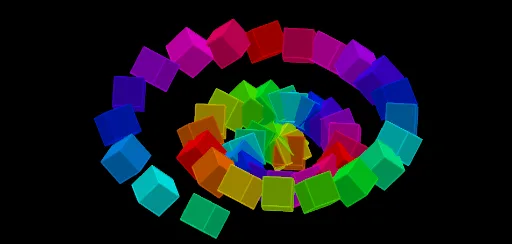
This example demonstrates a dynamic geometric construction where a series of cubes are arranged along a spiral path and rotate in a dancing motion, creating a visually engaging three-dimensional spiral structure. The core mathematical concepts include parametric equations of space curves, geometric transformations (rotation and translation) of cubes, and sequence generation with animation control. Construction highlights: using GeoGebra commands such as CurveCartesian to define the spiral path, Sequence and Point to generate points along the path, Cube to construct cubes at those points, and Element and Color to style each cube individually, with sliders or animation parameters driving the rotational movement. This example is suitable for high school or undergraduate teaching of solid geometry, parametric equations, and dynamic geometry, as well as for mathematical art demonstrations, helping students intuitively understand the combination of space curves and geometric solids.
GeoGebra Commands & Parameters
CurveCartesian(((r_0 / a^((3 * 3.141592653589793 / 2)) * a^(t)) * cos(t)), ((r_0 / a^((3 * 3.141592653589793 / 2)) * a^(t)) * sin(t)), t, -31.41593, 12.56637) → hCurveCartesian(((r_0 / a^(3.141592653589793 / 2) * a^(t)) * cos(t)), ((r_0 / a^(3.141592653589793 / 2) * a^(t)) * sin(t)), t, -31.41593, 12.56637) → fCurveCartesian(((r_0 * a^(t + α)) * cos(t)), ((r_0 * a^(t + α)) * sin(t)), t, -31.41593, (2 * 3.141592653589793) + α) → bCircle(O, 5.5, xOyPlane) → dSequence((x(O) + ((r_0 * a^(t + α)) * cos(t)), y(O) + ((r_0 * a^(t + α)) * sin(t)), z(O) + (0.075 * t)), t, (-4 * π), π + α, π / p) → l1Sequence(Vector[O, Element[l1, i]], i, 1, Length[l1]) → l2Point(Circle[B, Distance[A, B], Segment[A, B]]) → CCube(A, B, C) → c, D, faceCDHG, faceEFGH, arêteAD, arêteAB, arêteBC, arêteCD, arêteAE, arêteDH, arêteEH, arêteEF, E, arêteBF, arêteFG, arêteCG, arêteGH, F, G, H, faceABCD, faceADHE, faceABFE, faceBCGFSequence(Rotate[Translate[c, Vector[Element[l2, i]]], t + ((2 * π) * i / p), Element[l1, i]], i, 1, Length[l2]) → l3Element(l3, A1) → B1Element(l3, A2) → B2Element(l3, A3) → B3Element(l3, A4) → B4Element(l3, A5) → B5Element(l3, A6) → B6Element(l3, A7) → B7Element(l3, A8) → B8Element(l3, A9) → B9Element(l3, A10) → B10Element(l3, A11) → B11Element(l3, A12) → B12Element(l3, A13) → B13Element(l3, A14) → B14Element(l3, A15) → B15Element(l3, A16) → B16Element(l3, A17) → B17Element(l3, A18) → B18Element(l3, A19) → B19Element(l3, A20) → B20Element(l3, A21) → B21Element(l3, A22) → B22Element(l3, A23) → B23Element(l3, A24) → B24Element(l3, A25) → B25Element(l3, A26) → B26Element(l3, A27) → B27Element(l3, A28) → B28Element(l3, A29) → B29Element(l3, A30) → B30Element(l3, A31) → B31Element(l3, A32) → B32Element(l3, A33) → B33Element(l3, A34) → B34Element(l3, A35) → B35Element(l3, A36) → B36Element(l3, A37) → B37Element(l3, A38) → B38Element(l3, A39) → B39Element(l3, A40) → B40Element(l3, A41) → B41Element(l3, A42) → B42Element(l3, A43) → B43Element(l3, A44) → B44Element(l3, A45) → B45Element(l3, A46) → B46Element(l3, A47) → B47Element(l3, A48) → B48Element(l3, A49) → B49Element(l3, A50) → B50